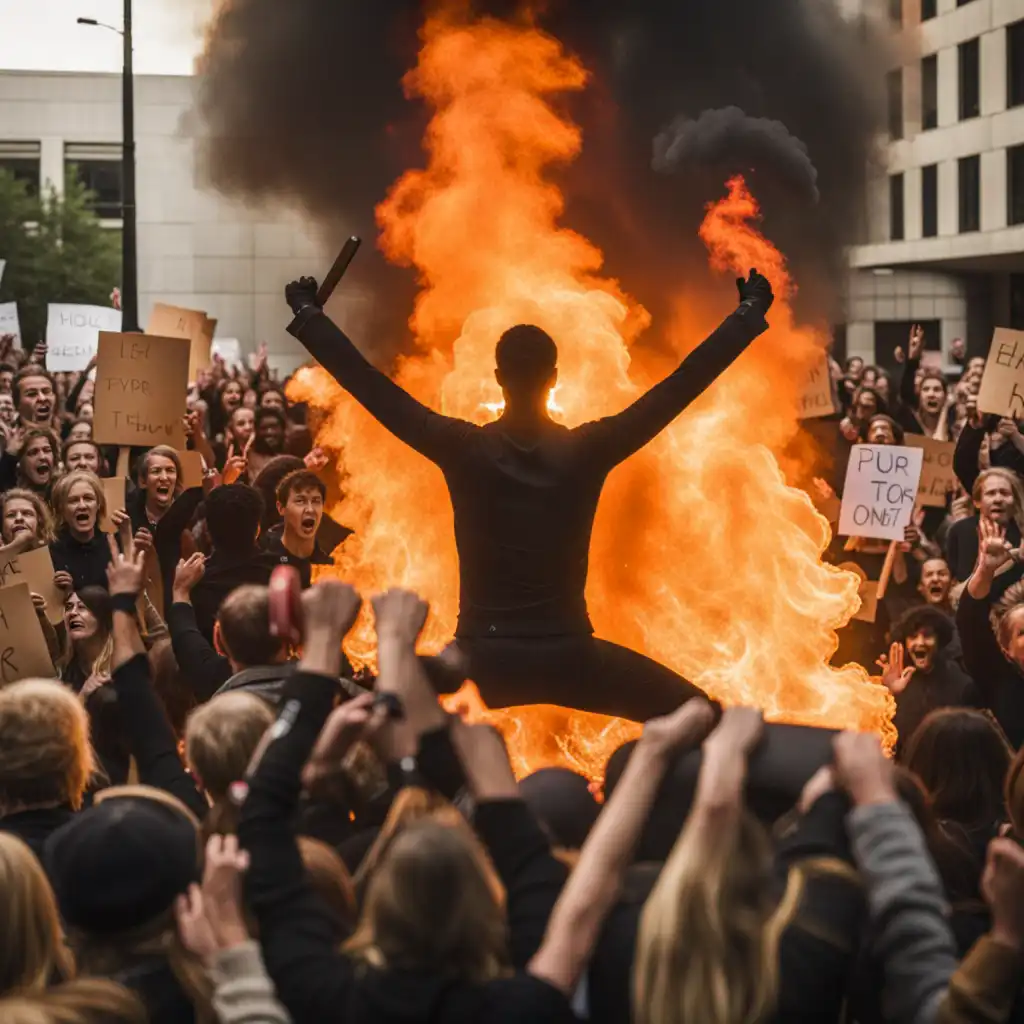
effigy
noun effigy
ˈefɪdʒi
A sculpture or model of a person
The protestors burnt an effigy of the president.
effigy
ˈefɪdʒi
加载中…
ˈefɪdʒi
A sculpture or model of a person
The protestors burnt an effigy of the president.

ˈefɪdʒi
A representation of a specific person in the form of sculpture or some other three-dimensional medium
The museum displayed a wax effigy of the Queen.
音频无法加载,请稍后再试。
The word 'effigy' refers to a sculpture or representation of someone or something, usually made of materials like clay, wood, or wax. It is often used to depict a disliked or hated person or symbol as a form of protest or anger. For example, people may burn or destroy an effigy of a political leader during a demonstration. The word 'effigy' can also be used to refer to a dummy used for practice or training purposes, such as a CPR dummy in medical training.
Dummy is typically used to refer to a model or representation of a person, often used for testing or training purposes.
For example, a CPR dummy is used to practice chest compressions.
Dummy is a model, while effigy is a symbol of protest.
打开单词: Dummy →Effigy refers to a representation of a person or group made for the purpose of mocking or as a symbol of protest, while figure refers to a representation of a person, object, or idea in general.
For example, an effigy may be used in a protest demonstration or political rally to represent a disliked public figure, while a figure may refer to a statue or model of a historical leader or a toy doll used for play.
Essentially, effigy is more about the intention and context in which the representation is used, while figure is a more general term for any type of representation.
打开单词: Figure →Image is a general term for a picture or representation of something.
It can be a photograph, painting, or digital image. Images are used in various contexts like advertising, propaganda, and art.
Effigy is a specific type of representation of a person, usually made for protest, while image is a general term for any type of visual representation.
打开单词: Image →Like is a comparison word that typically indicates that two things have some similarities.
For example, an effigy might be created to represent a disliked politician, and burned as a way of expressing anger or dissatisfaction with their actions.
Like might be used to say that something is similar to something else, such as "the taste of this soup is like chicken noodle soup."
Effigy is used to refer to a specific type of symbolic sculpture, while like is used to compare two things in a general sense.
打开单词: Like →Model can refer to a representation of something that is used to study or explain how it works. This can be something like a miniature version of a building or a computer simulation of a scientific phenomenon.
Effigy is a representation of a person or thing, while model is a representation of an idea or concept. Effigy is more symbolic or ceremonial, while a model is more practical and used for educational or scientific purposes.
打开单词: Model →Replica refers to an exact copy of an object, person or place.
It is used in situations where one wants a duplicate or imitation of something. For example, creating a replica of the Taj Mahal for a theme park.
An effigy is used to represent something negative or undesired, while a replica is used for making exact copies of objects or places.
打开单词: Replica →Representation means to depict or show something in a particular way, usually based on its visual, verbal or artistic interpretation.
Representation can be used in advertising or art to convey a specific message or idea.
An effigy is a physical representation of an object, usually with political or social implications, while representation is a broader term used to describe any depiction or portrayal of an object, idea, or concept.
打开单词: Representation →A statue is a physical object, usually made of metal, stone, or other durable material, that is created to honor or memorialize someone or something.
To summarize: Effigies are symbolic, often negative representations of a person, while statues are physical objects created to honor or memorialize someone or something.
打开单词: Statue →David Mackay: A reality...
在 YouTube 上观看 ↗Pro football gave me a good sense of perspective to enter politics: I'd already been booed, cheered, cut, sold, traded and hung in effigy.
How one piece of...
在 YouTube 上观看 ↗I've learnt that through life you just get on with it. You're going to meet a lot of dishonest people along the line and you say good luck to them. I hope they live in comfort. Then I start sticking more pins in their effigies.
Family Keeps Corpse in...
在 YouTube 上观看 ↗Anonymity is a wonderful thing if you can hang on to it. I live in Pasadena where we try to keep the movie people out. We discourage them from moving in our neighborhood and if they do we burn effigies on their lawns.
In the days when I used to tweet, I would encounter comments wishing death upon me. There were people who claimed they were sticking pins in my effigy because they couldn't stand me. There's some seriously disturbed people out there.
In the spiritual body moreover, man appears such as he is with respect to love and faith, for everyone in the spiritual world is the effigy of his own love, not only as to the face and the body, but also as to the speech and the actions.
I have been hung in effigy by the gay community for a long time, from when I was on President Reagan's first AIDS commission.
One of my fans made a lifelike doll of me. It was incredible - it looked just like me - but an effigy is kinda weird.
I have encountered riotous mobs and have been hung in effigy, but my motto is: Men's rights are nothing more. Women's rights are nothing less.
I remember the noise of the bells ringing at school as the effigy of Guy Fawkes we'd prepared earlier was carried out on a canvas stretcher, hoisted on to the huge bonfire and set alight. Then the revelry would begin. My school friends and I would all have sparklers we passed around, lighting one from another.