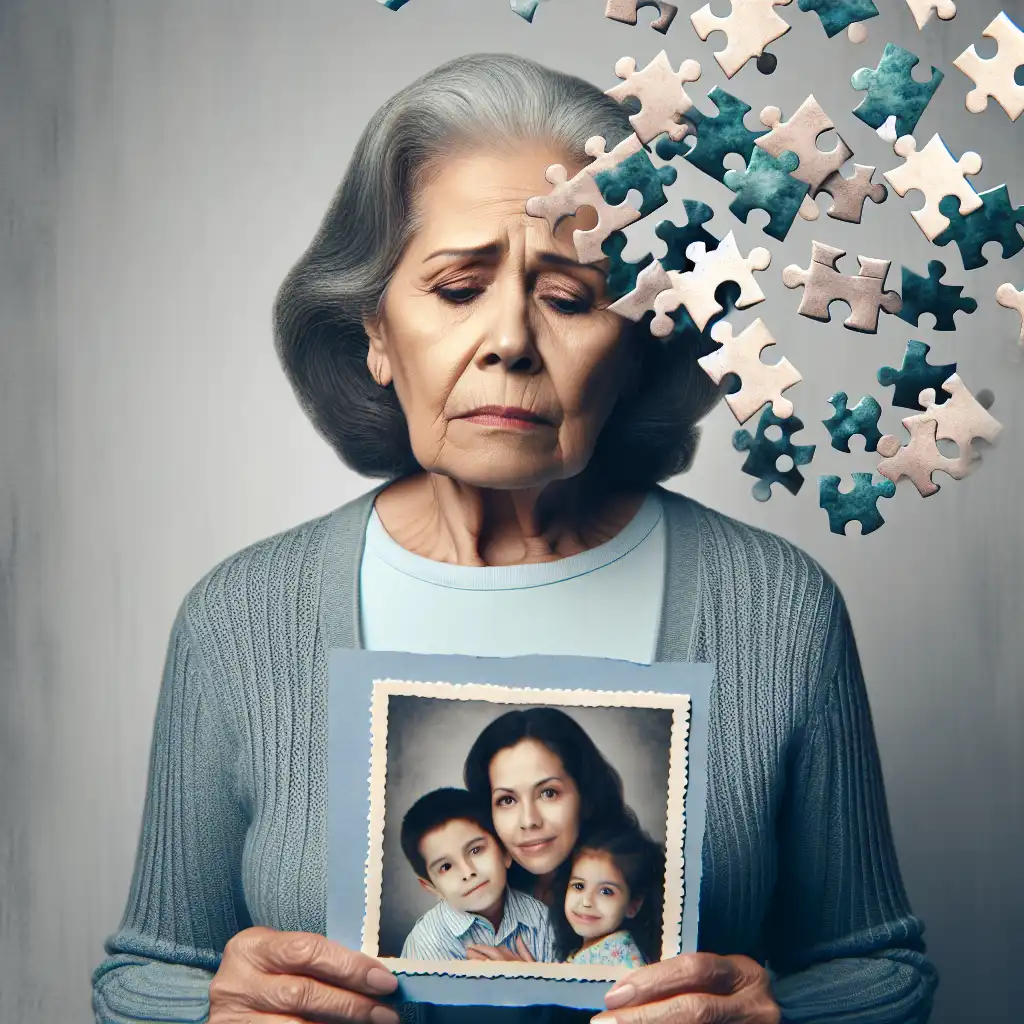
dementia
noun dementia
dɪˈmenʃə
A medical condition that affects memory and other thinking skills.
Her grandmother was diagnosed with dementia.
dementia
dɪˈmenʃə
불러오는 중…
dɪˈmenʃə
A medical condition that affects memory and other thinking skills.
Her grandmother was diagnosed with dementia.
오디오를 불러오지 못했어요. 잠시 후 다시 시도해 주세요.
Dementia is a word used to describe a decline in a person's ability to remember and think clearly. It often happens to older people and can cause them to have difficulty with daily activities like dressing, cooking or remembering directions. It's important to be kind and patient with someone who has dementia, as it can be frustrating and confusing for them. We use this word when discussing the medical condition or condition of the brain, and when referring to someone who has an illness in which they are experiencing these symptoms.
Amnesia refers to a partial or complete loss of memory, usually due to brain injury, trauma, or psychological factors. It affects a person's ability to remember past events or form new memories.
Amnesia is a specific memory problem, whereas dementia is a more general decline in brain function.
Amnesia can be caused by an injury, while dementia is usually caused by a disease.
단어 열기: Amnesia →Forgetfulness is a natural and occasional occurrence where a person might forget something small like where they put their keys or an appointment they scheduled.
Dementia is much more severe and affects a person's ability to perform daily tasks, while forgetfulness is a minor lapse in memory that usually does not affect a person's daily life.
단어 열기: Forgetful →Dementia and senility both refer to a decline in mental abilities, but they are used differently. Dementia is a medical term that describes a set of symptoms associated with memory loss, difficulty with communication, and loss of independence caused by brain damage or disease.
It is a specific medical diagnosis and can affect people of any age. Senility is an outdated and often offensive term that was once used to describe age-related declines in memory and other mental abilities.
단어 열기: Senility →that can in some cases even result in dementia. The culprit is a protein called tau. Usually tau proteins support tiny tubes inside our axons called microtubules. It's thought that repeated subconcussive hits damage the microtubules,
YouTube에서 보기 ↗Dementia is not exclusively a problem of the developed world.
Imagine the ripples of this notion for the millions of people living and dying with dementia. Primal sensorial delights that say the things we don't have words for, impulses that make us stay present -- no need for a past or a future.
YouTube에서 보기 ↗There are so many people getting dementia. It is like an epidemic now. It is a terrible disease because once you get it, your life changes completely.
to enter from the body's bloodstream into the brain. Despite this protection, tumors and other complications can lead to life-threatening problems and diseases in the brain such as dementia. Thankfully scientists have found ways
YouTube에서 보기 ↗Science is, rightly, searching for drugs to arrest ageing or to slow the advance of dementia. But the evidence suggests that many of the most powerful factors determining how you age come from what you do, and what you do with others: whether you work, whether you play music, whether you have regular visitors.
muscle and so that means if you practice it we have evidence that learning a language in your later years can help you ward off the onset of dementia later on might as much as four or five years
YouTube에서 보기 ↗With something like cancer, there is a feeling that you can fight it in some way or control your response to it, but with dementia there is the fear of losing control of your mind and your life.
About one-third of stroke survivors suffer from aphasia making it more prevalent than Parkinson's disease or multiple sclerosis, yet less widely known. There is one rare form of aphasia called primary progressive aphasia or PPA, which is not caused by stroke or brain injury, but is actually a form of dementia
YouTube에서 보기 ↗I think everyone knows someone who's battling with dementia or caring for a relative affected by it. I've been staggered by how commonplace it is.
The heightened workout a bilingual brain receives throughout its life can also help delay the onset of diseases like Alzheimer's and dementia by as much as five years. The idea of major cognitive benefits to bilingualism may seem intuitive now,
YouTube에서 보기 ↗We can alleviate physical pain, but mental pain - grief, despair, depression, dementia - is less accessible to treatment. It's connected to who we are - our personality, our character, our soul, if you like.
Every four seconds, someone is diagnosed with Alzheimer's disease. It's the most common cause of dementia, affecting over 40 million people worldwide,
YouTube에서 보기 ↗I've never minded solitude. For a writer, it's a natural condition. But caring for a dementia sufferer leads to a peculiar kind of loneliness.
that you get from sleep. The question now is whether we can translate this same affordable potentially portable piece of technology into older adults and those with dementia. Can we restore back some healthy quality of deep sleep,
YouTube에서 보기 ↗Those with dementia are still people and they still have stories and they still have character and they're all individuals and they're all unique. And they just need to be interacted with on a human level.
that would have an immediate positive benefit for your brain including your mood and your focus? And what if I told you that same thing could actually last a long time and protect your brain from different conditions like depression Alzheimer's disease or dementia.
YouTube에서 보기 ↗That's the worst thing about dementia: it gets you every time. Sufferers look and act the same but beneath the familiar exterior something quite different is going on. They're in another world and you cannot enter.
Should we take hormones? That's a fair question it's a good question. And the shortest possible answer right now is that hormonal therapy can be helpful to alleviate a number of symptoms like hot flashes, but it's not currently recommended for dementia prevention.
YouTube에서 보기 ↗My dad has dementia, so I monitor my own memory in a way that other people may not. As an atheist, I don't believe in an afterlife so I feel I need to fit in as much as I can while I'm here.