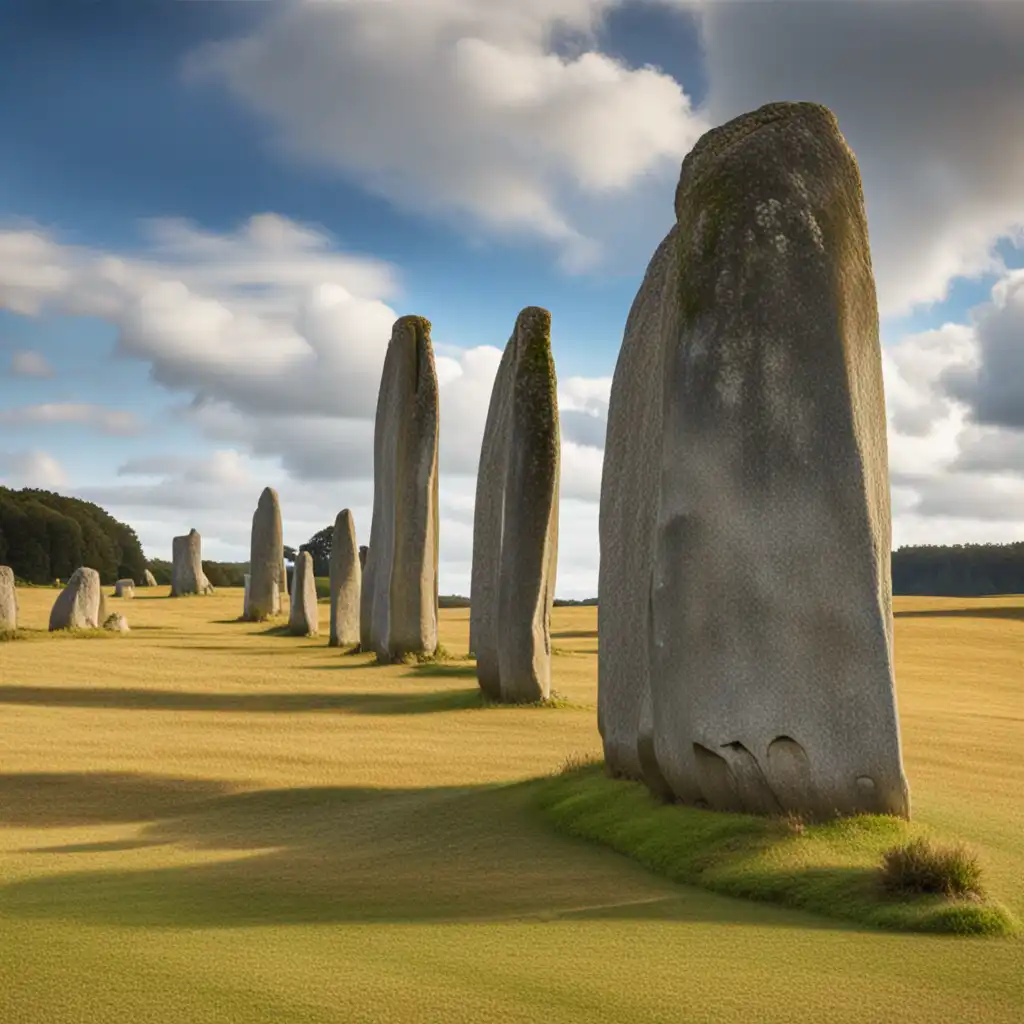
menhir
noun menhir
ˈmenhɪr
A large, upright standing stone, made in prehistoric times
Visiting the field of menhirs in Brittany is like stepping back into ancient times.
menhir
ˈmenhɪr
Đang tải…
ˈmenhɪr
A large, upright standing stone, made in prehistoric times
Visiting the field of menhirs in Brittany is like stepping back into ancient times.
Không tải được âm thanh. Vui lòng thử lại sau.
A menhir is a tall upright stone that was erected by prehistoric people. They are found in places like France, Spain, and England. People believe that they were used for spiritual or religious purposes. Nowadays, some people use the word 'menhir' to refer to any tall standing stone, not just the ones made by prehistoric people.
A cairn is a man-made pile of stones used as a marker or monument, often used to indicate a trail or a burial site. They are typically smaller and more modest in size.
A menhir is a large upright standing stone, often used as a monument or religious symbol. They were usually erected during prehistoric times and are much bigger than cairns.
Menhirs were usually used as part of ancient astronomical observatories, while cairns were used to mark paths or guide travelers to various locations.
So, in brief, a cairn is a smaller pile of stones used as a marker or monument, while a menhir is a large upright standing stone used as a monument or religious symbol.
Mở từ: Cairn →A dolmen is a type of ancient burial structure made of large stones arranged in a specific way to support a capstone.
Both dolmen and menhir are used to describe ancient structures created during the Neolithic period.
However, dolmens were mainly constructed as burial chambers, while menhirs were often created as standing stones to mark a location or serve as a religious symbol.
A dolmen is a tomb made of several stones, while a menhir is a single, upright standing stone.
Mở từ: Dolmen →A megalith is a large stone structure that was used in prehistoric times for religious and ceremonial purposes.
In summary, megaliths are large stone structures made up of multiple stones, while menhirs are individual large standing stones.
Mở từ: Megalith →A menhir is a tall upright stone that stands alone in a field or on a hill. Menhirs were often placed in prehistoric times as a worship of gods, whereas Monoliths are huge structures made from one or more large stones, often used in architecture, sculptures, or other monumental or ceremonial purposes.
Monoliths can have different shapes and features, such as obelisks or pillars. In summary, menhirs are typically standing stones with religious significance, while monoliths are generally large, single stones used for various purposes.
Mở từ: Monolith →Both menhirs and obelisks are tall standing stones, but there are some differences between them. Menhirs are usually rough and uncarved stones, while obelisks are tall, narrow pillars that are often decorated with carvings or hieroglyphics on their sides.
Menhirs were commonly used by prehistoric societies as memorials or landmarks, while obelisks were originally used in ancient Egyptian architecture as part of temple complexes or monuments.
Today, obelisks can also be found in other parts of the world as decorative structures or monuments.
In short, menhirs are rough and uncarved standing stones used for marking or memorial purposes, while obelisks are tall, narrow pillars that are often decorated with carvings and have a history of use in ancient Egyptian architecture.
Mở từ: Obelisk →