
billow
verb billow
ˈbɪləʊ
To swell or puff up, generally related to smoke, fabric, or clouds.
Smoke billowed out of the factory chimney.
billow
ˈbɪləʊ
Loading…
ˈbɪləʊ
To swell or puff up, generally related to smoke, fabric, or clouds.
Smoke billowed out of the factory chimney.
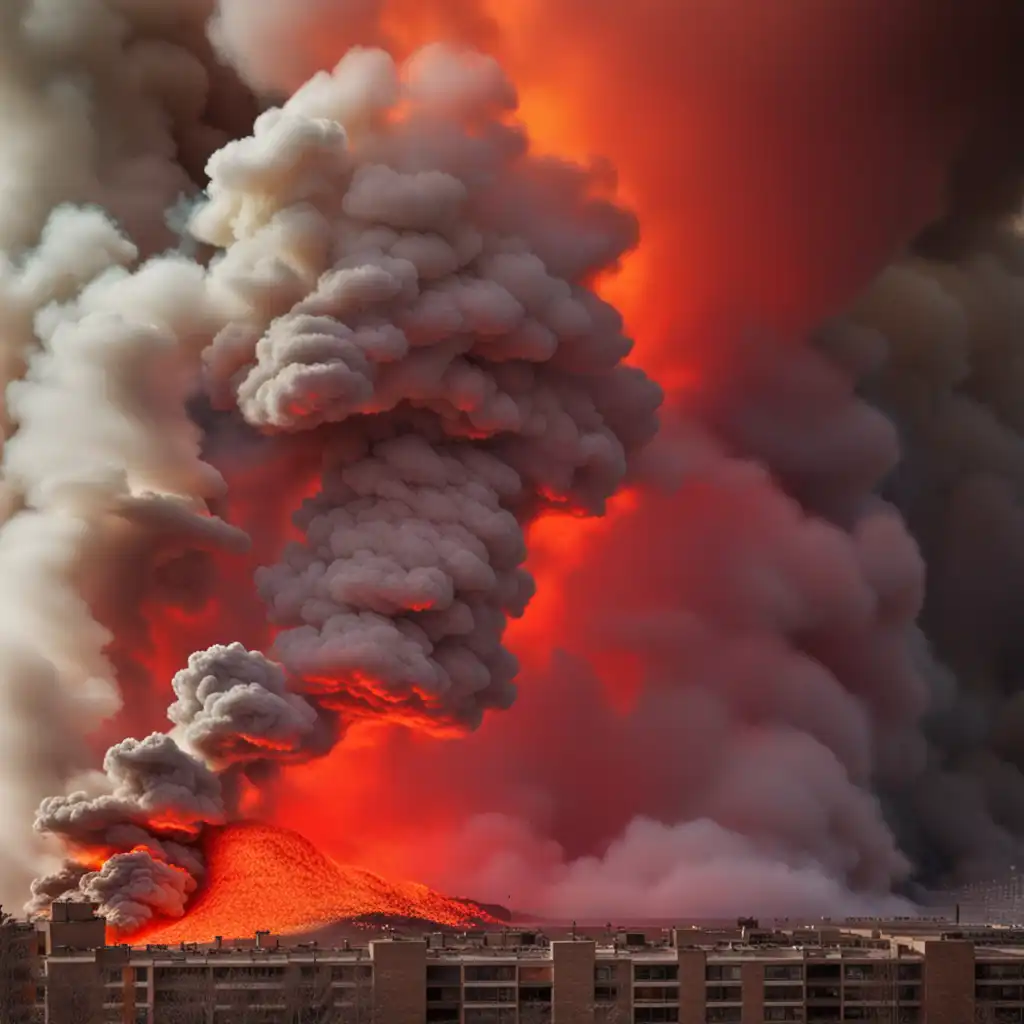
ˈbɪləʊ
A large puff or cloud, typically of smoke, steam, or dust.
The fire produced a billow of smoke.
Audio could not be loaded. Please try again later.
The word "billow" refers to a large mass of something, usually air or water, that moves in a rolling or swelling motion. It is often used to describe the movement of smoke, clouds, or waves. You might say that the clouds billowed across the sky or that the waves billowed up against the shore. The word can also be used to describe the movement of fabric or clothing that is blown by the wind. For example, you might say that the sheets on a clothesline were billowing in the breeze.
Flow refers to the movement of something in a smooth, continuous manner, such as a river flowing downstream or a person's thoughts flowing freely.
The main difference between these two words is that billow implies a more rapid and forceful movement, while flow implies a smoother and more gradual movement.
Open word: Flow →Heave describes a strong lifting motion, often involving effort or struggle. For example, a person might heave a heavy box onto a shelf, or a ship might heave in a rough sea.
While both words can describe movements of something with force, billow typically describes a more fluid and rolling motion, while heave describes a more forceful and abrupt motion.
Open word: Heave →Both billow and puff refer to the movement of air, but they have different connotations and applications.
Puff typically refers to a gentler, smaller release of air, such as a breath or a light gust that blows a few leaves or strands of hair.
It can also describe a small burst or explosion, such as a puff of smoke from a cigarette or a puff of air from a balloon.
Billow is more appropriate for describing larger, forceful movements of air or substances, while puff is better for smaller and gentler movements.
Open word: Puff →Ripple describes a small wave or series of waves that move across the surface of water. This term is commonly used in ponds, lakes, and even bathtubs or pools.
Billow describes large waves caused by strong winds, while ripple describes small waves that move across the surface of water.
Open word: Ripple →Roll refers to movement that involves something turning over repeatedly or rotating. It's applicable in situations where you want to describe something rolling over, like a ball or a wheel.
For example, "The car rolled down the hill and crashed into the fence."
Billow refers to a wave-like movement while roll refers to a repetitive turning or rotating movement.
Open word: Roll →Both billow and surge refer to the movement of water, air or fabric, but they have slightly different connotations.
Surge implies a strong, sudden and rapid movement, like a surge of water rushing forward.
If you want to describe a large, rolling movement, use billow. If you want to describe a sudden and strong movement or increase, use surge.
Open word: Surge →Swell usually refers to a more gradual rise and fall of the sea. It doesn't have the same intensity as a billow and can describe the gentle, rhythmic movement of the waves on a calm day.
Billow describes a sudden, powerful movement of water, while swell describes a more subdued, continuous movement.
Open word: Swell →Both billow and undulate describe a type of movement in waves or curves.
Undulate, on the other hand, describes a smoother, more rhythmic movement in waves or curves.
It can also describe a more repetitive or cyclical motion, such as the undulating movement of a snake or the undulating hills in a landscape.
So, while both words describe movement in waves or curves, billow is applicable when talking about larger or more dramatic movements, while undulate is more commonly used for softer or more repetitive movements.
Open word: Undulate →Wave refers specifically to the movement of water, where the surface of the water rises and falls.
Waves can be small, like ripples, or large, like ocean swells.
Billow describes large, sweeping movements of things like clouds or smoke, while wave describes the movement of water.
Open word: Wave →The habits of happiness...
Watch on YouTube ↗Character is formed in the stormy billows of the world.
Taking imagination...
Watch on YouTube ↗Designers want me to dress like Spring, in billowing things. I don't feel like Spring. I feel like a warm red Autumn.
The Fascinating Lives of...
Watch on YouTube ↗I loved watching the base of those thunderstorms, the billowing tops of the cumulonimbus, the lightning that effortlessly lit up the lake and the sky. It was gorgeous, so energetic. I was in love.
Designing for social...
Watch on YouTube ↗A cloud is made of billows upon billows upon billows that look like clouds. As you come closer to a cloud you don't get something smooth, but irregularities at a smaller scale.
This ancient rock is...
Watch on YouTube ↗The idea of a stag hunt evokes chivalry - knights in jerkins and hose, ladies on sidesaddles with wimples and billowing dresses, a white stag symbolizing something-or-other, and Robin Hood getting in the way. An actual stag hunt is more like a horseback meeting of a county planning commission.
Janet Echelman: Taking...
Watch on YouTube ↗I know my own soul, how feeble and puny it is: I know the magnitude of this ministry, and the great difficulty of the work; for more stormy billows vex the soul of the priest than the gales which disturb the sea.
Tom Shannon: The painter...
Watch on YouTube ↗Marvels of an Arctic...
Watch on YouTube ↗The myth of Pandora’s...
Watch on YouTube ↗Frida Kahlo: The woman...
Watch on YouTube ↗