relativity
noun relativity
ˌreləˈtɪvəti
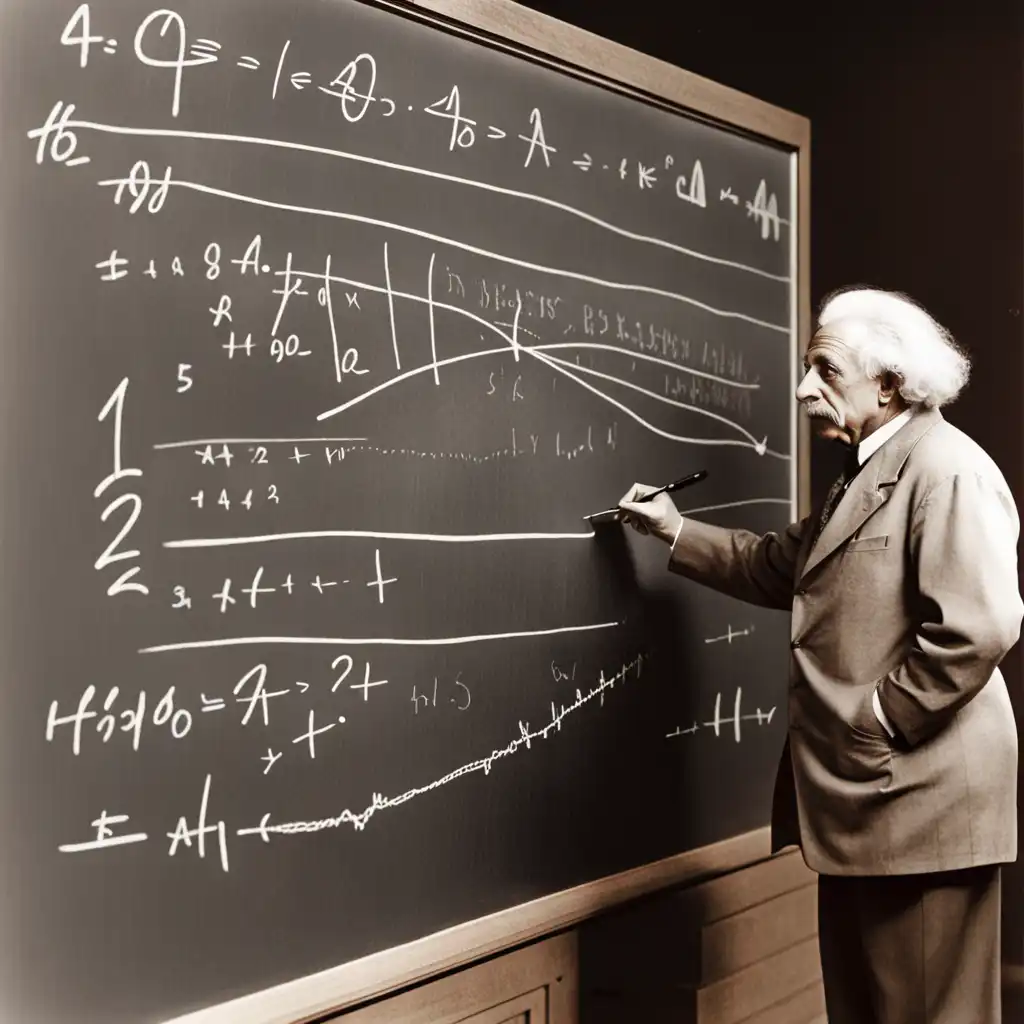
The idea in physics that space and time can change according to where you are and how fast you are going.
Albert Einstein developed the theory of relativity.
relativity
ˌreləˈtɪvəti
लोड हो रहा है…
ˌreləˈtɪvəti
The idea in physics that space and time can change according to where you are and how fast you are going.
Albert Einstein developed the theory of relativity.
ˌreləˈtɪvəti
The way in which things are thought of as dependent on and changing according to a relationship with something else.
The relativity of culture means that values change with context.
ऑडियो लोड नहीं हो सका। कृपया बाद में फिर कोशिश करें।
The word 'relativity' means that something is not absolute or fixed, but instead is dependent on other things or factors. For example, the speed of something can only be measured in relation to something else. The theory of relativity, developed by physicist Albert Einstein, explains how time and space can be affected by gravity and motion. In everyday conversation, we might use the word 'relativity' to talk about things being relative to each other, like saying "My salary is high relative to my expenses." It's important to understand the idea of relativity in many fields, including physics, math, and even social sciences like economics and psychology.
Correlate means that two things are connected or have a relationship with each other. For example, if a study shows that people who exercise regularly are generally happier, we say that there is a correlation between exercise and happiness.
To summarize, correlate describes a connection between two things, while relativity is used to explain how measurements and observations vary depending on the point of reference.
शब्द खोलें: Correlate →Dependence means that something relies on something else for support or existence. For example, a plant is dependent on sunlight and water to grow.
In other words, if the plant doesn't get sunlight or water, it will not survive. Dependence is applicable in situations where there is a need for one thing to rely on another to survive, function, or progress.
शब्द खोलें: Dependence →Mutability refers to the ability of something to change or be changed over time. It is applicable when talking about things that can be changed or altered in some way, such as the personality of a person, the climate of a region, or the quality of a product.
Mutability refers to the ability to change over time, while relativity refers to the idea that everything is connected and can only be understood in relation to other things.
शब्द खोलें: Mutability →Proportionality refers to the relationship between two things that change together. For example, if you add more ingredients to a recipe, the proportion of each ingredient needs to change in order to keep the overall taste balanced.
Proportionality is often used in math and science to describe the relationship between two variables, such as how the speed of a car changes in relation to how far it travels.
Both proportionality and relativity are applicable in different fields. Proportionality is commonly used in math and science to describe the relationship between variables, while relativity is used in physics and other fields to understand how things are connected to each other.
शब्द खोलें: Proportionality →Subjectivity refers to the idea that one's perspective or opinion is based on personal feelings, beliefs, or experiences, and may not be universally true.
In simpler terms, relativity is about understanding things in relation to something else, while subjectivity is about personal opinions and perspectives.
Relativity can be applied in physics and other scientific fields, while subjectivity is applicable in areas such as art, literature, and personal preferences.
शब्द खोलें: Subjectivity →if it was the speed of light that remained constant, regardless of reference frame, while both time and space were relative to the observer. It took Einstein only a few weeks to work out the details and formulate what came to be known as special relativity.
YouTube पर देखें ↗Pulsars are in an ideal part of the universe to test Einstein's theory of relativity - so far, it's holding up well. They may even one day act as navigational beacons for spacecraft. I'll never tire of them; they really are the most extraordinary objects.
I should've seen it before. This is so simple so beautiful. Acceleration and gravity are the same thing. This is the idea I've been missing to complete relativity. This may just be one of the happiest thoughts of my life.
YouTube पर देखें ↗Einstein, in the special theory of relativity, proved that different observers, in different states of motion, see different realities.
A hundred years ago, Albert Einstein first published his theory of general relativity. In the years since then, scientists have provided a lot of evidence in support of it. But one thing predicted from this theory black holes, still have not been directly observed. Although we have some idea as to what a black hole might look like,
YouTube पर देखें ↗String theory is the most developed theory with the capacity to unite general relativity and quantum mechanics in a consistent manner. I do believe the universe is consistent, and therefore I do believe that general relativity and quantum mechanics should be put together in a manner that makes sense.
beautiful woman and as we started talking I managed to get a conversation going with her and I talked about typical things that guys do like pie and relativity and drawing and somehow managed to get her interested in talking to me and as we talked she said what a
YouTube पर देखें ↗What you can show using physics, forces this universe to continue to exist. As long as you're using general relativity and quantum mechanics you are forced to conclude that God exists.
prevents science fiction scenarios, like using entangled particles to send messages faster than light. So relativity is safe for now. But the quantum universe is far stranger than Einstein wanted to believe.
YouTube पर देखें ↗And it really began with Einstein. We attended his lectures. Now the theory of relativity remained - and still remains - only a theory. It has not been proven. But it suggested a completely different picture of the physical world.
And it was his conclusions, formulated in the theory of special relativity, that opened the door into the world of time travel. Imagine a man named Jack, standing in the middle of a train carriage, traveling at a steady speed. Jack's bored and starts bouncing a ball up and down.
YouTube पर देखें ↗I discovered Einstein said the same thing about his celebrated theories of relativity that writers say about their work when he said he didn't have any feelings of personal possession of these ideas. Once they were out there, they came from somewhere else. And that's exactly the feeling when you write. You don't feel possessive about it.
describing the universe right? We currently have two sets of equations that govern physics. General relativity describes the behavior of very large things, while quantum physics explains the very small. One of the biggest goals in theoretical physics
YouTube पर देखें ↗Relativity can, for instance, explain that the universe had once been clumped into a dense fireball. But it can never explain how matter actually behaved.
But from having studied special relativity, the twins know it’s not that simple. First of all the faster an object moves through space, the slower it moves through time compared to an unmoving observer. This relationship can be quantified with something called the Lorentz factor, which is defined by this equation.
YouTube पर देखें ↗For years, my early work with Roger Penrose seemed to be a disaster for science. It showed that the universe must have begun with a singularity, if Einstein's general theory of relativity is correct. That appeared to indicate that science could not predict how the universe would begin.
We used to think that the theory of the universe could be divided into two parts. First there were the laws like Maxwell's equations and general relativity that determined the evolution of the universe,
YouTube पर देखें ↗When you are courting a nice girl an hour seems like a second. When you sit on a red-hot cinder a second seems like an hour. That's relativity.
The universe began its cosmic life in a big bang nearly fourteen billion years ago, and has been expanding ever since. But what is it expanding into? That's a complicated question. Here's Einstein's equations of general relativity
YouTube पर देखें ↗Trying to understand the way nature works involves a most terrible test of human reasoning ability. It involves subtle trickery, beautiful tightropes of logic on which one has to walk in order not to make a mistake in predicting what will happen. The quantum mechanical and the relativity ideas are examples of this.