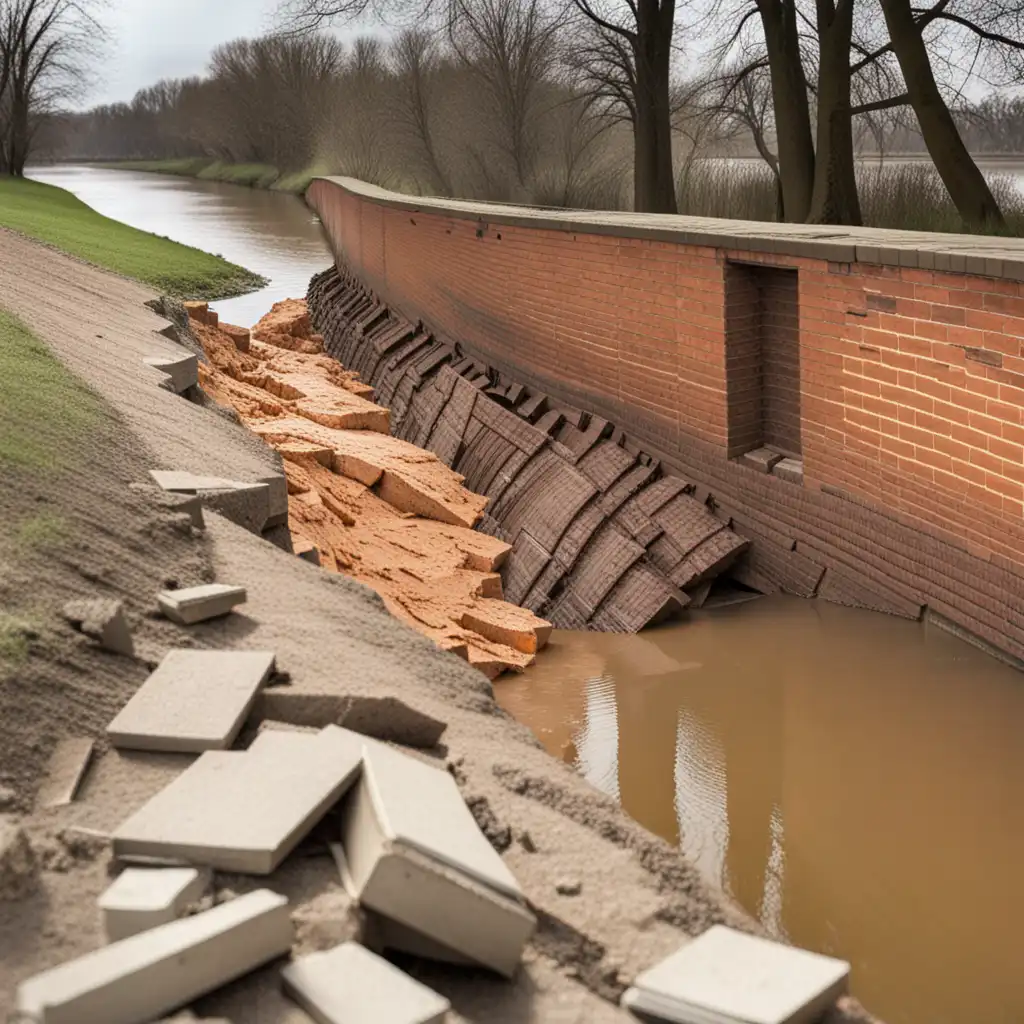
levee
noun levee
ˈlevi
A wall, or embankment, built to prevent overflow of a river or rising water.
After the storm, the city's levee was damaged.
levee
ˈlevi
Đang tải…
ˈlevi
A wall, or embankment, built to prevent overflow of a river or rising water.
After the storm, the city's levee was damaged.

ˈlevi
A formal reception of visitors or guests.
The king held a levee to greet his subjects.
Không tải được âm thanh. Vui lòng thử lại sau.
A levee is a type of structure that is built along a river or other body of water to prevent flooding. It is like a wall made of soil or concrete that runs parallel to the body of water. Levees are used in areas where there is a high risk of flooding, such as in coastal regions, and are designed to keep the water from overflowing into nearby areas. The word "levee" can also refer to a formal gathering or reception, but this is less common than the flood control structure.
A bank is a raised area of land alongside a river or body of water that can be natural or man-made.
A levee is a raised embankment built alongside a river or body of water, usually for the specific purpose of preventing flooding or protecting low-lying areas from inundation.
Levees can be much larger than a typical river bank, and their construction is typically more complex. Both banks and levees can help manage water flow, but levees are specifically designed for flood control.
Mở từ: Bank →A barrier is something that stops or prevents movement or access. For example, a fence around a yard or a wall along a highway can be considered a barrier.
A barrier is a general term used to describe something that blocks or restricts movement, whereas a levee is a specific type of barrier designed to prevent flooding in certain areas.
Mở từ: Barrier →A berm is a small, raised hill or ridge of soil built to control the flow of water or to prevent erosion.
Berms can be used for landscaping, as flood protection, or to prevent soil erosion.
Berms are usually narrower and shorter than levees.
In summary, berms are small raised hills used for controlling water flow or preventing erosion, while levees are large structures built for flood protection.
Mở từ: Berm →A causeway is a raised road or path built over water or marshy land to connect two points that are separated by water. It's typically used to connect two land masses or to create a passage over a body of water.
A causeway is used to create a road or path over water, while a levee is used to prevent flooding along a river or body of water.
Mở từ: Causeway →A dam is a barrier built across a river or a stream to hold back and control water flow. The purpose of a dam is to create a reservoir where water can be stored for various uses, such as hydroelectricity, irrigation or drinking water supply.
So, while a dam is used to control water flow, a levee is used to control flooding. Dams are used to hold back water behind a barrier, while levees are used to divert water.
Mở từ: Dam →Both dyke and levee are used to refer to obstacles built to control or direct the flow of water, but there are some key differences.
A dyke is typically a smaller and more localized barrier, often made of earth or other natural materials, that is meant to protect specific areas from flooding or erosion.
Dikes can be found in coastal regions, around lakes, and as part of agricultural drainage systems. The term dyke can also be used offensively to refer to a lesbian or masculine-presenting woman.
Dyke is a more specialized term used in smaller-scale applications, while levee refers to larger, more significant barriers.
It's important to be mindful of the potentially offensive connotations of dyke and to use the term with care.
Mở từ: Dyke →An embankment is an artificially created slope or raised area of land that is used to prevent flooding or erosion of a coastline or river bank.
A levee is a type of embankment specifically designed to prevent flooding by containing the water within the banks of a river or other waterway.
Both embankments and levees serve similar functions, but levees are typically more focused on flood control and are often used in areas where flooding is a frequent problem.
Embankments are more general in purpose and can be used for a variety of reasons, including erosion control and stabilization of coastal areas.
Mở từ: Embankment →It is usually man-made and designed to keep water in its channel. In contrast, a ridge is a long, narrow high land formation that rises higher than the surrounding area.
Ridges occur naturally and can be found in mountainous areas or on the edges of plateaus. While a levee is designed to control water, a ridge is simply a natural geological feature.
Mở từ: Ridge →Floods 101 %\PIPE% National...
Xem trên YouTube ↗We have seen levee breaks and flooding in the wake of storms, some of which have caused the loss of life, and USDA is ready to assist in any way we can.
What intelligent...
Xem trên YouTube ↗Loving relatives and home-cooked meals are solid levees against a recession.
Let's prepare for our...
Xem trên YouTube ↗Save the stonewall to build the levees.
Creating living...
Xem trên YouTube ↗Disasters happen. We still have no way to eliminate earthquakes, wildfires, hurricanes, floods or droughts. We cope as best we can by fortifying ourselves against danger with building codes and levees, and by setting aside money to clean up afterwards.
How we could change the...
Xem trên YouTube ↗You probably have to have redundant levee systems with canals in between them, like the Dutch have, to make sure that incoming water is channeled off to areas where you deal with it rather than have it drown you.
Jumping the Border Fence...
Xem trên YouTube ↗The answer to New Orleans's levee woes is painfully obvious: money and willpower.
Termite-Inspired Robots...
Xem trên YouTube ↗I did grow up in New Orleans. I grew up right on the lake, right across the levee.
Vicki Arroyo: Let's...
Xem trên YouTube ↗Unless engineers can stop southern Louisiana from sinking into the Gulf - the Mississippi Delta is the fastest-disappearing land on the planet - even post-Katrina's modernized levees will be overwhelmed.
3 ways to plan for the...
Xem trên YouTube ↗I wrote a story about a man who is orphaned during the 1927 Mississippi River flood in Louisiana, and he's on the banks of levee, and he's starving. And there are other people starving, too. And he's so desperate, he's seven years old, that he finds a pig that's been abandoned. He kills it with a hammer, and he drags it back.
5 Years After Katrina,...
Xem trên YouTube ↗We used to play football on the levee, with no shirts on in the summer - August in New Orleans - and my skin would turn red. They'd call me Redskin, Red Apache, then it turned around to Apache Red.