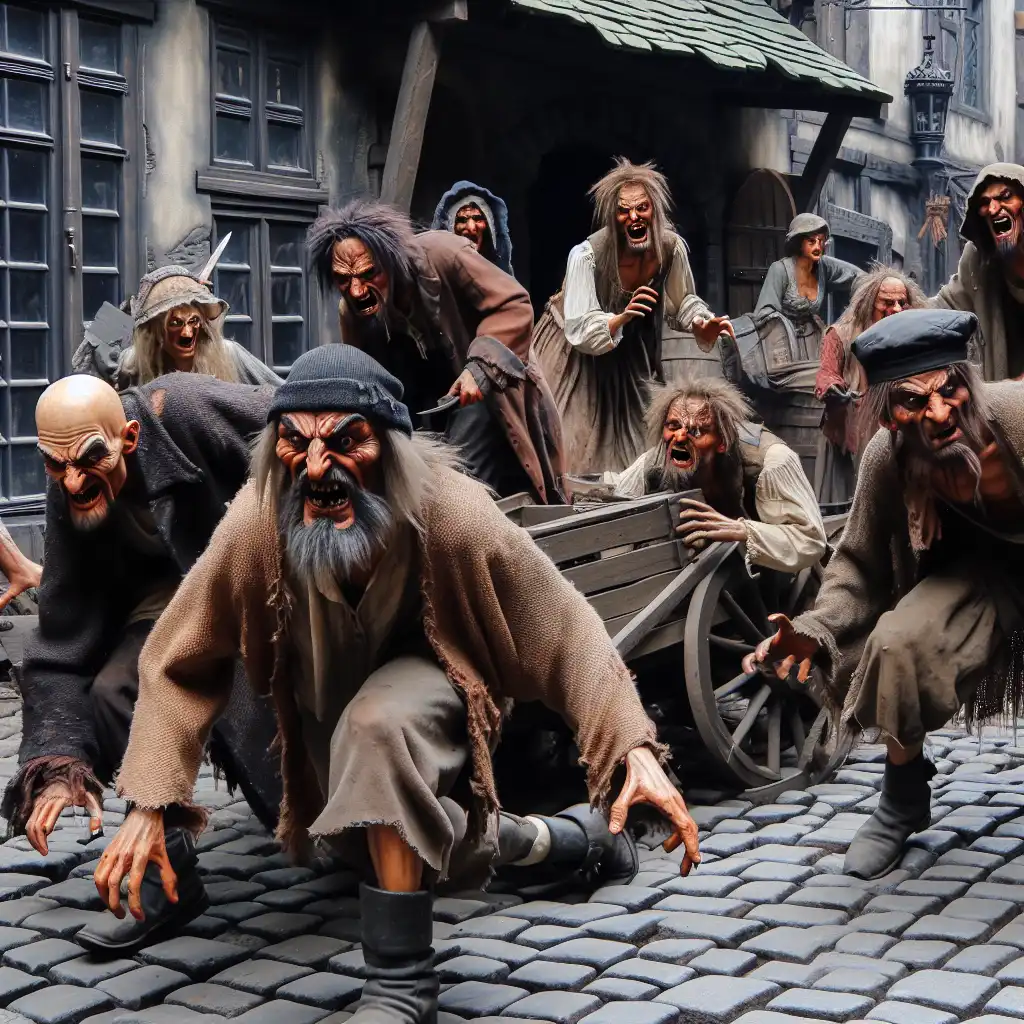
ruffian
noun ruffian
ˈrʌfiən
A person who behaves in a violent or lawless way
The town was plagued by a band of ruffians who were notorious for their disruptive behavior.
ruffian
ˈrʌfiən
Đang tải…
ˈrʌfiən
A person who behaves in a violent or lawless way
The town was plagued by a band of ruffians who were notorious for their disruptive behavior.
Không tải được âm thanh. Vui lòng thử lại sau.
The word 'ruffian' is used to describe someone who is rough or violent. It is usually used in formal language when talking about a person who is unruly or behaves badly. A 'ruffian' is someone who is often seen as a troublemaker or a bully, and they may be involved in fighting or other aggressive behavior. It is important to use this word carefully and appropriately as it may offend others if used disrespectfully.
Brute refers to a person who is crude, violent, and lacking in intelligence or sensitivity.
In summary, both brute and ruffian refer to people who are violent and lack social grace.
However, brute emphasizes the lack of intelligence or sensitivity, while ruffian emphasizes the lack of civility or conformity to social norms.
Mở từ: Brute →Bully and ruffian are both words used to describe people who are aggressive and intimidating towards others, but they have slightly different meanings.
A bully is someone who deliberately hurts or intimidates someone else, often repeatedly and for no reason. They may use physical force or verbal abuse to try to dominate others and make them feel inferior.
Bullies may target people who are weaker or smaller than them, or who they perceive as different in some way.
Bully is a more common and widely applicable term, while ruffian is more specific and often used in contexts related to crime or violence.
Mở từ: Bully →Delinquent refers to someone who has committed a minor crime or offense, often related to breaking laws or rules. It is most commonly used to describe young people who have committed crimes, but it can apply to anyone who has broken the law.
Delinquent is applicable in situations where someone has broken the law or rules, while ruffian describes someone who is acting in a physically aggressive or threatening manner.
Mở từ: Delinquent →Hoodlum and ruffian both refer to a rough or violent person.
Hoodlum is typically used to describe a young criminal who is a member of a gang, often involved in illegal activities such as theft and vandalism.
Hoodlum may also connote a lack of education or respect for authority.
Hoodlum is a term more commonly used to describe young criminals involved in unlawful activities and often part of a gang, while ruffian refers to anyone who is rough, tough or violent.
Mở từ: Hoodlum →Hooligan usually suggests antisocial behavior, especially in groups.
Hooligan is often used for rowdy behavior, while ruffian is used for more serious criminal behavior.
Mở từ: Hooligan →Miscreant refers to someone who behaves badly or does something wrong, especially something that is morally wrong.
So, while both words describe individuals who engage in negative behavior, miscreant is typically used to describe someone who violates moral or ethical standards, while ruffian describes someone who engages in physical violence or other types of criminal behavior.
Mở từ: Miscreant →Rowdy refers to someone or something that is boisterous or noisy, often in an unpleasant or aggressive way.
It usually describes a group of people who are causing a disturbance, like a rowdy party or a rowdy crowd at a sports event.
Ruffian on the other hand, refers to someone who is rough or tough, and often engages in criminal behavior. It is a more serious word than rowdy and implies a greater degree of violence and danger.
Rowdy refers to disorderly behavior, while ruffian refers to a person who is potentially dangerous.
Mở từ: Rowdy →A thug usually refers to a person who engages in serious criminal activity, such as robbery, assault or murder. Thugs may also be associated with organized crime or gang activity.
In conclusion, while both words describe someone who is violent or aggressive, ruffian is more commonly used to describe someone who is unpleasant, while thug describes someone who engages in serious criminal behavior.
Mở từ: Thug →I've always thought that people got the impression that I was a tough sort of ruffian type.
I like that the hard-core ruffians, the street thugs come up to me and say, 'Man, you killed it with Adele.
The rescue of a person, who is assaulted, or restrained of his liberty, without authority of law, is not only morally, but legally, a meritorious act; for every body is under obligation to go to the assistance of one who is assailed by assassins, robbers, ravishers, kidnappers, or ruffians of any kind.