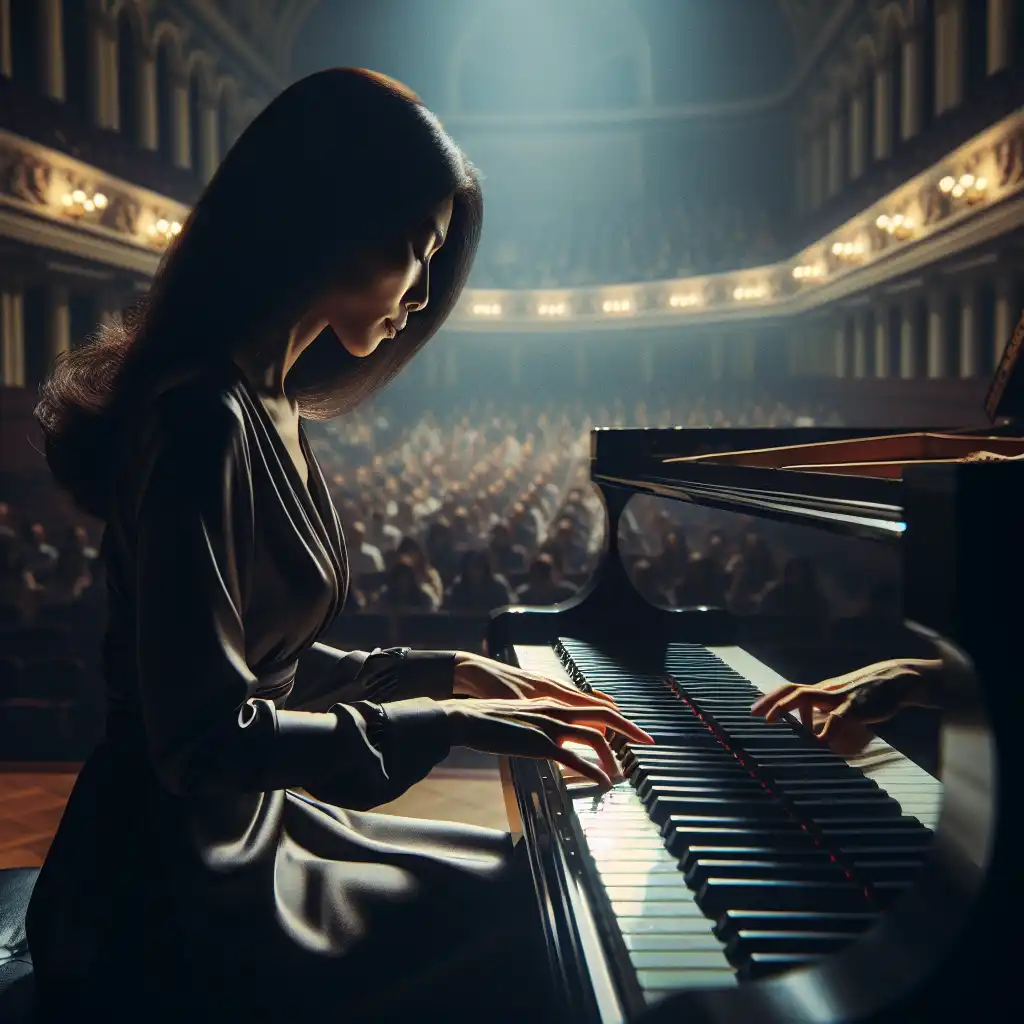
cadenza
noun cadenza
kəˈdenzə
A special part of a piece of classical music, often near the end, played by a single musician
The pianist played an elaborate cadenza that really showcased his technical skills.
cadenza
kəˈdenzə
読み込み中…
kəˈdenzə
A special part of a piece of classical music, often near the end, played by a single musician
The pianist played an elaborate cadenza that really showcased his technical skills.
音声を読み込めませんでした。しばらくしてからもう一度お試しください。
The term 'cadenza' is mainly used in music, especially in classical music. It refers to a part of a piece of music where the performer can freely showcase their skills, often through a solo or a series of solo passages. It is usually placed towards the end of a piece and allows the performer to express their individual style and creativity within the structure of the music. In simpler terms, a cadenza is like a mini-concerto within a larger musical piece, in which an instrumentalist or vocalist can perform and improvise.
Decorate refers to the action of adding ornamentation or embellishment to something, such as a room, a cake, or a piece of clothing.
To simplify things, cadenza is a term used in music for a solo section, while decorate refers to adding decoration to something.
単語を開く: Decorate →To embellish means to add decorative details to something, like a melody, a chord progression, or a piece of art.
A cadenza is a specific term that refers to a solo section in a performance, while to embellish is a more general term that refers to adding decorative details to something.
単語を開く: Embellish →A flourish is a decorative or showy gesture that can be used both in music and other forms of art.
It's a way of adding some extra embellishment to a piece, often at the beginning or the end of a phrase. In music, a flourish can be a quick scale, a trill, or any other ornamental passage that enhances the melodic line.
A cadenza is a solo passage that showcases the performer's skills, while a flourish is a decorative gesture that enhances the overall sound of the music or art.
単語を開く: Flourish →Ornamentation is a technique used to embellish a melody or musical line. It involves adding extra notes, trills, and other decorative elements to a piece of music.
Ornamentation is often used to add interest and complexity to a melody and is typically left up to the performer's interpretation.
A cadenza is a specific passage within a musical piece where the performer can showcase their virtuosity, while ornamentation is a technique used to add embellishments to a melody throughout the piece.
単語を開く: Ornamentation →A riff is a repeated sequence of notes or chords that serve as a musical motif. Riffs are often used in rock, blues, and jazz music as a way of creating a catchy and memorable melody.
In simpler terms, a cadenza is a showy solo while a riff is a repeated melody. Cadenzas are common in classical music while riffs are common in rock, blues, and jazz music.
単語を開く: Riff →A cadenza is a musical passage used in a concerto for a solo instrument, where the soloist plays a showy and elaborate series of notes.
A solo refers to a section in a piece of music where a single performer plays a solo melody, often accompanied by the rest of the orchestra.
A solo can be played on any instrument, including a voice. It is applicable in various genres of music, including pop, rock, and jazz.
単語を開く: Solo →A trill is a musical ornament that involves rapidly alternating between two adjacent notes.
A cadenza is a solo passage in classical music that allows a performer to show off their skills, while a trill is a rapid alternation between two notes used to add ornamentation to a melody.
単語を開く: Trill →A variation is a modification or alteration of a theme or melody. It could be a change in the rhythm, harmony, or melody itself.
Variations usually occur within the structure of the piece and might repeat throughout the song.
A cadenza is a solo part of a performance that showcases the performer's skills, while a variation is a modification of a pre-existing melody or theme within the structure of a piece of music.
単語を開く: Variation →Improvisation is an important part of bluegrass, and I would hasten to add that classical music wasn't always such an improvisational void. Back in the day, everyone's cadenzas were improvised, and improvisation was taught in conservatories.