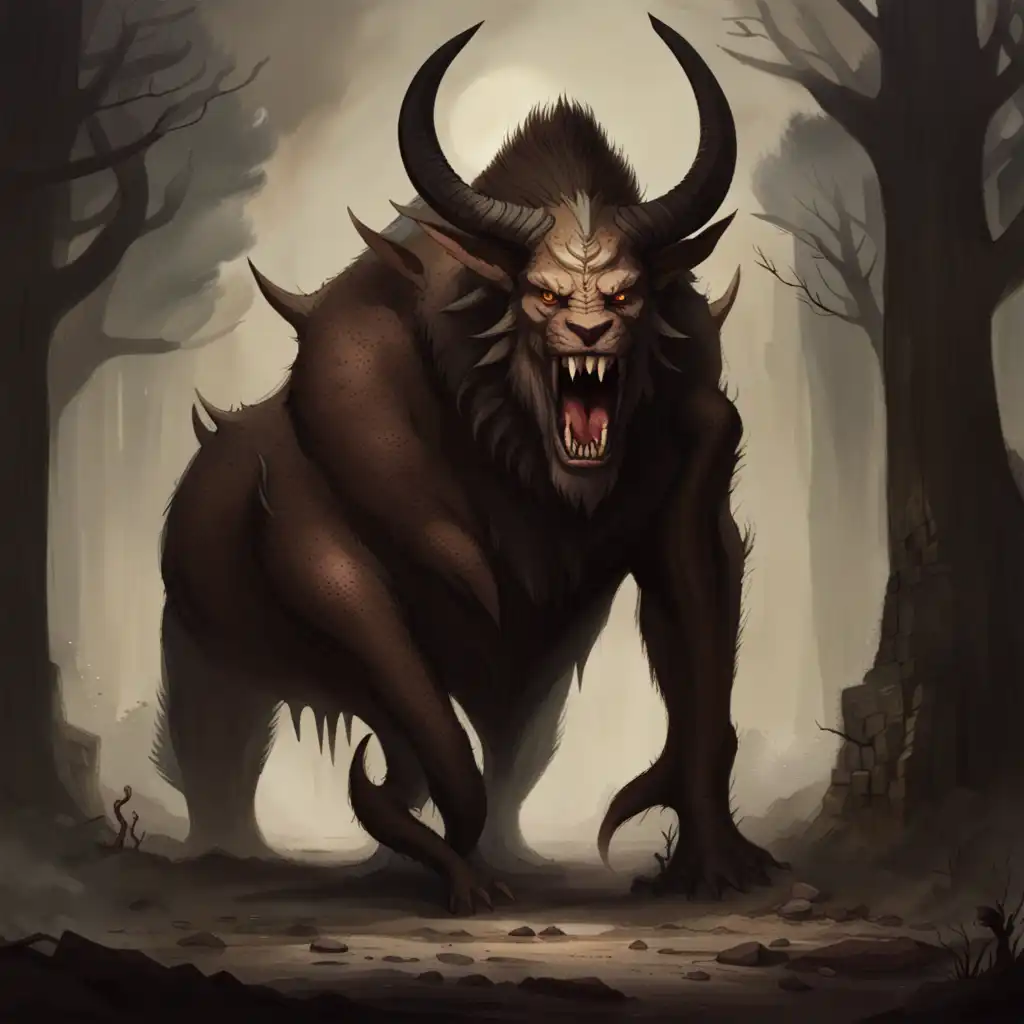
ogre
noun ogre
ˈəʊɡər
A large, frightening monster in stories, often eating humans.
In the fairy tale, the ogre was turned into a mouse.
ogre
ˈəʊɡər
Chargement…
ˈəʊɡər
A large, frightening monster in stories, often eating humans.
In the fairy tale, the ogre was turned into a mouse.

ˈəʊɡər
A person who is seen as cruel, brutish, or monstrous.
He was an ogre in his management style, always demanding and never happy.
Impossible de charger l’audio. Réessayez plus tard.
The word "ogre" is used to describe a large, ugly, and scary creature from folk tales and children's stories. It is often portrayed as a man-eating giant with exaggerated features like horns and sharp teeth. In everyday language, we may use the word "ogre" to describe a person who is very mean, cruel, or difficult to deal with. For example, if someone is demanding or aggressive, we might say "he's an ogre." It's important to note that calling someone an "ogre" is not a compliment and could be considered rude.
Beast refers to any animal that is not a human being.
Beast can describe any animal, while ogre is specific to a particular type of mythical creature.
Beast can also be used metaphorically to describe a person who is behaving in a way that is animalistic or savage, while ogre describes a particularly evil or cruel person or creature.
So in general, beast is a more general term, while ogre is more specific and often used in a fantasy or fairy tale context.
Ouvrir le mot: Beast →Both brute and ogre generally refer to a large and violent person, but there are some differences in their usage.
Brute can apply to any person or animal that is big, strong, and aggressive.
It can also refer to someone who is very rough or uncompromising in their behavior. For example, a football player who plays aggressively and physically might be called a brute.
Brute is a more general term for a big, strong, and aggressive person, while ogre specifically refers to someone who is cruel or unpleasant to be around.
Ouvrir le mot: Brute →Daemon generally refers to a supernatural being or spirit, often associated with good or evil. Ogre refers to a large, ugly and monstrous humanoid creature typically portrayed as cruel or villainous.
Daemon is a more abstract concept, often used in religious or spiritual contexts, while ogre is a more concrete and visual representation of a villainous character.
Both words can be used in various contexts, including literature, mythology, and storytelling. For example, in fantasy stories, an ogre may be portrayed as the villain who is defeated by the hero, while a daemon may be an otherworldly ally or enemy with magical powers.
Ouvrir le mot: Daemon →Fiend is typically used to describe a malicious, evil, or wicked individual, while ogre is typically used to describe a cruel, brutish, or monstrous person or creature.
In other words, a fiend is a person who is intentionally harmful, while an ogre is someone or something that is strong and dangerous.
A fiend can be human or supernatural, while ogres are usually portrayed as mythical creatures.
Ouvrir le mot: Fiend →Both giant and ogre are mythical creatures that are known for their huge size and strength.
A giant is typically seen as a large humanoid creature that is more benevolent in nature. They are often portrayed as friendly and helpful in children's stories, such as 'Jack and the Beanstalk'.
Giant refers to a large, humanoid creature that is viewed in a positive light, while an ogre refers to a large, monstrous creature that is viewed in a negative light.
Ouvrir le mot: Giant →Both monster and ogre refer to mythical creatures that are often portrayed as frightening and dangerous.
A monster is a general term used to describe any imaginary creature that is usually large, ugly, and scary.
It can be any kind of supernatural being, such as a dragon, werewolf, or giant spider. In modern times, monsters have often been depicted in movies, TV shows, and video games as terrifying and intimidating creatures that threaten the heroes and humans in their way.
An ogre is a specific type of monster that is known for being particularly cruel and unpleasant. They are usually portrayed as being large, brutish, and dim-witted creatures that enjoy eating humans and other animals.
In summary, while both monster and ogre refer to mythical creatures, the term monster is more general and can be applied to any kind of supernatural being.
On the other hand, ogres are a specific type of monster known for their cruel behavior and grotesque appearance.
Ouvrir le mot: Monster →Savage refers to a person or animal that is wild or untamed, and often violent or aggressive.
Ogre is more commonly associated with fantasy or mythology, while savage is a more real-world term that can apply to both people and animals.
Ouvrir le mot: Savage →A troll is also a mythical creature, but it is usually smaller than an ogre, and it is often depicted as having a mischievous personality.
Trolls are usually associated with Scandinavian folklore and are known for living in forests and mountains.
In general, ogres are more aggressive and violent than trolls, while trolls are more playful and mischievous. Both ogres and trolls are usually depicted as being dangerous to humans, but a troll is more likely to play pranks on people, while an ogre is more likely to attack and eat them.
Both words can be used metaphorically to describe people who are mean or malicious, but ogre is usually associated with physical size and strength, while troll is more associated with mischievous behavior.
Ouvrir le mot: Troll →before throwing it out of the nest noting the little ogre does alarms the foster parents even when their own eggs
Voir sur YouTube ↗What am I, a Frankenstein? What am I, some kind of an ogre? I'm a good person; I'm a warm person.
It tastes like pillows of sparkles or old shoe and dung. No more of sounding good or bad. You sound like lilting baby laughter or ogres marching to war. Dear God you do not look good or bad. You look like a feathery angel or a morose faun.
Voir sur YouTube ↗Sometimes, I'm an ogre. I can be short. I'll walk into the office some days and I've gotten up on the wrong side of the bed, and everybody knows it. I'm a perfectionist. I like to be organized, and I like to get everything done today.
get to see a cat so clearly up in a tree especially in green season so that's perfect we're this is seeping here all day I especially could have been seeping here all day like I said to you it was quite nice because why was it nice since all ogres was not to what you had to do
Voir sur YouTube ↗There was no convincing me that a stepmother could be anything but a wicked ogre, and I acted accordingly.
before I had a chance to kill him. Up until our mother asked him to leave and not come back, Bageye had been a terrifying ogre.
Voir sur YouTube ↗The ogres and witches and giants of fairytales stand in as metaphors for those obstacles that we all face in our own lives.
Patriarchy doesn't just make men out to be ogres. Women buy into the patriarchy as well, and women make those comments as well, like, 'Boys will be boys.' Women have to undo that stuff, too.
There are ogres and black beasts out there; you have to be constantly on guard.
I remember my agent at ICM at the beginning of my career telling me that I wasn't pretty enough, that I was always going to be a quirky sidekick. And he was an ogre of a man. He should have been carrying a torch. If he was in a bar, he couldn't have come near me, and then he was deciding my fate.
So they ended up turning this little twenty eight page book into the movie. And it's all about this stinky, smelly ogre who doesn't care what anybody thinks of him.
Food's delicate. You have to handle it with finesse. You can't just be a big ogre.
I love people; don't get me wrong. Individually, I love that interaction between people, and I'm not an ogre or something; but huge crowds of people, huge groups of people who seemingly have endless access to you - as I get older, I'm not really into that.