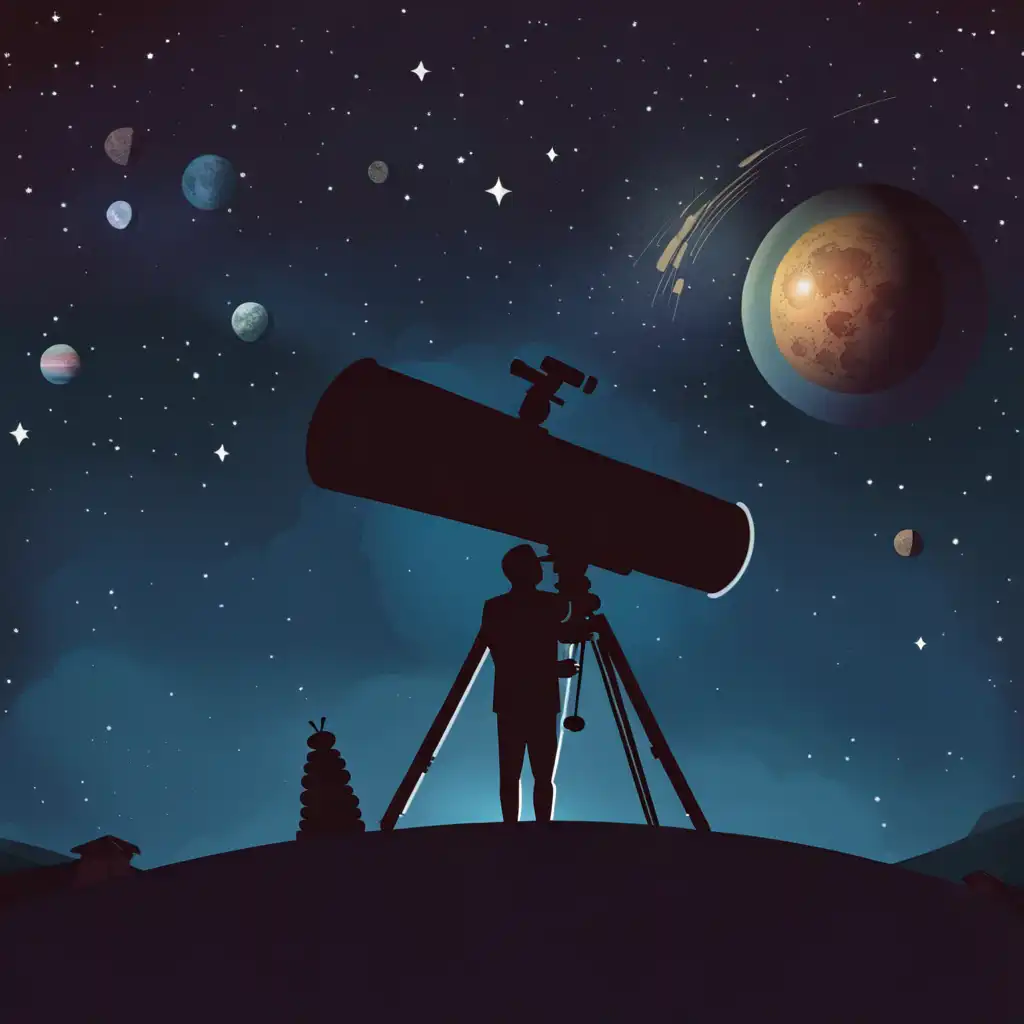
astronomer
noun astronomer
əˈstrɑːnəmər
A person who studies stars, planets, and other things in space
The astronomer used a telescope to observe the star.
astronomer
əˈstrɑːnəmər
लोड हो रहा है…
əˈstrɑːnəmər
A person who studies stars, planets, and other things in space
The astronomer used a telescope to observe the star.
ऑडियो लोड नहीं हो सका। कृपया बाद में फिर कोशिश करें।
An astronomer is someone who studies outer space, such as stars, planets, galaxies, and black holes. They use telescopes and other equipment to observe and analyze the universe. It is a word that can be used to describe someone's job or profession. For example, "My friend is an astronomer and works at a space observatory."
An astrophysicist is someone who not only studies celestial objects, but also tries to understand the physical processes that are happening in the universe.
So, while both astronomers and astrophysicists study space and the universe, astrophysicists go deeper into the physical processes behind them, and use more advanced mathematical models to understand those processes.
As for where each one is applicable, both astronomers and astrophysicists can work in academia, research centers, and observatories, but astrophysicists might be more likely to work in physics or physics-related fields.
शब्द खोलें: Astrophysicist →A cosmologist is a scientist who studies the origins, evolution, and structure of the universe as a whole. They try to understand the universe's properties, such as its size, age, and composition, and how it has changed over time.
In simpler terms, while astronomers focus on specific objects in space, cosmologists take a broader perspective and study the entire universe.
Therefore, astronomers are more concerned with what is happening where cosmologists are more focused on what everything means.
शब्द खोलें: Cosmologist →it could be rocky and warm enough to have oceans and perhaps life. Astronomers discover these potentially habitable planets, and their eyes get big and wide. Could one of these distant worlds carry the building blocks of life?
YouTube पर देखें ↗The astronomer will believe that the most erratic comet will yet accomplish its journey and revisit our sphere; but we give up those for lost who have not wandered one-half the distance from the centre of light and life.
different people bring to the table. We're a melting pot of astronomers, physicists mathematicians and engineers. This is what will make it soon possible to achieve something once thought impossible. I'd like to encourage all of you to go out and help push the boundaries of science,
YouTube पर देखें ↗Although we don't know what is outside our universe, astronomers still wonder. Several pictures of what there might be have been dreamed up. An interesting one, called multiverse, has lots of universes. Picture it as a foam of bubbles. Our universe would be one bubble, and we'd be surrounded by lots of other bubbles.
last that long okay and so so there are about two three years lifetime so if you're planning on foot anyway is just not gonna not gonna work they're very inexpensive suits that you can always go out and buy that for the next month so what's a suggestion that astronomers
YouTube पर देखें ↗First Light' is nonfiction, a true story about astronomers who are looking for light coming from the edge of the universe. It tells how science is really done - and science is a lot weirder and more human than most people realize.
and astronomer wasn't that so wild okay this is what I thought instead of them thinking that might be big solar panels in the sky over that planet what if it's just big advertisements we don't know what that civilization is right maybe the key to developing an advanced
YouTube पर देखें ↗Astronomers have been bewildered by the theory of an expanding universe, but there is no less expansion in the moral infinite of the universe of man. As far as the frontiers of science are pushed back, over the extended arc of these frontiers one will hear the poet's hounds on the chase.
Astronomers have announced they've found what could be evidence of life elsewhere and not on Mars but on the much more inhospitable Venus. There's something seriously weird going on that perhaps perhaps
YouTube पर देखें ↗Recent results from astronomers who study the occasional gravitational lensing of unknown worlds by intervening stars suggest that orphan planets could be at least as numerous as the stars. In other words, there could be hundreds of billions of orphan worlds shuffling through our galaxy.
most of which we'll never be able to reach? The answer is light. And although light from distant parts of the universe can take billions of years to reach us, it carries six unique messages that when put together, can disclose an amazing amount of information to astronomers who know how to look for it.
YouTube पर देखें ↗Astronomers are greatly disappointed when, having traveled halfway around the world to see an eclipse, clouds prevent a sight of it; and yet a sense of relief accompanies the disappointment.
Aided by some distance and direction information from the neutrino detectors, the amateur astronomers and scientists alike will scan the skies and share information to quickly identify the new galactic supernova
YouTube पर देखें ↗Extraordinary claims require extraordinary evidence, and it is my job, my responsibility, as an astronomer to remind people that alien hypotheses should always be a last resort.
was awarded to two teams of astronomers for a discovery that has been hailed as one of the most important astronomical observations ever. And today after briefly describing what they found, I'm going to tell you about a highly controversial framework for explaining their discovery,
YouTube पर देखें ↗You know, there was a time, just before I started to study physical science, when astronomers thought that systems such as we have here in the solar system required a rare triple collision of stars.
Extraordinary claims require extraordinary evidence, and it is my job my responsibility as an astronomer to remind people that alien hypotheses should always be a last resort.
YouTube पर देखें ↗Whether you are an astronomer or a life scientist, geophysicist, or a pilot, you've got to be there because you believe you are good in your field, and you can contribute, not because you are going to get a lot of fame or whatever when you get back.
I'm delighted to be here. I'm honored by the invitation and thanks. I would love to talk about stuff that I'm interested in, but unfortunately I suspect that what I'm interested in won't interest many other people. First off my badge says I'm an astronomer.
YouTube पर देखें ↗I am an astronomer, and my job is to look to the heavens to better understand the universe and our place in it.