angle
noun angle
ˈæŋɡl
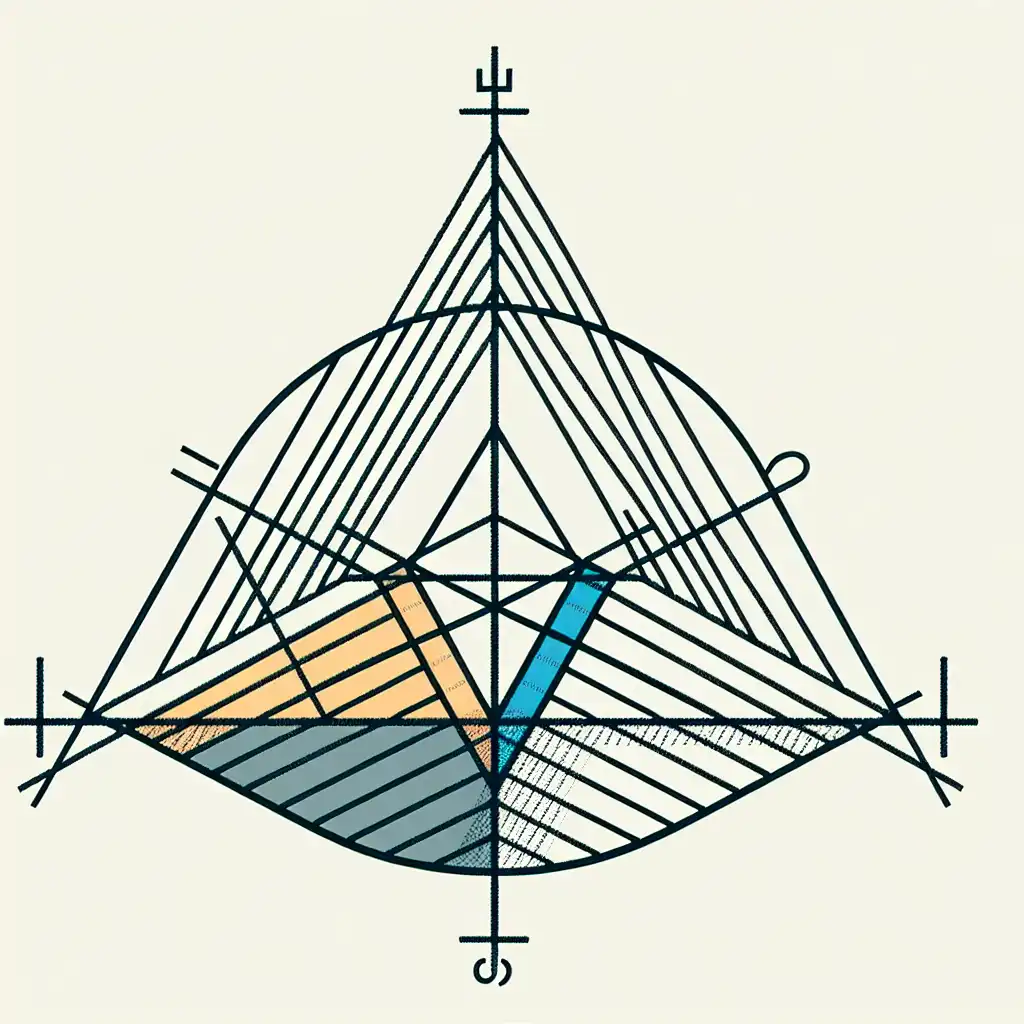
The space or difference between two lines or paths that meet at a point.
The angles of a triangle always add up to 180 degrees.
angle
ˈæŋɡl
Loading…
ˈæŋɡl
The space or difference between two lines or paths that meet at a point.
The angles of a triangle always add up to 180 degrees.
ˈæŋɡl
A point of view or way of considering something.
We need to look at the problem from a different angle.

ˈæŋɡl
The direction from which something approaches or is looked at.
She photographed the building from several angles.

ˈæŋɡl
To move or be inclined at an angle.
He angled his chair towards the window.

ˈæŋɡl
To aim or direct something towards a particular person or thing.
The company is angling its marketing efforts towards young people.

ˈæŋɡl
To try to get something indirectly, often by hinting or scheming.
He's been angling for a promotion.

ˈæŋɡl
A fisherman's implement consisting of a line and a hook used for fishing, a fishing rod.
He caught a big fish with his angle.
Audio could not be loaded. Please try again later.
The word "angle" can be used to describe the degree of difference between two lines or surfaces that meet at a point. For example, if you imagine two lines intersecting, the degree of turn between them is called the angle. Angles are measured in units called degrees, with a full circle measuring 360 degrees. Angles are used in math, science, and engineering to describe the shape and position of objects, and in everyday language to describe perspectives or points of view. For instance, you may hear someone say they have a different angle on a problem, meaning they have a different perspective or way of looking at it.
A bevel refers to the sloping edge or surface on a piece of material or object. It is created by cutting or grinding the edge or surface at an angle other than a right angle.
Bevels are used to add a decorative or functional aspect to objects, such as creating a smooth transitional edge or allowing two pieces of material to fit together properly.
An angle is a measurement of the space between two lines, while a bevel is a cut or sloping edge on a material or object.
Angles are used in geometry and measurements, while bevels are used in construction, woodworking, and other trades to create smooth and precise edges.
Open word: Bevel →A corner is the point where two lines or sides meet to form an angle. It is a physical feature, while an angle is a measurement or concept.
Corners can be found in buildings, furniture, and many other objects. They are important for construction, design, and aesthetic purposes.
In simpler terms, an angle is the measurement of the space between two lines, while a corner is the actual point where two lines meet.
Open word: Corner →An angle is the measure of the space between two lines or surfaces that meet. Meanwhile, an edge is a line where two surfaces meet.
For example, the corners of a square or a rectangle have angles since two lines meet to form a corner. The sides of the square or rectangle have edges because two surfaces meet to create a line.
In other words, angles refer to the measurement of the space between two lines or surfaces, while edges refer to the boundary line where two surfaces meet.
Open word: Edge →Gradient refers to the rate of change of something over distance or time. It's often used in sciences like physics, engineering, and mathematics to describe how a quantity (like temperature, pressure, or color) changes across space or time.
To summarize, angle is about the direction of lines and surfaces, while gradient is about the rate of change of a quantity.
Open word: Gradient →For example, when two lines intersect, the angle between them is the amount of turn between those lines. Inclination on the other hand, refers to the slope or tilt of a surface or object.
For example, the inclination of a hill is the angle at which it slopes upward.
In simpler terms, angle is about the amount of turn between two lines or surfaces, while inclination is about the tilt or slope of a surface or object.
Open word: Inclination →Orientation refers to the position or direction of an object or system in relation to another object or system.
For example, when describing the position of a building, we would use the term orientation to describe which way it faces, while the term angle would be used to describe the space between two walls that meet at a corner.
In simpler terms, an angle describes the relationship between two objects or surfaces, while orientation describes the position or direction of one object relative to another.
Open word: Orientation →Perspective refers to a particular way of looking at or thinking about something. It is the point of view or the outlook of an individual.
Perspective can also refer to the technique used in art to create the illusion of depth and three-dimensional space on a two-dimensional surface.
In everyday language, angle is used when talking about the physical position of something, while perspective is used when discussing opinions, ideas, and attitudes towards a particular topic or situation.
For example, when discussing a subject or topic, we can have different perspectives, depending on our opinions, experiences, and biases.
Open word: Perspective →Angle refers to the measurement of the degree between two lines intersecting each other. Slant refers to a slope or an incline of an object or surface.
So, while angle is used to measure the degree of a corner or intersection, slant describes the direction of a slope or an object that is leaning to one side.
For example, a carpenter may use an angle to measure the degree of a corner while a writer may use a slant to describe the tilt of a bookshelf.
Open word: Slant →A slope refers to the steepness or incline of a surface or line. It is the ratio of the vertical change over the horizontal change.
For example, the slope of a hill, the slope of a ski run or the slope of a line on a graph.
Angle refers to the amount of turn while slope refers to the steepness of an object or surface. Angles are commonly used in geometry while slopes are often used in mathematics and physics.
Open word: Slope →like psychotherapy or practicing compassion towards others can be helpful. The difficulty is it can be challenging for people with narcissistic personality disorder to keep working at self-betterment. For a narcissist self-reflection is hard from an unflattering angle.
Watch on YouTube ↗To raise new questions, new possibilities, to regard old problems from a new angle, requires creative imagination and marks real advance in science.
yes so i was working on these locations where we set up camera taps and then i want to show this map to the rangers and some cameras you know when setting up we have to change the angle because animals come but you can't get exact spots you know which are important for identification of
Watch on YouTube ↗TV helped me understand camera angles, close-ups, master shots.
because he's so smart I think he's trying to be helpful but he's really creating a lot of confusion Chris and I butt heads sometime and I don't think that's a bad thing you know I think that the angle he come from is very different than angry that I come from a buy-ins the debate now he's blowing hey let it go let it go
Watch on YouTube ↗As you get older, you see the world at a different angle, maybe more cynically, but I just bury my anger.
Fourth someone has something you thought you knew everything about, but they're introducing a new angle of looking at it. And I tell people that this is where great stories start from -- these four intersections of what you're passionate about and what others might be invested in. And most people respond really well to this exercise.
Watch on YouTube ↗For my money, if I'm playing anything then it has to have some sharp angles on it. It's got to have some edges that you can cut yourself on, otherwise it's boring.
this was a great word there are a lot of other words that are related to this word there's mirka veldt there's in adult there's work angles of melt they're basically there's a world of
Watch on YouTube ↗Every man of genius sees the world at a different angle from his fellows, and there is his tragedy.
Your knees should be at a right angle with your feet flat on the floor. But what if your posture isn't that great? Try redesigning your environment. Adjust your screen so it's at or slightly below eyelevel. Make sure all parts of your body, like your elbows and wrists are supported,
Watch on YouTube ↗I have yet to meet very many people in the press who are really, truly interested in writing a good story or getting at the truth. Most press people, when they come into an article, have an angle that they want already, so they need points to support that angle, whatever the angle may be.
creating enough combined force to support its weight. In fact the whole gecko could dangle from a single one of its toes. That super stickiness can be broken though, by changing the angle just a little bit. So the gecko can peel its foot back off,
Watch on YouTube ↗You have more time to work in movies. My experience with movies is that you have more time to experiment with the character and camera angles and things like that.
But another reason is that honeybees are in fact, excellent mathematicians. Scientists claim the tiny insects can calculate angles, and can even comprehend the roundness of the Earth. But there's particular mathematical bee genius behind the most important aspect of honeybee the hive.
Watch on YouTube ↗In life, people talk at right angles. One asks a question, and the other replies in part, then uses that part to move the conversation to something else. Everyone has an agenda, has something they're trying to say - or not say.
you might be able to see the density change due to a solid tumor in a patient, but you wouldn't know how deep it is beneath the surface. However if you take X-rays from multiple angles, you should be able to find the tumor's position and shape.
Watch on YouTube ↗I'm not very particular about the commercial angle in my films, but entertainment is very important.
while sea anemones are symmetric when you rotate them at any angle. Some corals on the other hand have no symmetry at all. They are completely asymmetric. But why do organisms exhibit these different symmetries? Does body symmetry tell us anything about an animal's lifestyle? Let's look at one particular bilaterally symmetric animals.
Watch on YouTube ↗You know how the best story angles often spring from that thought you have on reading an article or watching a show - that thought you have before the responsible journalist in you comes up with something boring. I usually recommend people get in touch with their deep 'reptilian brain.