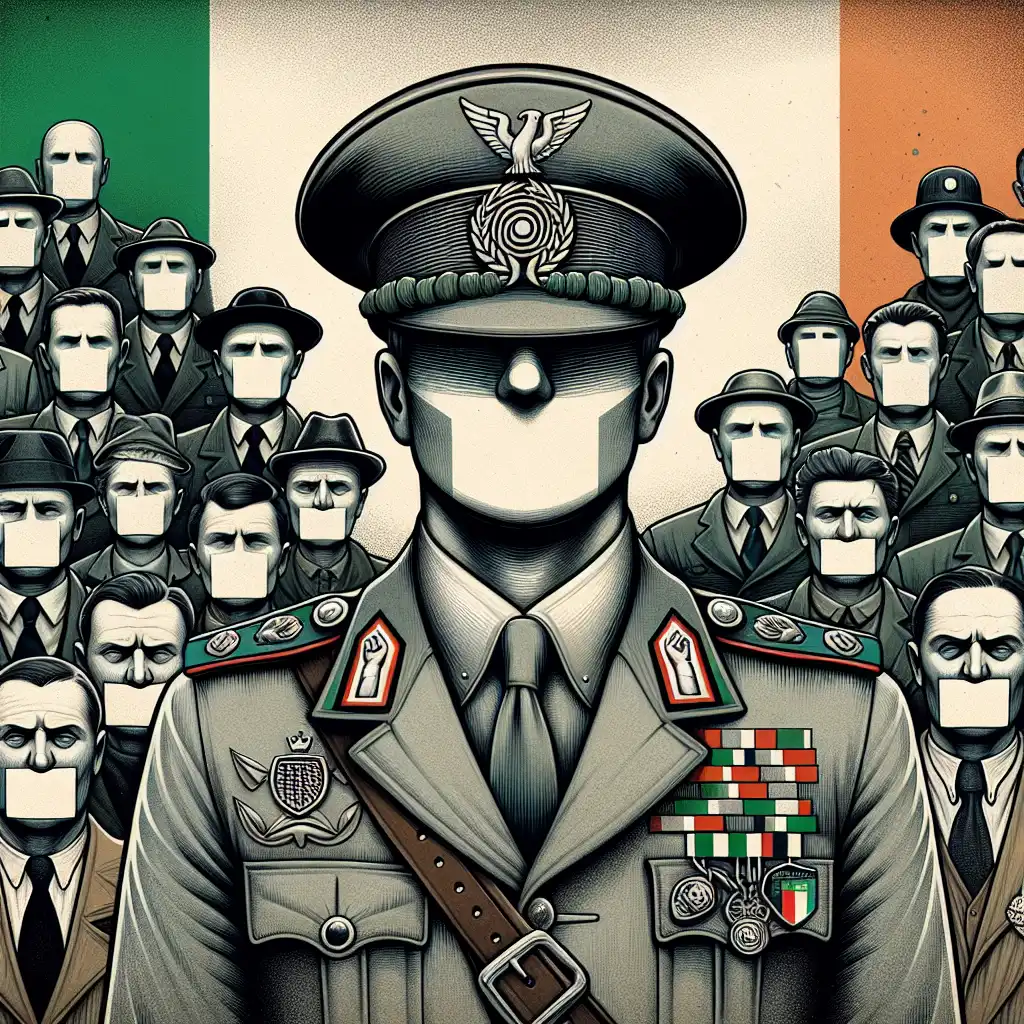
Fascism is a political ideology that aims to create a strong and centralized government led by a single leader or party. The government controls and suppresses individual freedoms in the name of achieving a higher, collective goal. This word is often used to describe governments or leaders who use authoritarian methods to control their citizens.
Authoritarian is a term used to describe a system of government in which one person or a small group holds complete power over the citizens.
Fascism is a specific form of authoritarian government that developed in the early 20th century. Fascist governments are characterized by extreme nationalism, strict social and economic controls, and often a willingness to use violence to suppress opposition.
Both terms can be applicable in different contexts, but fascism is a more specific form of authoritarianism that involves a particular ideology and set of beliefs.
Authoritarianism can take many different forms, but it always involves a concentration of power in the hands of a few individuals rather than a democratically elected government.
Autocracy refers to a form of government in which a single person holds complete power and authority over the state. This person has the power to make all important decisions without any external checks or balances.
While autocracy can refer to any single-person rule, fascism specifically refers to a political ideology that seeks to create a totalitarian state.
Autocracy might be applicable to traditional monarchies, while fascism is often associated with totalitarian regimes such as Nazi Germany or Mussolini's Italy.
Jingoism is an extreme form of nationalism that promotes aggressive and bellicose foreign policies. It often emphasizes a sense of superiority over other nations and can be characterized by a willingness to engage in military action and confrontational diplomacy.
So while fascism emphasizes a strong state and suppresses individual freedoms, jingoism emphasizes aggressive foreign policies and a sense of nationalism.
Fascism and militarism are two different concepts.
Militarism is an ideology that glorifies military power and the use of military force. It is applicable to societies and governments that encourage the development and use of military force as a means to achieve political objectives.
Militarism can involve the domination of civilian life by the military, as well as the promotion of war and aggression as a viable solution to political conflicts.
Fascism is a political ideology that seeks to establish a centralized and authoritarian state, while militarism is an ideology that values and promotes the use of military force.
Fascism is an extreme form of nationalism that places the nation above all else, including individual rights and freedoms.
Nationalism is a belief in the importance and value of one's nation and the people who make it up.
Fascism is a radical and oppressive form of extreme nationalism, while nationalism on its own is a belief in the importance of one's nation without necessarily promoting oppressive or discriminatory actions.
Totalitarianism is a political system in which the government has total control over all aspects of society. This includes the economy, the media, and even people's thoughts and beliefs.
Totalitarianism often involves the use of propaganda and censorship to control the population, as well as the suppression of individual freedoms and human rights.
Both fascism and totalitarianism are forms of authoritarian government, but fascism tends to focus more on nationalism and militarism, while totalitarianism is more concerned with control over all aspects of society.
Fascism is often associated with Italy under Mussolini and Germany under Hitler, while totalitarianism has been seen in countries like North Korea and China.
Tyranny is a form of government where a leader has absolute power and uses it unjustly. This can include oppression, brutality, and suppression of individual freedoms.
While both terms refer to oppressive forms of government, fascism is specific to a particular set of beliefs and policies, while tyranny can manifest in a variety of ways.
Generally speaking, fascism is applicable to regimes that prioritize nationalism and government control, while tyranny can refer to any oppressive regime regardless of specific ideology.
Fascism, the more it considers and observes the future and the development of humanity, quite apart from political considerations of the moment, believes neither in the possibility nor the utility of perpetual peace.
It is dangerous when you start calling people from one part of the world terrorists or fanatic, and you reduce them to some abstract notion. If evil has a geographical place, and if the evil has a name, that is the beginning of fascism. Real life is not this way. You have fanatics and narrow-minded people everywhere.
I remember saying goodbye to my father the night he left to join the Navy. He didn't have to. He was older than other servicemen and had a family to support but he wanted to be a part of the fight against fascism, not just make movies about it. I admired this about him.
Green politics at its worst amounts to a sort of Zen fascism; less extreme, it denounces growth and seeks to stop the world so that we can all get off.
I'm against genocide. I'm against fascism. I'm willing to fight against them so that, in that sense, I think one can still be committed to justice and committed to peace but recognize the circumstances under which one does have to fight.