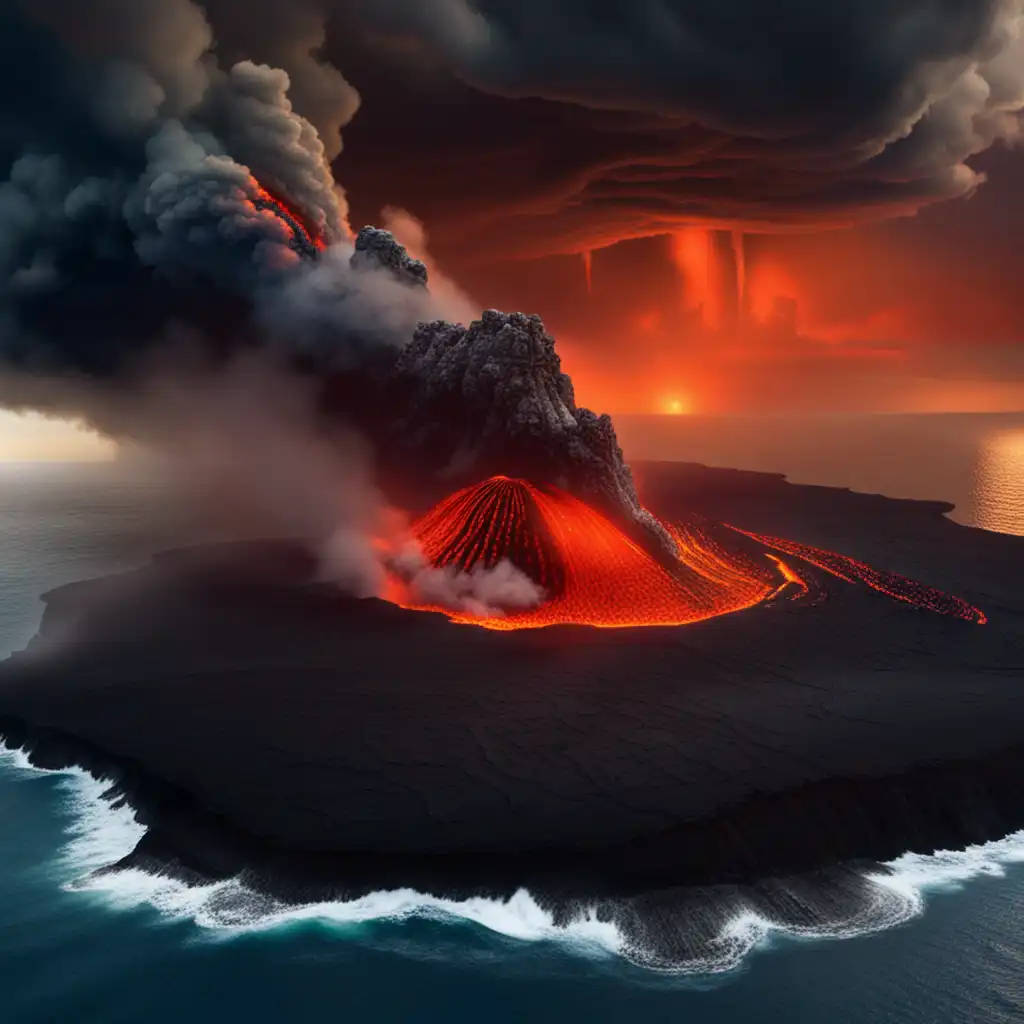
volcanic
adjective volcanic
vɑːlˈkænɪk
Related to volcanoes or the powerful forces that create them.
The island was formed by volcanic activity millions of years ago.
volcanic
vɑːlˈkænɪk
लोड हो रहा है…
vɑːlˈkænɪk
Related to volcanoes or the powerful forces that create them.
The island was formed by volcanic activity millions of years ago.

vɑːlˈkænɪk
Having or showing very strong or energetic emotions.
She made a volcanic protest against the new policy.
ऑडियो लोड नहीं हो सका। कृपया बाद में फिर कोशिश करें।
The word 'volcanic' is used to describe things that have to do with volcanoes - which are mountains that release hot melted rock, ash, and gas from inside the earth. For example, when we talk about a 'volcanic eruption,' we mean when a volcano explodes and releases all of that material. We might also use 'volcanic' to describe rocks or land forms that were created by volcanic activity, or to talk about places where there are a lot of volcanoes.
Blaze generally refers to a big, strong flame, often produced in a fire or wildfire.
It can also be used figuratively to describe something that is very noticeable or intense. For example, "the fire was blazing brightly" or "the musician's talent blazed on stage.".
Blaze refers to strong flames and something that is intense or noticeable, while volcanic relates specifically to things related to volcanoes.
शब्द खोलें: Blaze →Bubble refers to a small, round, and transparent ball of air, gas, or liquid that rises to the surface. For example, you blow bubbles with bubble solution and a wand.
Bubble describes a small and innocent object that rises to the surface, while the word volcanic describes a natural disaster that can cause massive destruction.
शब्द खोलें: Bubble →Eruptive refers to any sudden and violent outburst or explosion, while volcanic specifically refers to geological activity associated with volcanoes.
For example, a large explosion at a factory would be described as eruptive, while a volcano spewing ash and lava would be described as volcanic.
Eruptive can refer to any type of sudden and explosive event, while volcanic is specifically related to geological activity involving volcanoes.
शब्द खोलें: Eruptive →Explosive refers to something that can combust with great force and release energy suddenly. This can apply to things like bombs, fireworks, or chemicals that can explode.
Explosive refers to a sudden and powerful release of energy, while volcanic refers to geological phenomena related to volcanoes.
शब्द खोलें: Explosive →Fiery refers to something that has flame or heat.
To summarize, fiery describes fire and intense emotion, while volcanic describes volcanoes and volcanic activity.
शब्द खोलें: Fiery →Both the words igneous and volcanic refer to the type of rocks that are formed from molten material inside the earth.
Igneous rocks are rocks that are formed from magma (molten rock beneath the earth’s surface) which cools and solidifies.
These rocks can form deep within the Earth's crust or on the surface. Examples of igneous rocks include granite, basalt, and pumice.
Igneous rocks are formed from molten rock that cools and solidifies below the Earth’s crust, whereas volcanic rocks are formed from molten rock that is erupted from a volcano and solidifies on the surface.
शब्द खोलें: Igneous →Incandescent refers to something that emits visible light as a result of being heated, such as an incandescent light bulb.
Incandescent is used more often to describe objects or substances that are glowing with heat, whereas volcanic describes geological phenomena associated with volcanoes.
For example, you might use incandescent to describe a red-hot piece of metal or a flame, whereas you would use volcanic to describe lava, ash, or pyroclastic flow from a volcano.
शब्द खोलें: Incandescent →Melt means to change from a solid to a liquid state as a result of heating. This can happen to many materials, such as ice or chocolate.
Melt refers to a physical change in state, while volcanic refers to a geological process that involves the eruption of a volcano.
शब्द खोलें: Melt →Seethe means to be filled with intense but restrained anger.
Seethe describes a person who is angry but keeping it under control or to describe a situation that is intense but not yet violent.
For example, "He was seething with anger after the argument with his friend."
शब्द खोलें: Seethe →characterized by a volume of erupted material, many times greater than that of ordinary volcanoes. And while the popular image of volcanic destruction is molten rock engulfing the surrounding land, far greater devastation is caused by what remains in the air.
YouTube पर देखें ↗We're constantly re-evaluating the potential for life. We're finding it where we didn't think it could exist, such as volcanic vents and other extreme conditions like under arctic ice. We're finding life in these incredibly harsh and dynamic conditions, so we're having to re-evaluate our own ideas of what's possible on this planet alone.
were caused by cataclysmic volcanic eruptions it's not the lava or ash that wiped out life but an invisible gas released by
YouTube पर देखें ↗Anger clearly has its proper place at work, which is neither wholly absent nor ever present. The manager who is an emotional blank is just as hard to work for as the volcanic boss, and both can do great harm by setting an unhelpful example for what kind of emotional expression is expected and accepted.
and mid-ocean ridges which are underwater chains of volcanic mountains no matter their shape or size all volcanoes emit gas and molten rock the journey of these emissions begins deep underground in the earth's core
YouTube पर देखें ↗Rachel Weisz is amazing, instinctive, volcanic - an amazing force of nature.
Here again is that ancient volcanic landscape in the Pilbara. Little did I know that our research here would provide another clue to that origin-of-life puzzle. It was on my first field trip here, toward the end of a full long week mapping project,
YouTube पर देखें ↗We still carry this old caveman-imprint idea that we're small, nature's big, and it's everything we can manage to hang on and survive. When big geophysical events happen - a huge earthquake, tsunami, or volcanic eruption - we're reminded of that.
earth we also find them preserved within volcanic materials for billions of years and they look a lot like these microbial tubules we also study impact craters these are observed on every planetary body in the solar system and they're created when an asteroid or comet hits the planet or a moon they have a very
YouTube पर देखें ↗Black Rainbow' is about control and your emotions being repressed and controlled, and 'Mandy's' about all a volcanic eruption!
About 66 million years ago, something terrible happened to life on our planet. Ecosystems were hit with a double blow as massive volcanic eruptions filled the atmosphere with carbon dioxide
YouTube पर देखें ↗We cannot prevent hurricanes or earthquakes, floods or volcanic eruptions. But we can ensure that both people and communities are better prepared and more resilient.
io is the most volcanic world in the solar system
YouTube पर देखें ↗Every year, August lashes out in volcanic fury, rising with the din of morning traffic, its great metallic wings smashing against the ground, heating the air with ever-increasing intensity.
a unique blend of bits from its particular inhabitants. Household dust also contains substances that blow in from the wider world. Depending on the local geology, finely ground quartz coal or volcanic ash
YouTube पर देखें ↗The interior of Mexico consists of a mass of volcanic rocks, thrust up to a great height above the sea-level.
those of you who've been to the beach snorkeling, know corals are an amazing place to go -- full of life, some big animals small animals some nice some dangerous, sharks whales all that stuff. They need to be protected from humanity. They're great places. But what you probably don't know is in the very deep part of the ocean, we have volcanic eruptions.
YouTube पर देखें ↗What compels the Hindu right's volcanic reaction to Valentine's Day? Some of its members have protested that the holiday is the product of a 'rotten imported culture' from the West.
This silica-enriched water enters the voids inside pieces of volcanic rock, prehistoric river beds wood and even the bones of ancient creatures. Gradually the water starts to evaporate, and the silica-solution begins forming a gel,
YouTube पर देखें ↗I swam in the Great Barrier Reef when I was five months pregnant. I went on the bullet train in Japan, which was so much fun, and getting to see Mount Fuji. I did Mykonos and its black volcanic beach. Most of the fun times I've had have something to do with a vacation. I love traveling.