
simultaneity
noun simultaneity
ˌsaɪmltəˈniːəti
The fact or condition of happening at the same time.
The simultaneity of the two events caused a lot of confusion.
simultaneity
ˌsaɪmltəˈniːəti
Đang tải…
ˌsaɪmltəˈniːəti
The fact or condition of happening at the same time.
The simultaneity of the two events caused a lot of confusion.
ˌsaɪmltəˈniːəti
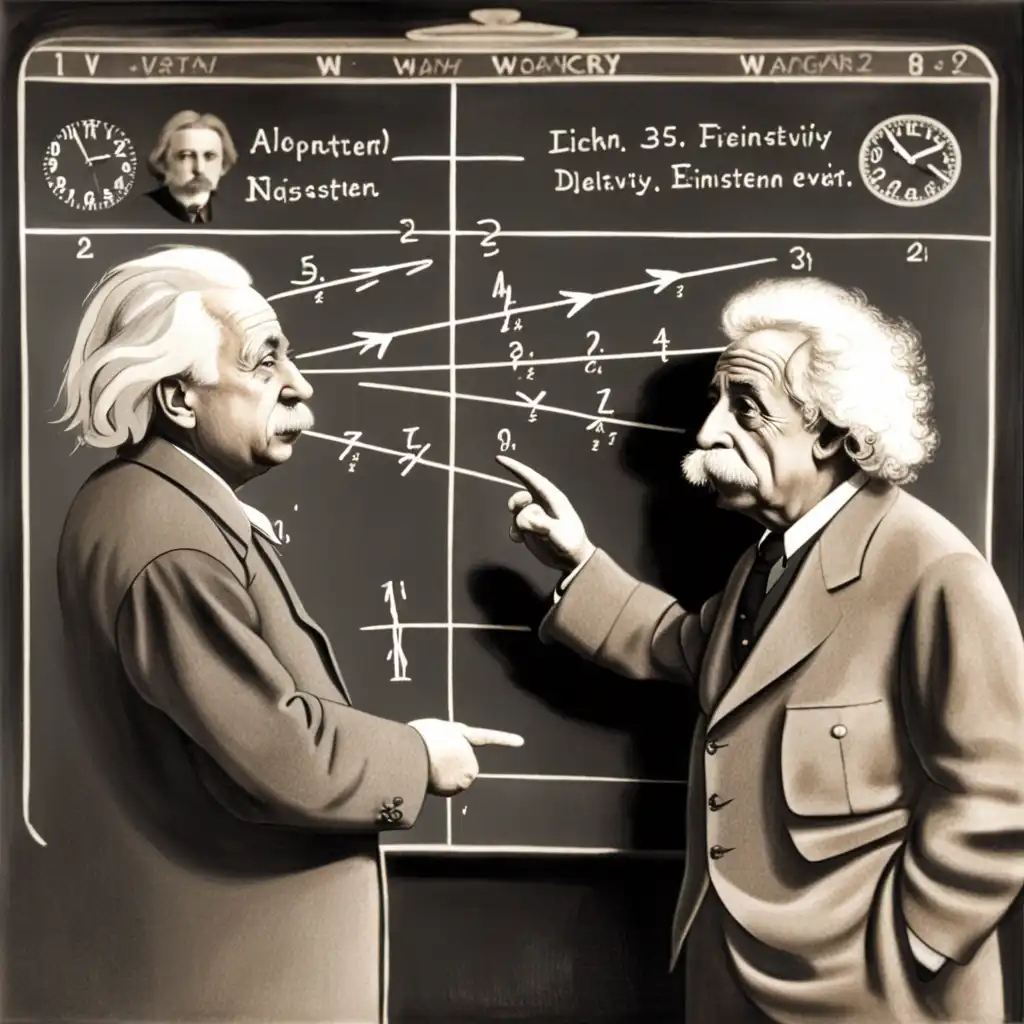
The theory in physics that the timing of two events can be different depending on where the observer is located.
Einstein's theory of relativity disrupts our usual assumptions about simultaneity.
Không tải được âm thanh. Vui lòng thử lại sau.
Simultaneity is used to describe something that happens at the same time as something else. For example, if two people start talking at the same time, you could say there was a moment of simultaneity. It is also used in physics to describe events that occur at the same time in different locations. Basically, if two things happen at the exact same time, you can use the word simultaneity to describe it.
All at once refers to something happening all in one go or at the same time, whereas simultaneity refers to multiple events happening at the same time.
For example, if you were to say "I finished my homework all at once," it means you completed all your homework at one time rather than completing it in parts.
If you were to say "The orchestra played with great simultaneity," it means that all the musicians were playing their instruments at the same time to create a synchronized sound.
All at once is applicable when describing a single event or action that happens in its entirety at the same moment, whereas simultaneity is applicable when describing multiple events happening at the same time.
Mở từ: All at once →At once means something is happening immediately or all at the same time. For example, "I need you to come to my office at once" means I need you to come right away.
Simultaneity means multiple things are happening at the same time. For example, "The concert and the basketball game are happening at the same time, which is a problem for fans who want to attend both.".
At once applies to immediate actions and simultaneity applies to happenings at the same time.
Mở từ: At once →The phrase at the same time means that two or more things are happening simultaneously.
For example, "I am eating dinner and watching TV at the same time."
Simultaneity refers to the quality or state of occurring at the same time.
For example, "The fireworks display and the music concert were planned with perfect simultaneity, so they started at the same time and ended together."
At the same time is a phrase used to describe the happening of two or more events simultaneously, whereas simultaneity describes the state of events happening at the same time.
Mở từ: At the same time →Concurrent means happening at the same time or overlapping in time. It implies that two or more events or situations are occurring simultaneously, but they may not necessarily be related to each other.
For example, if two people are watching TV at the same time, their activity is concurrent. But if they are watching the same program at the same time, their activity is simultaneous.
Concurrent is applicable when referring to events or situations that are happening at the same time, but not necessarily in sync with each other.
Mở từ: Concurrent →Contemporaneous means that two events happen at the same time or during the same period of time. For example, if two historical events took place during the same year, we can say that they were contemporaneous.
In simpler terms, contemporaneous means events that happened around the same time, while simultaneity means events that happened at the same exact moment.
Mở từ: Contemporaneous →Simultaneous refers to two or more events that occur at the same time, while simultaneity refers to the state or quality of being simultaneous.
For example, if two people both speak at the same time, they are speaking simultaneously. The occurrence of them speaking simultaneously is an example of simultaneity.
In other words, simultaneous describes an action, while simultaneity describes the state or quality of that action.
Mở từ: Simultaneous →Simultaneity refers to things happening at the exact same time, while synchronous refers to things happening at the same rate or in sync with each other.
For example, a music teacher might ask their students to clap along with the beat of the song, making sure their claps are synchronous with the rhythm.
Synchronous refers to things happening in sequence or in coordination with each other, while simultaneity refers to things happening at the exact same time without regard to sequence.
Mở từ: Synchronous →Together simply means that two or more things are happening at the same time, but not necessarily at exactly the same moment.
It is a more general term that can be used in everyday conversation. For example, "Let's all watch the movie together."
Simultaneity implies a more exact and precise synchronization, while together is a general term for things happening at the same time.
Mở từ: Together →When is elsewhen? %\PIPE% E...
Xem trên YouTube ↗The idea of the vital movement of the world and its movement is simultaneity.
John Maeda: My journey...
Xem trên YouTube ↗Every linguistic sign is located on two axes: the axis of simultaneity and that of succession.
To demonstrate this simultaneity is by no means trivial, because it may for example happen that the product nucleus always forms in an activated state at first.
There certainly is a tension between the relativity of simultaneity and non-locality in quantum theory, but it's not strong enough to add up to a falsification of either side by itself.
Simultaneity in light is harmony, the rhythm of colors which creates the Vision of Man.