despot
noun despot
ˈdespɑːt
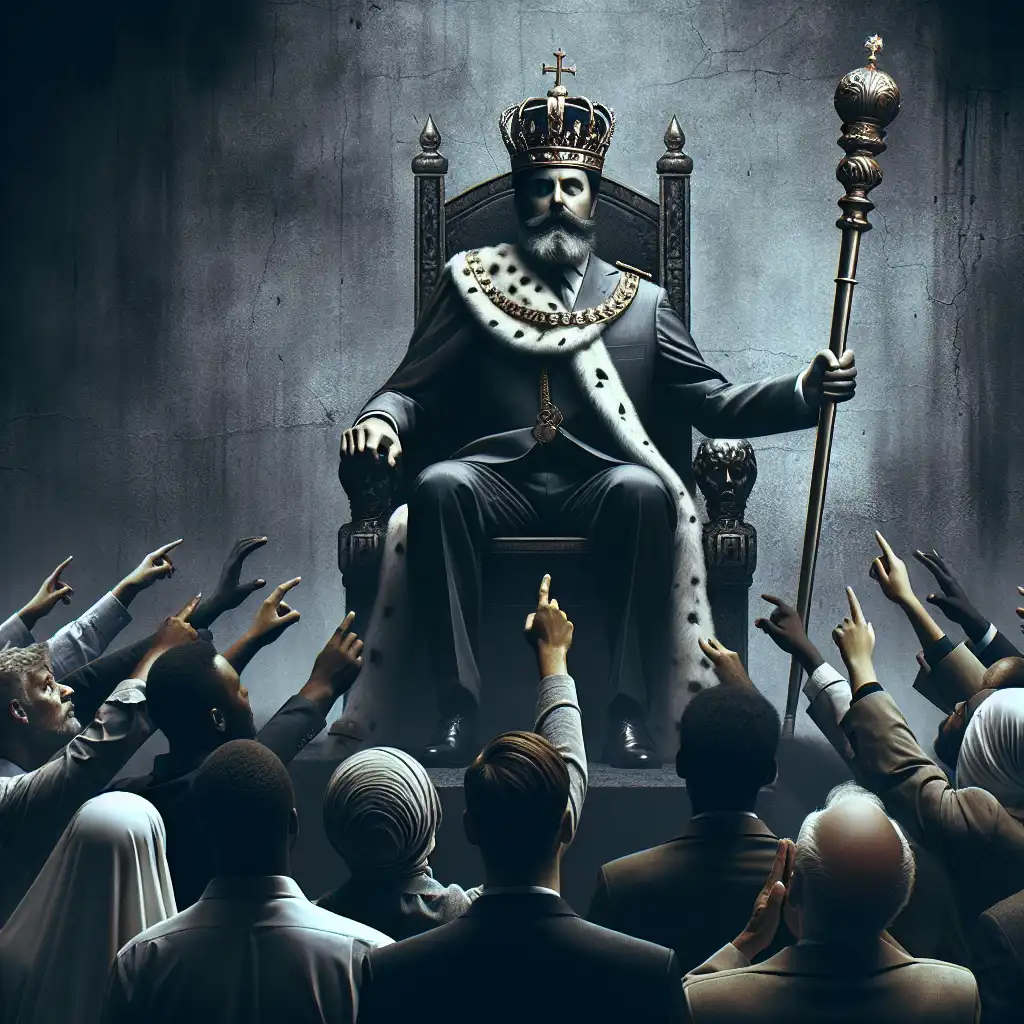
A ruler who has complete power of a country, and uses it cruelly.
The people were oppressed by the cruel despot.
despot
ˈdespɑːt
Đang tải…
ˈdespɑːt
A ruler who has complete power of a country, and uses it cruelly.
The people were oppressed by the cruel despot.
Không tải được âm thanh. Vui lòng thử lại sau.
The word 'despot' is used to describe a ruler who has a lot of power and control over their people. This kind of leader is usually very strict and doesn't allow much freedom or democracy for their citizens. The word 'despot' can also be used to describe someone who is very controlling and abusive towards others. It's not a nice thing to be called a 'despot' because it implies that you're not treating people fairly or kindly. So, it's important to use this word carefully and thoughtfully.
Authoritarian describes a leader or government that has a lot of power and controls people's lives, but doesn't necessarily use violence or force to get their way.
An authoritarian leader tries to control people through means other than violence, while a despot will use violence if necessary to maintain control.
Mở từ: Authoritarian →Both autocrat and despot refer to a ruler who holds absolute power, but there is a subtle difference between the two terms.
An autocrat is a ruler who has complete control over the government but is responsible for the well-being of the people.
An autocrat may use force to maintain law and order, but their ultimate goal is to ensure the stability and prosperity of their country.
In summary, while both terms describe absolute rulers, autocrat implies a degree of responsibility and concern for the governed, while despot implies a lack of concern for their well-being.
Mở từ: Autocrat →A despot and a dictator are both types of leaders who hold absolute power, but they differ in how they acquire and maintain that power.
A dictator is a ruler who takes control of a country through force, often by overthrowing a previous government or by winning a civil war.
They also have complete control over their country, but they maintain their power through fear and coercion. Examples of dictators include Adolf Hitler of Germany and Joseph Stalin of Russia.
The terms despot and dictator are used interchangeably to describe a leader who holds absolute power, but a despot is usually associated with inherited power while a dictator is associated with seizing power.
Mở từ: Dictator →An emperor is a monarch who has supreme authority over an empire. They are often seen as more benevolent rulers who use their power to promote public welfare and have a more long-term view of their reign.
While both terms refer to rulers with significant power, despot is generally used to describe a tyrannical leader, while emperor describes a leader of a stronger, more centralized and stable state.
Mở từ: Emperor →A fascist is a political ideology characterized by extreme nationalism, authoritarianism, and often, racism.
Mở từ: Fascist →A monarch is a ruler who inherits their position and power through their family lineage, and has usually been granted limited powers and responsibilities, such as ceremonial or symbolic duties.
Monarchs are associated with monarchies, where the political power is shared between the monarch and a parliament or other governing body.
In other words, a despot is a ruler who comes to power through force, often abuses their power, and has no accountability, while a monarch is a ruler who inherits their position, has limited powers and responsibilities, and shares political power.
Mở từ: Monarch →A despot is a ruler who has absolute power and uses it to oppress and control their citizens. An oppressor is someone who uses their power or authority to cruelly mistreat and control others.
In simpler terms, a despot is a specific type of oppressive ruler who has complete control over a country or region, while an oppressor can be any person or group who uses their power to harm others.
So, while a despot is a specific type of oppressive ruler, an oppressor can be anyone who wields power in a harmful or unjust way.
Mở từ: Oppressor →On the other hand, totalitarianism is a political system where the state has control over every aspect of people's lives, including their thoughts and beliefs.
Totalitarian governments rely on propaganda, censorship, and surveillance to maintain power, and they often use violence to suppress any opposition.
A despot is a ruler who exercises unlimited power over a state or people, whereas a totalitarian regime is a political system that seeks absolute control over its citizens.
Mở từ: Totalitarian →Both despot and tyrant refer to a ruler who has total power and authority, but there is a slight difference in their meaning.
A tyrant is a ruler who uses their power to oppress and mistreat their subjects.
A tyrant is known for their cruelty, oppression, and injustice towards their subjects.
A despot is a ruler with absolute power, whereas a tyrant is a ruler who uses their power to oppress and mistreat their subjects.
Mở từ: Tyrant →George Papandreou:...
Xem trên YouTube ↗Neither a life of anarchy nor one beneath a despot should you praise; to all that lies in the middle a god has given excellence.
Lions Hunt Zebra %\PIPE%...
Xem trên YouTube ↗The sea does not belong to despots. Upon its surface men can still exercise unjust laws, fight, tear one another to pieces, and be carried away with terrestrial horrors. But at thirty feet below its level, their reign ceases, their influence is quenched, and their power disappears.
Meet global corruption's...
Xem trên YouTube ↗There is one safeguard known generally to the wise, which is an advantage and security to all, but especially to democracies as against despots - suspicion.
The single despot stands out in the face of all men, and says: I am the State: My will is law: I am your master: I take the responsibility of my acts: The only arbiter I acknowledge is the sword: If any one denies my right, let him try conclusions with me.
A good constitution is infinitely better than the best despot.
Idealism is the despot of thought, just as politics is the despot of will.
Freedom is contagious. That's why despots fear it so much.
The savior who wants to turn men into angels is as much a hater of human nature as the totalitarian despot who wants to turn them into puppets.
Your generous part in my liberation is taken by the world for the revelation of the fact, that the United States are resolved not to allow the despots of the world to trample on oppressed humanity.
No tyrant, however evil, has yet lacked ready hands to execute his most abominable will. To read how eagerly men have rushed to serve the despot is the bitterest, the saddest matter of history; it is the saddest sight in our own day.