
causation
noun causation
kɔːˈzeɪʃn
The process or action that makes something happen
In the court, they discussed the causation of the accident.
causation
kɔːˈzeɪʃn
Cargando…
kɔːˈzeɪʃn
The process or action that makes something happen
In the court, they discussed the causation of the accident.

kɔːˈzeɪʃn
The relationship between cause and effect
The study explores the causation between smoking and lung cancer.
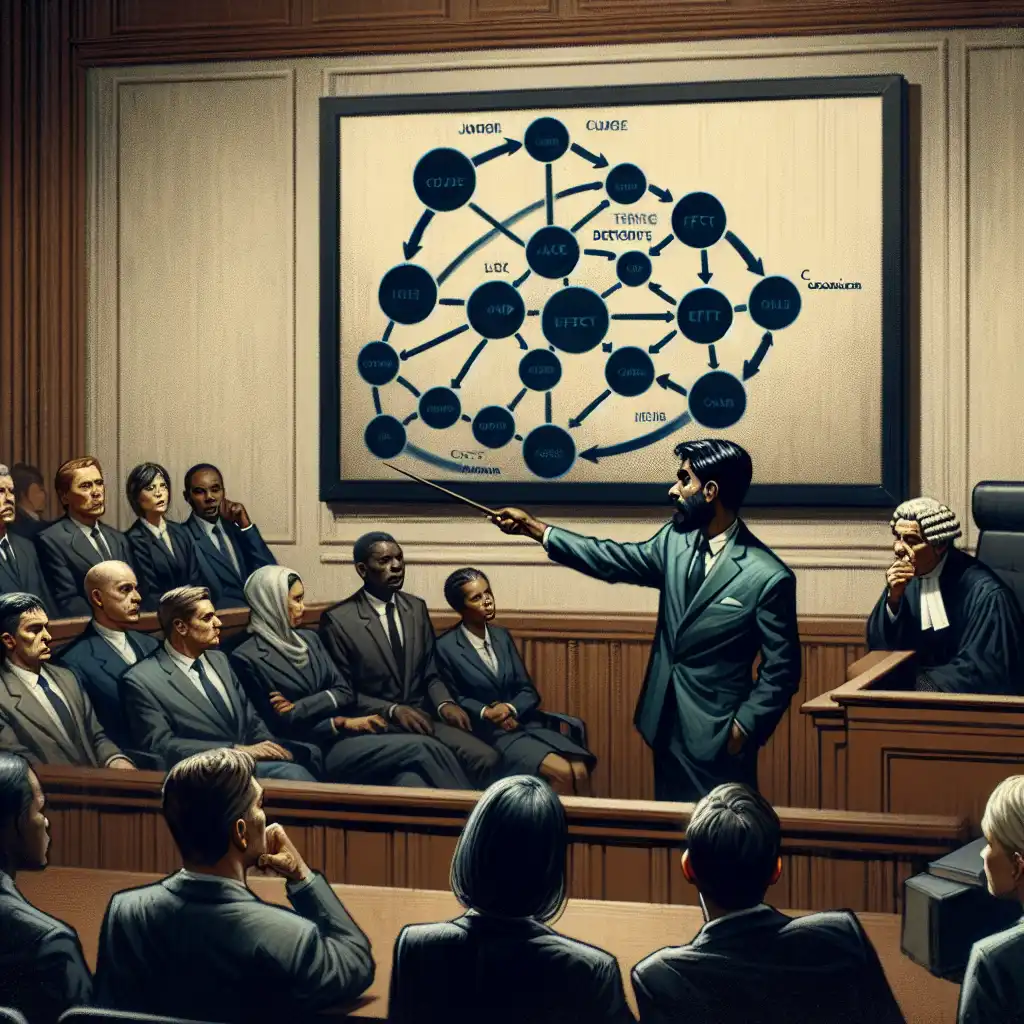
kɔːˈzeɪʃn
A principle in law that the cause of something will determine its effect
The lawyer explained the principle of causation to the jury.
No se pudo cargar el audio. Inténtalo de nuevo más tarde.
The word 'causation' is often used in situations where something causes something else to happen. For example, if someone eats too much junk food and then gets sick, the causation might be the junk food. It's a way of explaining why something happened and what led to that outcome. However, causation can be complex and it's important to consider other factors that could also have influenced the outcome.
Antecedent refers to something that came before a certain event or situation.
It can be any factor or condition that preceded the outcome. For example, if someone gets sick after eating bad food, the antecedent could be the food they ate.
In simpler terms, antecedent is something that comes before an event and causation is the direct cause of that event. Both are applicable in identifying and understanding the factors that contribute to a specific outcome.
Abrir palabra: Antecedent →A catalyst is something that accelerates a process or reaction without being directly involved in the reaction itself. For example, enzymes are catalysts in biological systems that speed up chemical reactions without being consumed in the reaction.
In simpler terms, causation is when one thing directly causes another, while a catalyst is something that helps something else happen more easily or quickly.
Abrir palabra: Catalyst →Causality refers to the principle that everything has a cause or causes, and that events occur in accordance with these causes.
Causation is typically used when discussing specific instances, while causality is a more general principle. For example, a study might investigate the causation (cause and effect relationship) between smoking and lung cancer, but an overall understanding of how events occur in the world would involve an understanding of causality (that everything has causes).
Abrir palabra: Causality →Origin refers to the starting point or source of something.
It is often used to trace the beginning of something concrete, like a product, idea or culture. For example, the origin of sushi can be traced to ancient Southeast Asia when people started preserving fish in fermented rice.
Both words can be used to explain why or how something came about, but causation focuses on the connection between the cause and effect while origin focuses on the starting point of something.
Abrir palabra: Origin →A precursor is something that comes before something else and may indicate or lead to its development. Example: Elevated cholesterol levels may be a precursor to heart disease.
Causation is applicable when trying to understand why something happened or how it came to be. Precursor is applicable when trying to identify early warning signs or factors that may lead to something else in the future.
Abrir palabra: Precursor →Propellant refers to a substance that is used to drive or propel something forward. For example, rocket fuel is a propellant that is used to launch a spacecraft into space.
The main difference between the two words is that causation is related to the reason why something happens, while propellant is related to the means by which something happens.
Causation is generally more applicable in situations involving cause-and-effect relationships, while propellant is more applicable in situations where something needs to be pushed or propelled forward.
Abrir palabra: Propellant →Source refers to the origin, beginning, or starting point of something.
It is often used in contexts that refer to the origins of something, such as the source of a river or the source of an idea.
Causation refers to the relationship between two events, while source refers to the origin or starting point of something.
Causation is more scientific, while source is more descriptive of where something comes from.
Abrir palabra: Source →Trigger refers to an event that initiates or sets off a series of other events. For example, an alarm clock can be a trigger that starts your morning routine.
While both words have to do with events leading to other events, causation refers to a direct cause and effect relationship, while trigger refers to an initiating event that sets off a series of events.
Causation is often used in scientific or legal contexts, while trigger is used more colloquially in everyday language.
Abrir palabra: Trigger →The new era of positive...
Ver en YouTube ↗It seems to me that evolution adds greatly to the wonder of life because it takes it out of the realm of the arbitrary, the exceptional, and links it to the sequence of natural causation.
On positive psychology -...
Ver en YouTube ↗Perhaps looking out through big baby eyes - if we could - would not be as revelatory experience as many imagine. We might see a world inhabited by objects and people, a world infused with causation, agency, and morality - a world that would surprise us not by its freshness but by its familiarity.
Paper towns and why...
Ver en YouTube ↗Fate is the endless chain of causation, whereby things are; the reason or formula by which the world goes on.
What to trust in a...
Ver en YouTube ↗All too often when liberals cite statistics, they forget the statisticians' warning that correlation is not causation.
The promise of quantum...
Ver en YouTube ↗I'm very familiar with how people can confuse correlation with causation.
Why we get mad -- and...
Ver en YouTube ↗The big mystery of Big Data is causation versus correlation.
How your emotions change...
Ver en YouTube ↗We should be cautious about embracing data before it is published in the academic press, and must always avoid treating correlation as causation.
How diversity makes...
Ver en YouTube ↗Biases and blind spots exist in big data as much as they do in individual perceptions and experiences. Yet there is a problematic belief that bigger data is always better data and that correlation is as good as causation.
Steven Pinker: What our...
Ver en YouTube ↗I do absolutely believe that the climate is changing. I'm not prepared to determine causation.
Chris McKnett: The...
Ver en YouTube ↗Agricultural practice served Darwin as the material basis for the elaboration of his theory of Evolution, which explained the natural causation of the adaptation we see in the structure of the organic world. That was a great advance in the knowledge of living nature.