perceptual
adjective perceptual
pərˈseptʃuəl
Related to the way we understand or interpret something through our senses
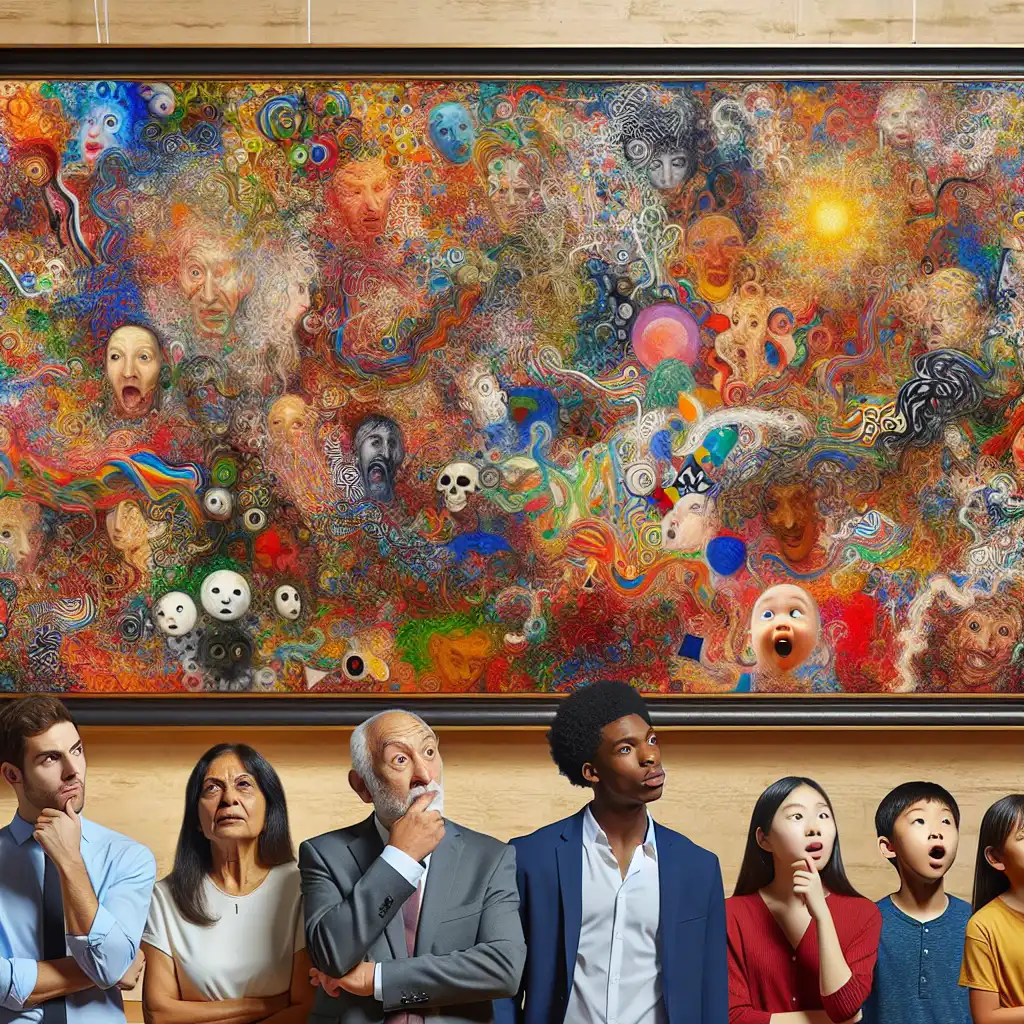
The painting explores perceptual experiences and how they affect our understanding of the world.
perceptual
pərˈseptʃuəl
불러오는 중…
pərˈseptʃuəl
Related to the way we understand or interpret something through our senses
The painting explores perceptual experiences and how they affect our understanding of the world.
오디오를 불러오지 못했어요. 잠시 후 다시 시도해 주세요.
The word 'perceptual' refers to how we perceive or understand things through our senses, such as sight, hearing, touch, taste, and smell. It can be used to describe how we perceive different sensations and stimuli, and how our brain processes and interprets that information. For example, a person's perceptual abilities might be affected by factors such as age, culture, or past experiences. The word can be used in a variety of contexts, such as psychology, neuroscience, and art.
Cognitive refers to mental processes related to thinking, understanding, and problem-solving, while perceptual refers to processes related to how we perceive and interpret sensory information from our surroundings, such as what we see, hear, smell, taste, and touch.
Cognitive processes are applicable in tasks that require mental effort, such as learning, reasoning, decision-making, and memory.
In simpler terms, cognitive is about how we process information in our minds, while perceptual is about how we interpret information from our senses.
단어 열기: Cognitive →Discriminatory means unfairly showing favor or bias towards certain people or things. This can be seen in situations where someone is treated differently because of their race, gender, religion, or other characteristic.
Discriminatory refers to unfair treatment of people or things, while perceptual refers to how we process and interpret sensory information.
Discriminatory can be used in social justice situations, while perceptual can be used in psychology or neurology.
단어 열기: Discriminatory →Experiential refers to something that you learn through personal experience or actually doing something. For example, you can learn about swimming by experiencing it firsthand and being in the water yourself.
Both words are applicable in different situations. Experiential learning is best for learning practical skills or gaining real-world experience, while perceptual learning is best for understanding concepts or experiences that are difficult to explain in words.
단어 열기: Experiential →Interpret means to explain the meaning behind something or to translate something from one language to another.
For example, if you are watching a movie in a foreign language and you need someone to translate the dialogue for you, you would use the word interpret.
단어 열기: Interpret →Intuitive refers to a person's ability to understand or know something without needing to analyze or reason it out. It is all about trusting your instincts.
단어 열기: Intuitive →Observation refers to the act of noticing or watching carefully, while perceptual refers to how our senses interpret and understand what we observe.
Observation is applicable in situations where we need to gather information or data, such as conducting a scientific experiment or making a diagnosis as a doctor.
Perceptual is applicable in situations where we need to interpret or understand our observations, such as when we are trying to evaluate a work of art or navigate a new environment.
단어 열기: Observation →Phenomenal refers to subjective experiences or sensations that cannot be easily measured or observed by others. It relates to how we feel or experience life, like emotions, thoughts, and consciousness.
For example, the feeling of love or the sensation of pain are phenomenal experiences that cannot be observed directly by others.
In brief, perceptual refers to the process of interpreting sensory information, while phenomenal relates to subjective experiences that cannot be easily observed by others.
단어 열기: Phenomenal →Perceptual and sensory are two terms used to describe how we experience the world around us. Sensory refers to our physical senses, such as touch, taste, smell, sight, and hearing.
Applying these terms, sensory is applicable when we talk about the activity of our senses, such as feeling the warmth of the sun or hearing the sound of a bird chirping.
Perceptual is applicable when we talk about how we make sense of that sensory information, such as recognizing the melody of a song or remembering a familiar face.
Sensory refers to the physical sensations we experience, while perceptual refers to the mental processes that allow us to interpret and make meaning out of those sensations.
단어 열기: Sensory →How miscommunication...
YouTube에서 보기 ↗Perceptual reality is different for different species. In certain species it is a mode of observation, so what we call scientific fact is actually not ultimate truth, it is perceptual experience, and it's a mode of observation.
A brain in a supercompute...
YouTube에서 보기 ↗Kids still can be said to live in their own little world. Even if their parents are helicoptering around them, assigning play dates and so forth, I think they're still living in some sense of their own little perceptual worlds.
Time Expert - Chess...
YouTube에서 보기 ↗Many objects of our three-dimensional perceptual world are not only chiral but appear in nature in two versions, related at least ideally, as a chiral object and its mirror image.
Expanding your mind with...
YouTube에서 보기 ↗I didn't only have a perceptual problem, I was also so nervous and so upset. The process just didn't work. I lost enthusiasm for school and I flunked second grade. The teachers said I was lazy.
Your brain hallucinates...
YouTube에서 보기 ↗The brain builds a version of the universe and projects this version of the universe like a bubble all around us. So I can say with some certainty, 'I think therefore I am.' But I cannot say, 'You think therefore you are,' because you are within my perceptual bubble.
How does the Rorschach...
YouTube에서 보기 ↗Photographic memory is often confused with another bizarre - but real - perceptual phenomenon called eidetic memory, which occurs in between 2 and 15 percent of children and very rarely in adults. An eidetic image is essentially a vivid afterimage that lingers in the mind's eye for up to a few minutes before fading away.
What color is Tuesday?...
YouTube에서 보기 ↗To be in love is merely to be in a state of perceptual anesthesia - to mistake an ordinary young woman for a goddess.
Do we see reality as it...
YouTube에서 보기 ↗The role of radiologists will evolve from doing perceptual things that could probably be done by a highly trained pigeon to doing far more cognitive things.
Why some people find...
YouTube에서 보기 ↗Pictures artists staged their own images or copied or cut out others already in existence. The viewer took them in separately, in sometimes paradoxical waves: an original image, then the manipulations of it, then the places where image and idea intersected. This created a crucial perceptual glitch that irony and understanding filled.
Soon We'll Cure Diseases...
YouTube에서 보기 ↗You don't want to end up telling somebody who's homeless or a refugee that stress is all perceptual, because it sure isn't in those cases. But most of us have fairly neurotic middle-class stressors.