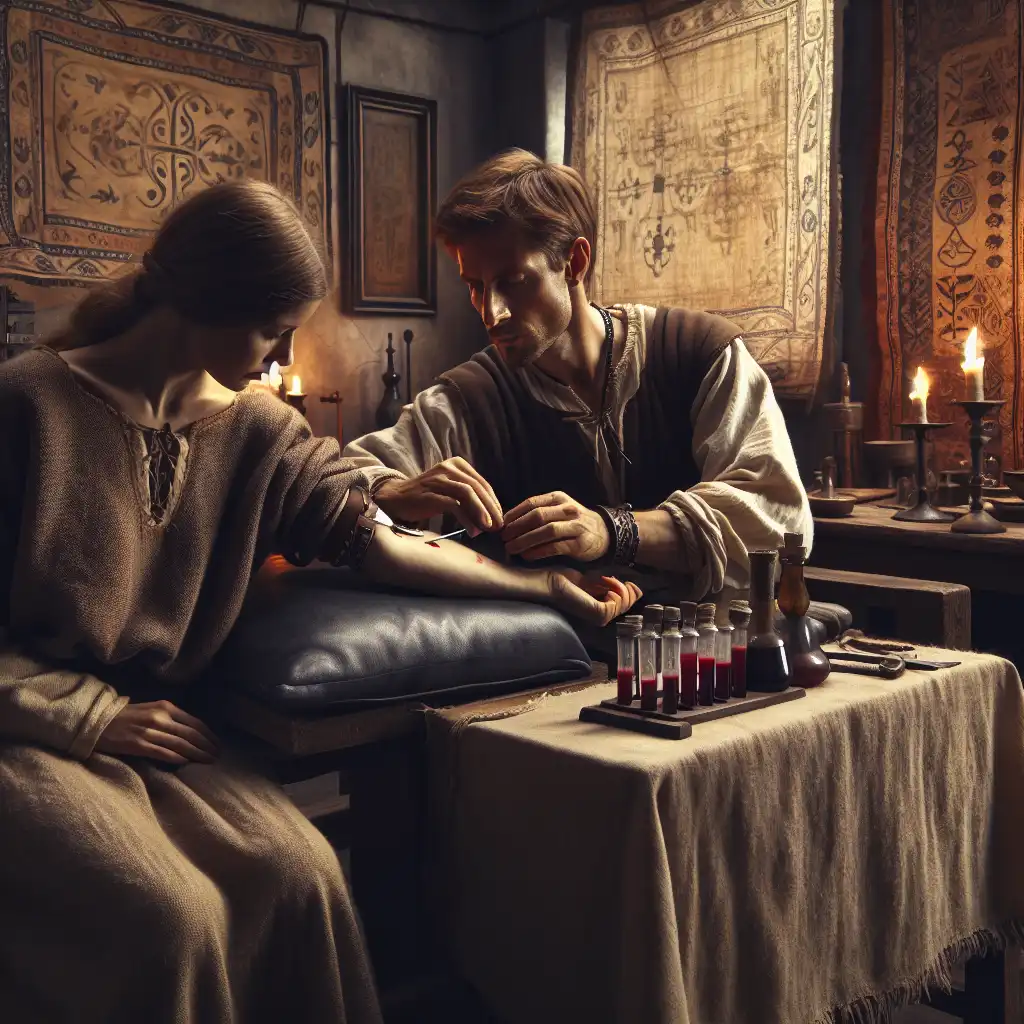
Bloodletting means the act of intentionally taking a person's blood out of their body, usually for medical reasons to treat various health problems. People used to believe that removing "bad blood" would cure or prevent illnesses. Today, the practice is rare and used only in certain medical situations. The word "bloodletting" can also be used figuratively to describe a situation where someone is causing harm or destruction, draining life or resources, or causing issues that need to be stopped.
Both bleed and bloodletting involve the letting out of blood from the body, but the usage of the two words is slightly different.
Bleed is a more general term that can refer to any instance of blood leaving the body, whether it is due to an injury or a medical procedure.
For example, if someone gets a cut on their finger and blood comes out, they are bleeding.
Bleed can refer to any instance of blood leaving the body, while bloodletting specifically refers to the intentional removal of blood for medical purposes.
Crucifixion is a method of execution where a person is nailed or tied to a cross and left to die. It was commonly used in ancient times as a form of punishment, particularly in the Roman Empire.
Bloodletting is applicable in the context of medical history and the study of outdated medical practices. Crucifixion is applicable in the context of history and the study of ancient methods of punishment.
Both bloodletting and phlebotomy refer to the act of removing blood from a person's body.
Phlebotomy, on the other hand, specifically refers to the modern medical practice of using a needle to withdraw blood from a vein.
Phlebotomy is typically performed for medical purposes, such as testing for diseases or monitoring a person's health. Bloodletting is not commonly used in modern medicine and is mainly found in historical contexts.
In Olympia, Washington, many of us were writing songs that were the equivalent of bloodletting: This is the sound a wound makes; this is the screech of a scar. But Mary Timony was always more kaleidoscope than microscope, creating magical worlds replete with weaponry or sorcery.
Afghans long ago resigned themselves to this sort of thing. Compromises must be made. Deals with the devil are better than ceaseless butchery. In the exigencies of post-conflict bygones, against the threat of collapse into more terrible bloodletting, the ugliness of realpolitik is the lesser evil.
The art of phlebotomy originated with bloodletting in 1400 B.C., and the modern clinical lab emerged in the 1960s - and it has not fundamentally evolved since then. You go in, sit down, they put a tourniquet on your arm, stick you with a needle, take these tubes and tubes of blood.