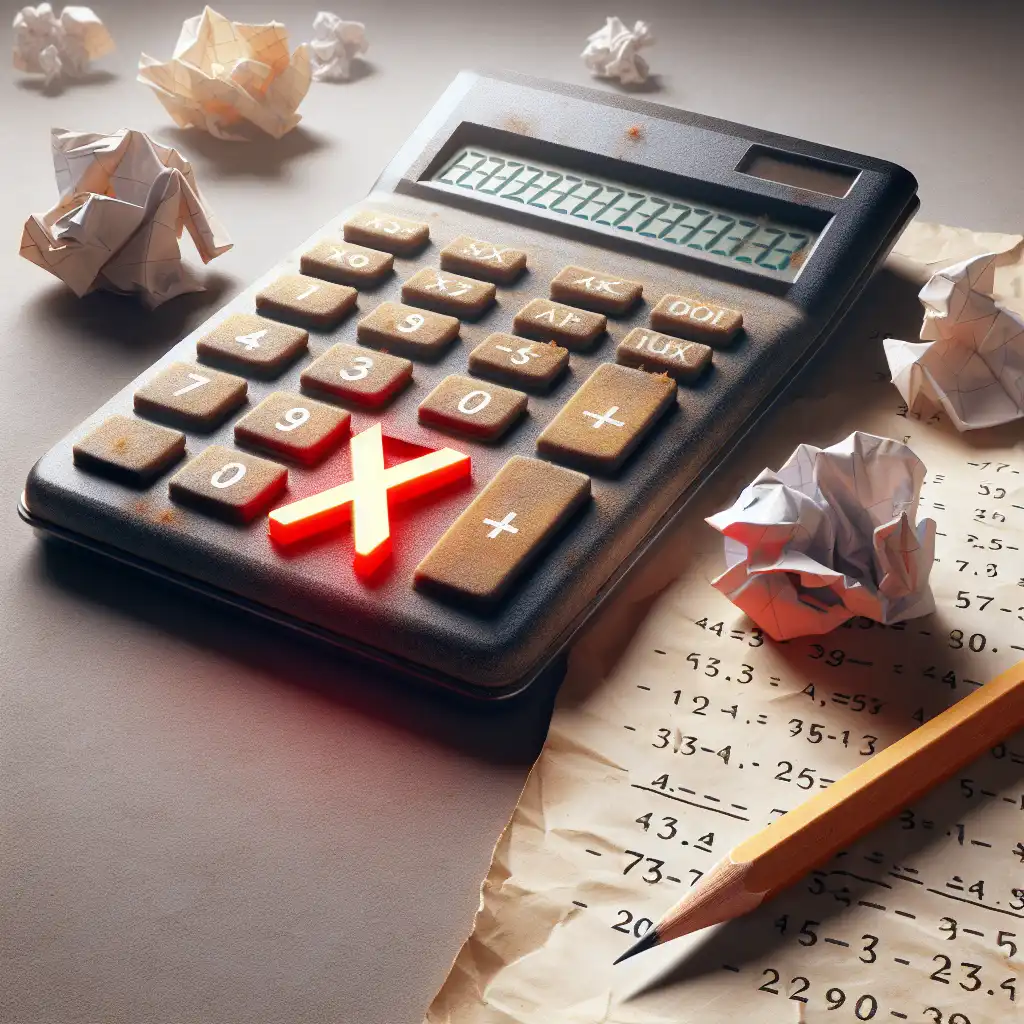
error
noun error
ˈerər
A mistake, something done wrong.
I found an error in my calculation, so all my results were wrong.
error
ˈerər
불러오는 중…
ˈerər
A mistake, something done wrong.
I found an error in my calculation, so all my results were wrong.

ˈerər
Inaccuracies in data or measurement.
Due to the experimental error, the results are not reliable.
ˈerər
A computer-related mistake or difficulty.
The programming error caused the application to crash.

ˈerər
In baseball, a misplay by a fielder.
The shortstop committed an error, allowing the runner to reach third base.

ˈerər
The weakness or sinfulness of humanity.
Sin is an error of the human soul.
오디오를 불러오지 못했어요. 잠시 후 다시 시도해 주세요.
The word "error" is usually used when someone makes a mistake or does something wrong. It is commonly used in situations where something has gone wrong, like in a computer program or a game. For example, if you press the wrong button on your phone and it does not work properly, you have made an error. However, it can also be used when someone makes a mistake in writing or speaking, such as using the wrong word or grammar. In school, teachers may use the word "error" when correcting a student's work. It is important to try and learn from one's errors and avoid making the same mistakes again in the future.
Accuracy refers to how close a measurement or calculation is to the true or expected value. It is a measure of correctness or precision.
Accuracy is how correct something is, while error is how wrong something is. For example, if you're shooting an arrow at a target, accuracy would refer to how close your arrow hits the bullseye, while error would refer to how far away your arrow is from the bullseye.
In science and math, accuracy is important when conducting experiments or calculations to ensure that the results are reliable and valid.
단어 열기: Accuracy →A blunder is a careless or stupid mistake, while an error is a mistake made due to lack of knowledge. For example, if you accidentally spill coffee on someone because you weren't paying attention, that's a blunder.
But if you calculate an equation incorrectly because you don't understand a concept, that's an error. Blunders are generally avoidable if you're careful and paying attention, while errors may require additional knowledge or education to avoid.
단어 열기: Blunder →Fallacy refers to a flaw in reasoning or an argument that is based on incorrect assumptions. It is applicable in situations where we use faulty logic or reasoning to make conclusions.
For example, if we assume that all dogs are black because the only dogs we have seen are black, we are committing the fallacy of hasty generalization.
Error refers to a mistake while fallacy refers to a flaw in reasoning.
단어 열기: Fallacy →A fault is a defect or flaw in something. For example, if a computer program has a bug that causes it to crash, that is a fault.
In general, errors are the result of human actions, while faults are the result of problems with technology or systems.
In everyday language, the terms error and fault are often used interchangeably or to describe the same thing.
단어 열기: Fault →Both error and glitch refer to problems or issues that occur within a system or process.
A glitch typically refers to a problem or fault that occurs within a system or technology.
Glitches can happen for a variety of reasons, such as software bugs or hardware malfunctions.
For example, if a video game started to freeze or show graphical issues, this could be considered a glitch.
An error is a mistake made by a person, while a glitch is a problem or fault that occurs within a system or technology.
단어 열기: Glitch →Goof describes a smaller, less serious mistake, such as when you accidentally spill coffee on your shirt or forget someone's name.
Error is applicable in more formal or serious situations, while goof is a more casual term for minor mistakes.
단어 열기: Goof →Miscalculate is more specifically related to math or calculations. It means to make a mistake in a mathematical calculation or estimate.
However, if you calculate the amount of paint you need to paint a room and get the wrong amount, that would be a miscalculation.
In summary, errors can refer to any kind of mistake, while miscalculations specifically refer to mistakes in calculations or estimates.
단어 열기: Miscalculate →Misconception refers to a wrong belief or understanding that a person has about something.
An error is a mistake while a misconception is a wrong belief or understanding. Errors happen when something is done incorrectly while misconceptions occur when something is misunderstood or misinterpreted.
단어 열기: Misconception →The words error and mistake are quite similar in meaning.
However, error usually refers to something that is done incorrectly because of a lack of knowledge or understanding, while mistake refers to a wrong action or decision made based on faulty judgment or misunderstanding.
For example, if someone solves a math problem incorrectly because they don't know the formula, that would be an error. If someone makes a decision to invest in a stock that later becomes worthless, that would be a mistake made due to faulty judgment.
Error tends to be more technical and scientific, while mistake is used in more everyday situations. But both words can be used interchangeably depending on the context.
단어 열기: Mistake →It can be a factual, technical or judgmental lapse. Misunderstanding refers to a failure to properly grasp or interpret something that has been communicated.
Misunderstandings can range from situations as simple as a misheard word in conversation causing confusion, to larger issues such as cultural differences leading to misunderstandings in communication.
An error implies that something was done wrong, while a misunderstanding implies that something was not properly understood.
It's important to differentiate between the two, as they require different approaches to correct them. For an error, we need to find a solution to rectify the mistake, while for a misunderstanding, we need to re-communicate or clarify the intended message.
단어 열기: Misunderstanding →Oversight refers to a failure to notice or recognize a mistake or problem, leading to an unintended outcome.
It can occur due to neglect or omission. For example, forgetting to include a vital piece of information in a report or failing to notice a typo in an email is an oversight.
An error is an action that results in a mistake, while an oversight is a failure to identify or address a mistake. Both terms are applicable in different contexts, but they represent different aspects of making mistakes.
단어 열기: Oversight →And while a more recent study did show that reaction times and errors increase for some bilingual students in cross-language tests, it also showed that the effort and attention needed to switch between languages triggered more activity in, and potentially strengthened the dorsolateral prefrontal cortex.
YouTube에서 보기 ↗To rise from error to truth is rare and beautiful.
Now the idea is simple when we're applying it to coin tosses, but in fact it's not very simple in everyday life. People are horrible at estimating both of these things, and that's what I want to talk to you about today. There are two kinds of errors people make when trying to decide
YouTube에서 보기 ↗It is error alone which needs the support of government. Truth can stand by itself.
the underwater passage leaves no room for error add a turn the rat finds a pocket of air just enough to help it push on to the end of the line how does it collapse its body like that
YouTube에서 보기 ↗Knowledge rests not upon truth alone, but upon error also.
was no margin for error somebody asked me once what are you looking for in a relationship and I replied certainty I needed certainty in an uncertain world but we live in an
YouTube에서 보기 ↗From the errors of others, a wise man corrects his own.
strange child I'm not really sure how I know how to put a skeleton together but there's so few textbooks and there's actually nobody out there who can do this it's a case of learning through trial and error if just getting life for us it's just a knack it's some people are very good at maybe bird-watching I guess mine is knowing how to put skeletons together I think my superpower
YouTube에서 보기 ↗Science in the modern world has many uses; its chief use, however, is to provide long words to cover the errors of the rich.
While criticized at the time by their respective governments for bargaining with the enemy, contemporary historical analysis shows great admiration for Kennedy's and Khrushchev's ability to diplomatically solve the crisis. But the disturbing lesson was that a slight communication error,
YouTube에서 보기 ↗Nine times out of ten, in the arts as in life, there is actually no truth to be discovered; there is only error to be exposed.
Humor is subjective. Comedy is trial and error. Writing is rewriting. Just keep trying. Find the flaws, discover the details, insert incongruities, incorporate k-words, and remember the most important rule of writing have fun.
YouTube에서 보기 ↗It is one thing to show a man that he is in an error, and another to put him in possession of the truth.
Today glasses can help millions of people with poor vision due to uncorrected refractive errors. The key to understanding what that means lies with the term refraction, the ability of a transparent medium like glass, water,
YouTube에서 보기 ↗To make no mistakes is not in the power of man; but from their errors and mistakes the wise and good learn wisdom for the future.
They collected the local flora and fed samples to lab rats, but struggled to replicate the effect. So they decided to directly observe the sheep with one scientist even living with the herd for three summers. After a decade of trial and error the scientists finally found the culprit,
YouTube에서 보기 ↗If you shut the door to all errors, truth will be shut out.
The space efficient comb that is a bee's trademark today, is probably the result of this trial and error, but over long periods of evolutionary history. However it paid off. Peek into any hive -- with your protective goggles and netting on of course --
YouTube에서 보기 ↗To kill an error is as good a service as, and sometimes even better than, the establishing of a new truth or fact.