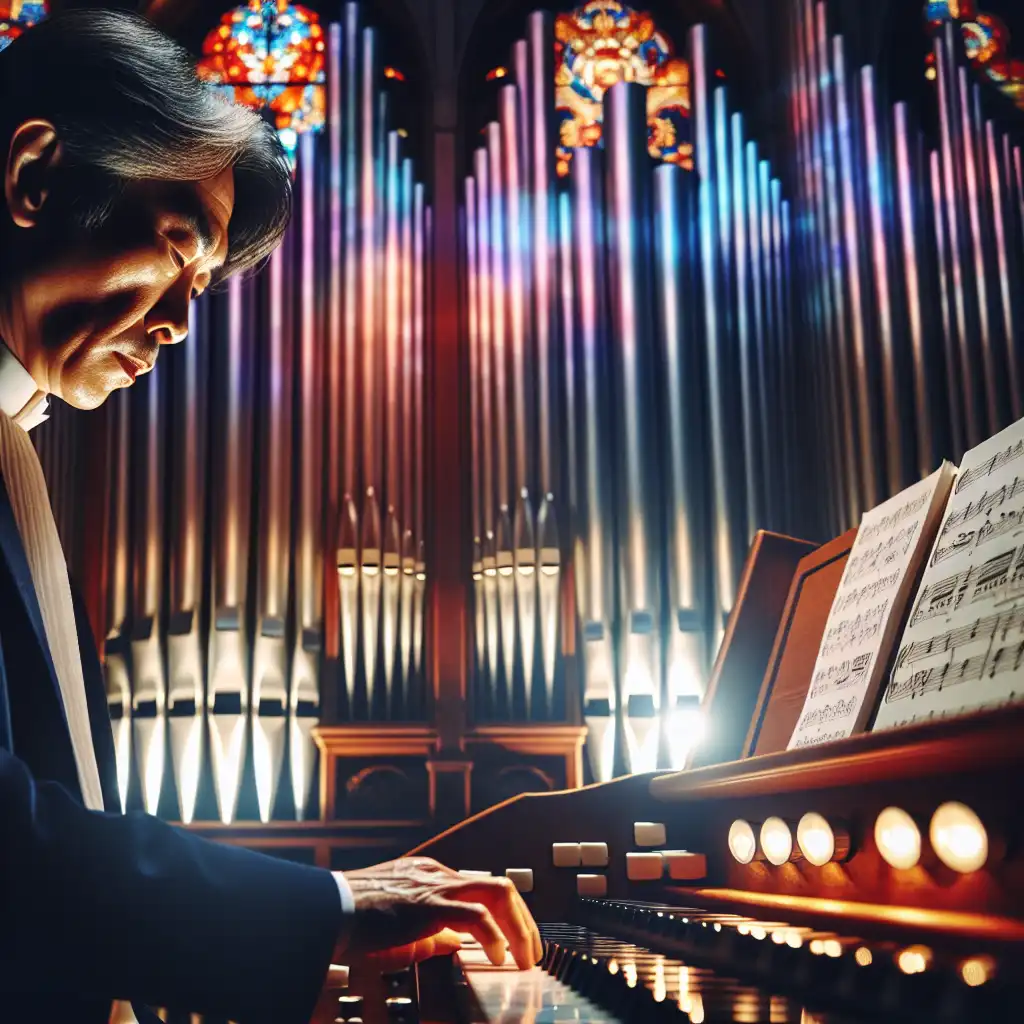
organist
noun organist
ˈɔːrɡənɪst
A person who plays the organ, especially as a job in a church.
The church organist will be performing a special selection of hymns this Sunday.
organist
ˈɔːrɡənɪst
लोड हो रहा है…
ˈɔːrɡənɪst
A person who plays the organ, especially as a job in a church.
The church organist will be performing a special selection of hymns this Sunday.
ऑडियो लोड नहीं हो सका। कृपया बाद में फिर कोशिश करें।
An organist is someone who plays the organ, a musical instrument that makes sound by blowing air through pipes. Organists can play in churches, theaters, and concert halls. They use their hands and feet to play the keys and pedals on the organ, creating beautiful and complex music. If you see someone playing the organ, you can refer to them as an organist!
An accompanist is a musician who accompanies a singer or another musician, usually on the piano or another instrument. They usually play along with the melody of the song.
An accompanist can play various instruments to accompany any musical performance, while an organist plays a specific instrument, the organ.
An accompanist can be applicable in any musical setting that requires accompaniment, while an organist is applicable in settings that have an organ, such as churches or concert halls.
शब्द खोलें: Accompanist →An artist is a person who creates art, which can include painting, drawing, sculpture, and other forms of visual media, as well as performing arts like music, dance, and theater.
An artist creates art, while an organist plays the organ.
Artists can work in a variety of media and settings, while organists typically play in churches.
शब्द खोलें: Artist →Maestro is a title for a brilliant musician or conductor who leads an orchestra or a choir. They are highly respected and have exceptional expertise in music.
A maestro leads large ensembles of musicians, while an organist specializes in playing the organ.
Maestro can be used for various types of music while organist mostly plays organ music.
शब्द खोलें: Maestro →A musician is a general term for someone who plays an instrument or creates music. An organist specifically refers to someone who plays the organ.
The term musician can be applied to anyone who plays an instrument, such as a guitar or piano.
Think of it this way: all organists are musicians, but not all musicians are organists.
शब्द खोलें: Musician →Performer is more general and can refer to someone who plays any musical instrument or engages in any other type of performing art, such as acting or dancing.
In summary, while an organist is a type of performer, performer is a more general term that can refer to a wider variety of performing arts.
शब्द खोलें: Performer →A pianist is a musician who plays the piano, a keyboard instrument that produces sound through hammers striking strings.
The main difference between the two is the instrument they play. An organist plays the organ and a pianist plays the piano.
शब्द खोलें: Pianist →A player is a broad term used for someone who plays any musical instrument. This can include pianists, guitarists, violinists, and so on.
Unlike the term organist, the term player can apply to any type of musical instrument.
An organist is a musician who plays the organ, whereas a player is a more general term used for anyone who plays a musical instrument.
शब्द खोलें: Player →A virtuoso is a highly skilled musician who typically performs solo, uses technical mastery and creativity to produce dazzling performances, and showcases their virtuosity through complex and challenging pieces.
A virtuoso is an exceptional musician who is highly skilled at their instrument, while an organist is a musician who specializes in playing the organ.
शब्द खोलें: Virtuoso →had studied as an organist at the Vienna Conservatory, but had given up his love for music to pursue a career in medicine. And that afternoon I had to ask him, "How was it for you making that decision?" And he said that there were still times when he wished he could go back and play the organ the way he used to,
YouTube पर देखें ↗My parents were terrific - mother was a church organist and my father was probably the most respected person in our church outside of the minister and sometimes maybe that much. The neighbors all called him - a gentleman.
so I was gonna doodle is my metier no local homicide on our underwater a dogleg they located even there man she knows not to suppress calles de minuto es el valor comes up to the time of the other organist escapes this is one area
YouTube पर देखें ↗The message of music was also the first thing what I learned from my first teacher. She was an organist too and she was very devoted to what she played, so she had a respect for every piece and she felt that she is not allowed to add something of her own.
Even Catholic parishes today are not wanting for talent. But no serious singer or organist will get anywhere near the typical music program, at least if he wants to retain his self-respect.
When I was growing up, I'd be in the choir. My mum was the organist in the church, so I'd sing in the church.
I worked extremely hard at my craft and at being a good songwriter, being a good guitar player, being a good organist, because I didn't think people would take me seriously.
My grandfather was a church organist and would sing in choirs and was a musical genius to a certain extent.
I use a lot more chords than most organists and I'm careful to phrase them with the guitar.
I grew up in a very religious household. My mom was a church organist. I was a religious kid.
My father was the church organist; the village curate was my mother's brother, a former monk from the order of Pijar, a very well-educated and ascetic man who loved nothing but solitude.
I grew up the son of a Seventh Day Adventist minister, so I was really close to the church and sang church music between sips at my bottle, you know? I sat on the piano bench next to my mother. She was the church organist, so that music is deeply inside of me.