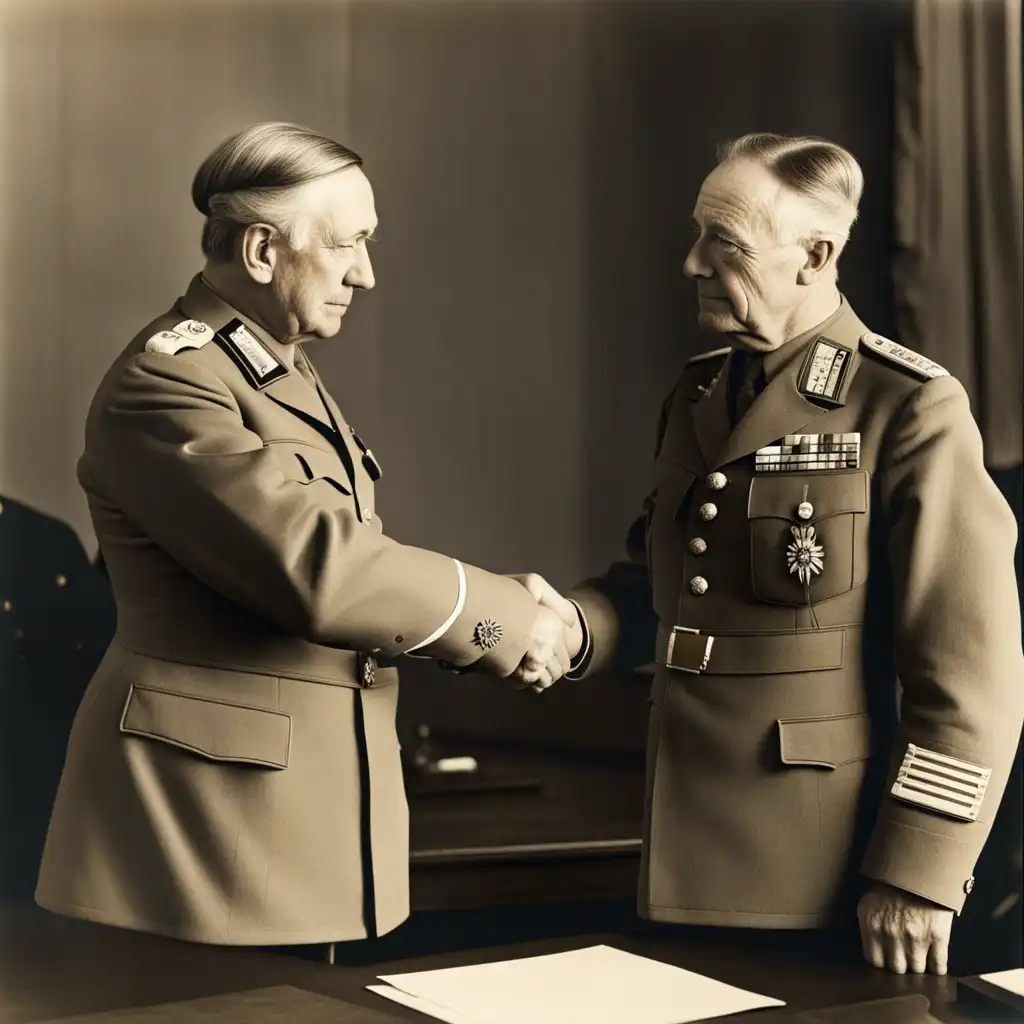
armistice
noun armistice
ˈɑːrmɪstɪs
An agreement made by opposing sides in a conflict, especially a war, to stop fighting for a certain time
The armistice was signed, marking the end of the war.
armistice
ˈɑːrmɪstɪs
加载中…
ˈɑːrmɪstɪs
An agreement made by opposing sides in a conflict, especially a war, to stop fighting for a certain time
The armistice was signed, marking the end of the war.
音频无法加载,请稍后再试。
Armistice means a temporary agreement between warring parties to stop fighting. The word is commonly used to refer to the end of World War I when an armistice was signed on November 11, 1918. Armistice Day is celebrated annually on this day to commemorate the end of the war. The word can also be used in other conflicts where a temporary truce or ceasefire is called for.
Armistice and ceasefire both refer to a temporary halt in fighting between two or more parties involved in a conflict.
A ceasefire is a temporary truce between belligerents to stop fighting for a specific period.
A ceasefire can be unilateral or agreed upon by all parties involved.
For instance, the 2018 border conflict between Israel and Hamas was resolved by a ceasefire.
An armistice signifies a more permanent cessation of warfare, while a ceasefire is a temporary halt in fighting to initiate further negotiations.
打开单词: Ceasefire →A truce is a temporary cessation of hostilities between the warring parties.
A truce may be called for a variety of reasons, such as to allow the wounded to be cared for or to exchange prisoners of war.
An armistice is a more official agreement to stop fighting, while a truce is a more informal pause in fighting. Both are used in wartime to reduce violence and allow for progress towards peace.
打开单词: Truce →and signed an armistice ending the fighting. As its imperial government collapsed, civil unrest and worker strikes spread across the nation. Fearing a Communist revolution, major parties joined to suppress the uprisings,
在 YouTube 上观看 ↗As well as remembering the service of the non-white soldiers and auxiliaries of the first world war, we have also to remember what happened to them and their dreams of justice in the months and years after the armistice.
I grew up in South Korea. To us North Korea was always the enemy, even before I was born. South and North have been under armistice for 63 years,
在 YouTube 上观看 ↗When my elders mentioned 'The War,' they invariably meant that of 1914-1918, even after 1939, for the Second World War was merely the continuation of the first, 'an armistice of 20 years,' as Marshal Foch had accurately predicted at the Versailles Peace Conference, with some changes of side.
When the armistice was declared American forces had fought their way to Sedan.
I hate phone calls, so I believe in a telephone armistice. To me, the idea of calling someone unprompted is basically saying, 'Hey, stop whatever you're doing and talk to me right now.' If you find yourself in the middle of something, getting an unprompted annoyance is incredibly frustrating.
In 1953, after the armistice ending the Korean War, South Korea lay in ruins. President Eisenhower was eager to put an end to hostilities that had left his predecessor deeply unpopular, and the war ended in an uneasy stalemate.