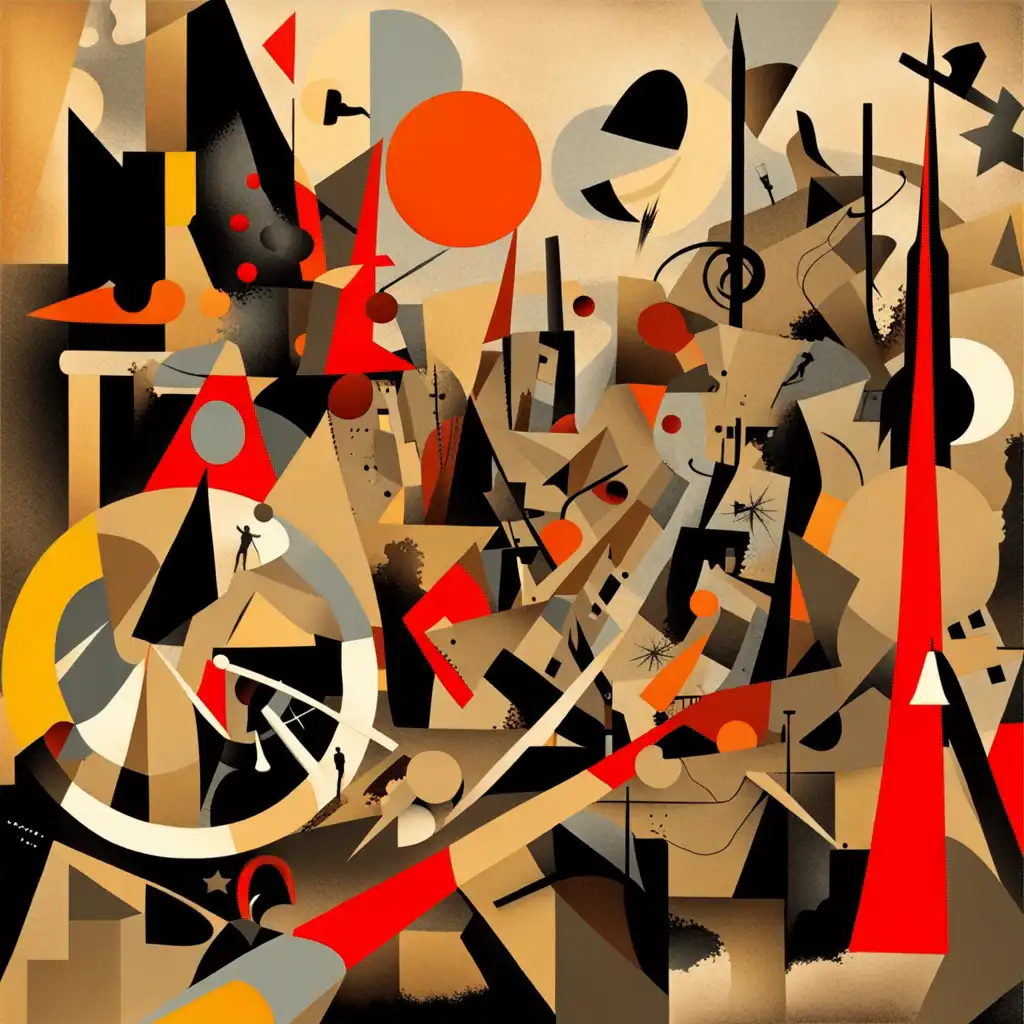
dada
noun dada
ˈdɑːdɑː
An art movement in the 20th century that focused on the irrational and absurd.
Dada art was a reaction to the horrors of World War I.
dada
ˈdɑːdɑː
Loading…
ˈdɑːdɑː
An art movement in the 20th century that focused on the irrational and absurd.
Dada art was a reaction to the horrors of World War I.

ˈdɑːdɑː
A term used by young children for their father.
The little girl cheered as she saw her dada coming home.
Audio could not be loaded. Please try again later.
The word 'dada' can have different meanings in different situations. In some cultures, 'dada' is a word used for a father or daddy. In the art world, 'dada' refers to an artistic movement that started in the early 20th century which was known for its unconventional and playful style. 'Dada' can also be an expression of surprise, confusion or nonsense. It is important to consider the context and cultural significance of the word before using it.
Both words - absurd and dada - are associated with bizarre and unconventional ideas, but they have different implications.
Absurd means something that is ridiculous or foolish, and it often refers to a situation that is contrary to common sense or logic but does not necessarily have any deeper meaning behind it.
For example, doing something like wearing a diamond tiara to school would be absurd behavior since it makes no practical sense.
Dadaists embraced absurdity but also sought to challenge traditional ideas and create new forms of expression. For example, a Dada artist might create a sculpture out of found objects, like a bicycle wheel or a urinal.
Therefore, while both absurdity and Dadaism involve unconventional or strange ideas, absurdity is just a quality that can be found in many different contexts, whereas Dadaism is a specific cultural movement and art form.
Open word: Absurd →Impractical refers to something that is not sensible or useful in a given context. It is applicable in situations where a certain course of action or decision is not feasible or realistic based on the available resources, time, or circumstances.
Dada is a term of endearment for a father, while impractical refers to something that is not feasible or realistic in a given context.
Open word: Impractical →Irrational, on the other hand, refers to something that goes against reason or logic.
Dada is applicable in the context of art and cultural movements, while irrational can describe any situation or behavior that is illogical or goes against reason.
For example, a decision that is made without considering all the facts may be considered irrational, whereas a piece of artwork that defies traditional artistic conventions may be considered dada.
Open word: Irrational →Ludicrous means something that is ridiculous, absurd, or completely unreasonable.
It describes something that is particularly extreme or excessive in its absurdity, for example, "The idea of flying to Mars without a spacecraft is ludicrous."
Dada is used to express disbelief or disapproval in a casual way, while ludicrous describes something that is absurd or unreasonable in a more serious or formal way.
Open word: Ludicrous →Dada refers to an art movement that emerged during World War I. It emphasized nonsense, irrationality, and rejection of conventional artistic values.
Nonsense refers to ideas or actions that lack sense or reasoning, and are often considered silly or absurd.
Nonsense, on the other hand, can be used more broadly to describe anything that lacks coherence or logic, including speech, writing, behavior, or ideas.
Open word: Nonsense →Ridiculous, on the other hand, means something that is unreasonable or absurd. It implies that something is so silly or illogical that it's almost laughable.
Dada is more casual and informal, while ridiculous is a more formal and serious word. Dada might be used among friends or in a comedic context, while ridiculous could be used to describe a serious issue or situation that is being handled poorly or in a foolish manner.
Open word: Ridiculous →Senseless refers to something that lacks any logical or comprehensible meaning.
While dada is applicable in the context of art and creativity, senseless can be used in different situations, such as describing an act of violence, a decision that makes no sense, or a statement that is nonsensical.
Open word: Senseless →Silly describes something that is lighthearted, playful, or humorous.
Dada refers to a specific style of art, while silly is a more general term that can be applied to a range of things that are considered to be amusing or trivial.
Open word: Silly →Michael Tilson Thomas:...
Watch on YouTube ↗Dada has always been competitive and respected and I'm excited to design and promote a shoe that represents both of us so well.
Navigating the High Cost...
Watch on YouTube ↗I seriously think Bachchan is more Bengali than any one I know. He's a true Bengali dada. And I'm not saying that because he has a Bengali wife or has spent time in Kolkata. There's more of Rabindranath Tagore's legacy in him than anyone else.
Dada was an extreme protest against the physical side of painting. It was a metaphysical attitude.
Mamata Banerjee and Narendra Modi, the ultimate didi and dada of Indian politics, should really commiserate.