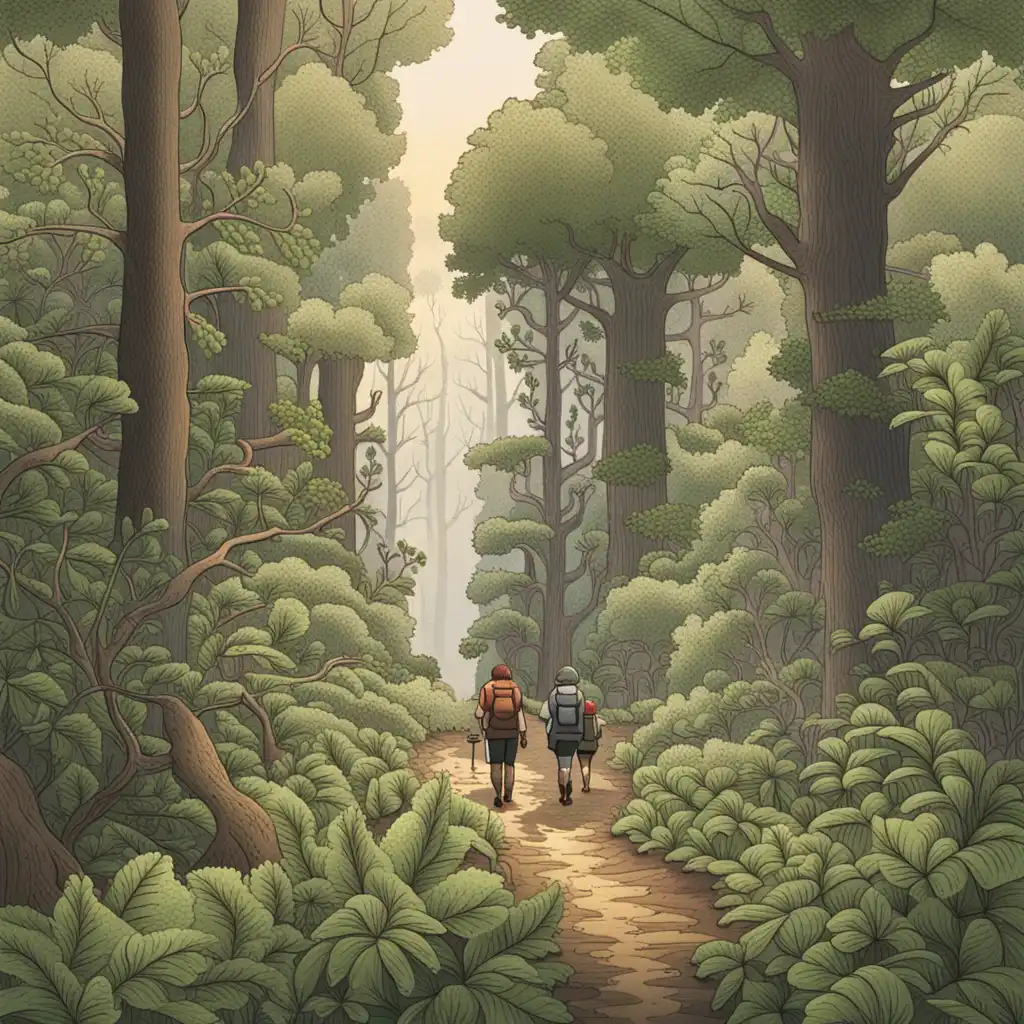
undergrowth
noun undergrowth
ˈʌndərɡrəʊθ
A mixture of small plants, bushes, and trees that grows under taller trees in a forest or jungle.
We struggled to move fast through the dense undergrowth of the rainforest.
undergrowth
ˈʌndərɡrəʊθ
加载中…
ˈʌndərɡrəʊθ
A mixture of small plants, bushes, and trees that grows under taller trees in a forest or jungle.
We struggled to move fast through the dense undergrowth of the rainforest.
音频无法加载,请稍后再试。
'Undergrowth' is a word that is used to describe the small plants and bushes that grow underneath bigger trees and bushes in a forest or jungle. It is also sometimes used to describe the collection of things that is hidden or difficult to see beneath a surface or area, such as the undergrowth of a city's streets or a person's personal issues.
Bracken is a specific type of plant, commonly found in forests, which has large fern-like leaves that grow in clumps.
Undergrowth is a general term that refers to all types of vegetation that grows beneath larger trees or other plants, including bracken but also many other types of plants, such as shrubs and wildflowers.
Bracken is only applicable when referring to that specific type of plant, whereas undergrowth can refer to any and all types of plants growing beneath larger trees.
打开单词: Bracken →Brush refers to the small trees, shrubs or plants that grow closely together in a patch.
It can be found in a forest, garden, or park. The term brush is often used by hikers or hunters to describe the areas with small trees and bushes.
Brush is a patch of small trees and plants that grow together, while undergrowth is the dense growth of plants and trees beneath larger trees.
打开单词: Brush →Brushwood refers specifically to the small branches and twigs that are cut from trees and shrubs for making fences, hedges, or kindling.
It is important to note that brushwood is a man-made product, while undergrowth is a natural occurrence. Brushwood is applicable in construction, fuel, and decoration purposes, while undergrowth is more related to the natural habitat of wildlife and vegetation.
打开单词: Brushwood →Coppice refers to a group of trees that are cut down to a few inches above the ground every few years to promote new growth.
Coppice refers to trees that are deliberately cut down to promote new growth, whereas undergrowth refers to the small plants and bushes that grow beneath the trees in a forest.
打开单词: Coppice →Scrub refers to small bushes, trees or plants that grow in an area where trees have been cut down or where the environment is harsh.
Scrub can be low-growing or sometimes taller, but they are still smaller than full-grown trees.
Scrub is often found in dry, rocky or sandy areas, and can survive in places where it's difficult for other plants to grow.
Scrub is a group of smaller,hardy plants that grow in harsh environments like deserts, while undergrowth is a variety of vegetation that grows beneath the tall trees in a forest.
打开单词: Scrub →Shrubbery refers to a collection of small to medium-sized woody plants, like bushes or shrubs, that are planted and maintained in a garden or landscape.
Shrubbery is applicable in a more controlled or designed setting, while undergrowth is applicable in a natural or wild setting.
打开单词: Shrubbery →Thicket and undergrowth are both words used to describe the vegetation in a forest.
A thicket refers to a dense growth of bushes, shrubs, or small trees, which are closely packed together.
Thicket describes a dense growth of larger plants that can be difficult to pass through, while undergrowth refers to the smaller plants that grow beneath the trees in a forest.
打开单词: Thicket →Underbrush and undergrowth are both terms used to describe the plants and vegetation that grow below the trees in a forest or wooded area.
Underbrush refers to the shorter and smaller plants, shrubs, and bushes that grow beneath the trees. These are usually less than six feet tall and include plants like berry bushes, ferns, and low-growing saplings.
Undergrowth refers to the entire layer of vegetation that grows beneath the trees, including both the underbrush and larger plants like trees, saplings, and vines.
The main difference between underbrush and undergrowth is that underbrush specifically refers to the smaller plants in the undergrowth layer, while undergrowth encompasses all the vegetation growing beneath the trees.
Both terms can be used interchangeably, but underbrush is typically used when describing the smaller plants, while undergrowth is used when referring to the entire layer of vegetation.
打开单词: Underbrush →The Unsinkable Lizard %\PIPE%...
在 YouTube 上观看 ↗A year in the life of...
在 YouTube 上观看 ↗Safari Live - Day 288 %\PIPE%...
在 YouTube 上观看 ↗Thomas P. Campbell:...
在 YouTube 上观看 ↗Sir David Attenborough...
在 YouTube 上观看 ↗Wild Beavers Return...
在 YouTube 上观看 ↗4 Adorable Animals That...
在 YouTube 上观看 ↗Discovering Wildlife in...
在 YouTube 上观看 ↗Reintroducing The...
在 YouTube 上观看 ↗Life of Insects %\PIPE%...
在 YouTube 上观看 ↗