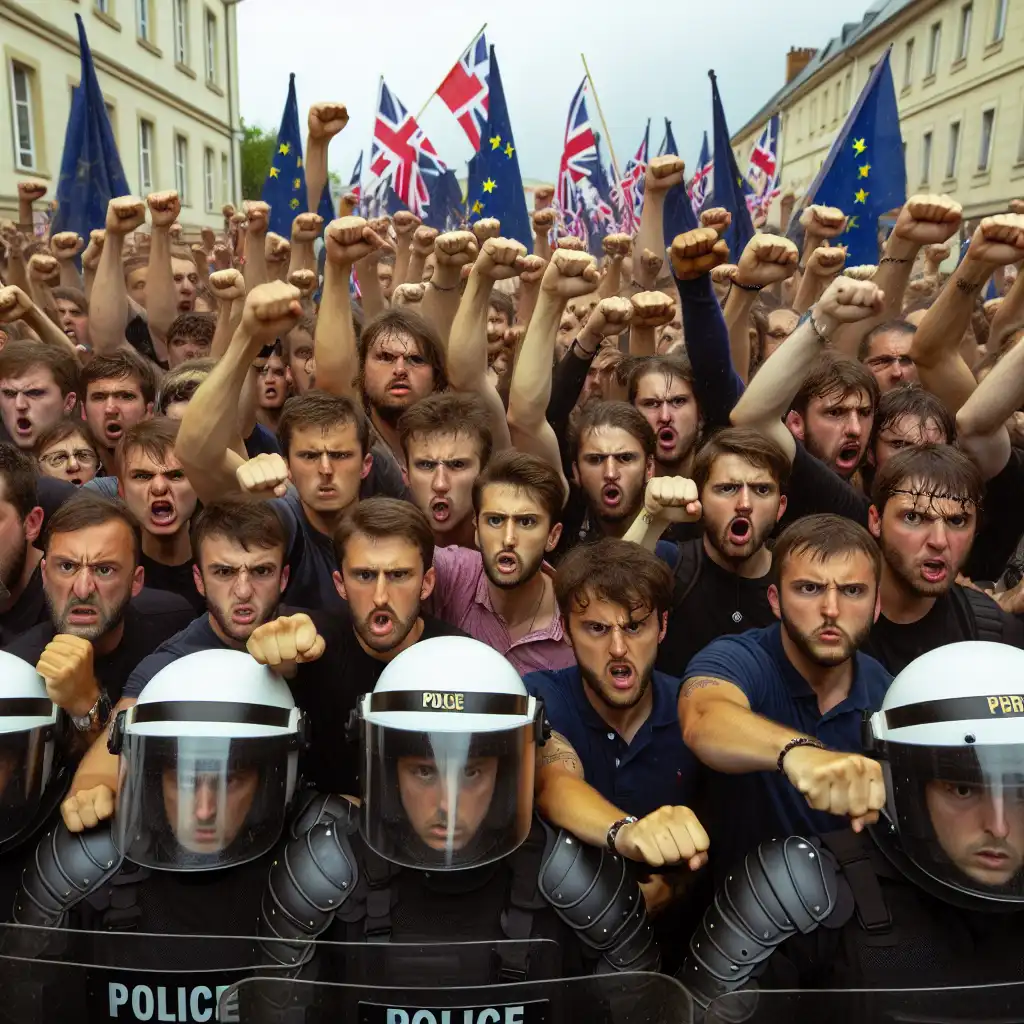
militancy
noun militancy
ˈmɪlɪtənsi
The use of confrontational or violent methods in support of a political or social cause.
The government was concerned about the growing militancy among protesters.
militancy
ˈmɪlɪtənsi
Loading…
ˈmɪlɪtənsi
The use of confrontational or violent methods in support of a political or social cause.
The government was concerned about the growing militancy among protesters.

ˈmɪlɪtənsi
The state of being combative or aggressive in attitude.
He expressed his opinions with an unexpected militancy.
Audio could not be loaded. Please try again later.
The word 'militancy' refers to the aggressive or confrontational behavior of people who strongly believe in a particular cause or purpose. It is often used in the context of politics, social issues, and activism. When someone is described as being 'militant,' it means that they are not afraid to take bold or forceful actions to achieve their goals. This word is commonly used in news reports and discussions about protests, demonstrations, and other forms of activism.
Activism refers to taking action to bring about social or political change through peaceful means, such as protests, petitions, letter-writing campaigns, and other forms of nonviolent resistance.
Activism is applicable when people want to bring about change in a peaceful and nonviolent way, and when they believe that they can achieve their goals through persuasive means.
Open word: Activism →Aggressive refers to a strong and forceful behavior towards someone or something, while militancy refers to a willingness to use extreme or violent measures to achieve a particular goal or objective.
Aggressive is applicable in situations where a person is acting in a forceful way to achieve their goals, but not necessarily using violent or extreme means.
For example, a salesperson might use aggressive tactics to sell their product, such as intense persuasion or pushing, but they are not using violence or force.
Open word: Aggressive →Belligerence refers to a combative or aggressive attitude or behavior towards others. It often describes someone who is eager to start a fight or conflict.
So, while belligerence describes an individual's attitude towards others, militancy describes the approach taken by a larger group or organization towards achieving their objectives.
Open word: Belligerence →Extremism refers to holding strong opinions and beliefs that are far outside of what is considered normal or acceptable by society.
Extremism refers to extreme beliefs and opinions, while militancy involves using violence to achieve those beliefs or goals.
Open word: Extremism →Fanaticism refers to extreme and obsessive devotion to a belief or cause, often to the point of intolerance towards those who do not share the same beliefs.
Fanaticism is characterized by extreme devotion to a belief, while militancy is characterized by aggressive and confrontational methods to achieve a goal.
Open word: Fanaticism →Hostility refers to a feeling of strong dislike or anger towards someone or something.
Hostility can occur in personal relationships or between groups of people.
Hostility is a negative feeling or attitude, while militancy is a proactive approach to achieving a goal or idea.
Hostility could be applicable in personal situations, while militancy is more often associated with social or political movements.
Open word: Hostility →Pugnacity refers to a natural tendency or inclination to fight or be combative in any situation, regardless of context or goal.
Militancy is applicable when discussing organized groups or movements and their approach to achieving their goals, while pugnacity is applicable when discussing individual behavior and tendencies towards aggression.
Open word: Pugnacity →Radical refers to extreme or fundamental action or ideas outside the traditional norms. It suggests progressive beliefs or thoughts that seek to fundamentally change the status quo or social order.
However, militancy is more focused on action and tactics, while radical deals with ideology and beliefs.
Open word: Radical →Except for teachers, who are 'controlled' as far as his militancy is concerned, good jobs are rare for Negroes.
The militancy of men, through all the centuries, has drenched the world with blood. The militancy of women has harmed no human life save the lives of those who fought the battle of righteousness.
In some cases non-violence requires more militancy than violence.
U.S. analysts estimate that Russian military expenditures have tripled during the Bush-Putin years, in large measure a predicted reaction to the Bush administration's militancy and aggressiveness.
Traditional Islam is a mixture of all obedience to Allah, and if that requires militancy, so be it.
You can have relatively high levels of class consciousness with a lower level of class militancy than one would have expected.
One of the tragedies of the struggle against racism is that up to now there has been no national organization which could speak to the growing militancy of young black people in the urban ghetto.
After so many cases of terror attacks related to Islamic militancy remaining unresolved in the last few years, the government has no moral authority to stay in power.
We condemn all shades and hues of terrorism and militancy and want to cooperate with India to fight this menace.
Accepting that Arabs have the right to elect their own leaders means accepting the rise of governments that do not share America's pro-Israel militancy.