joust
noun joust
dʒaʊst
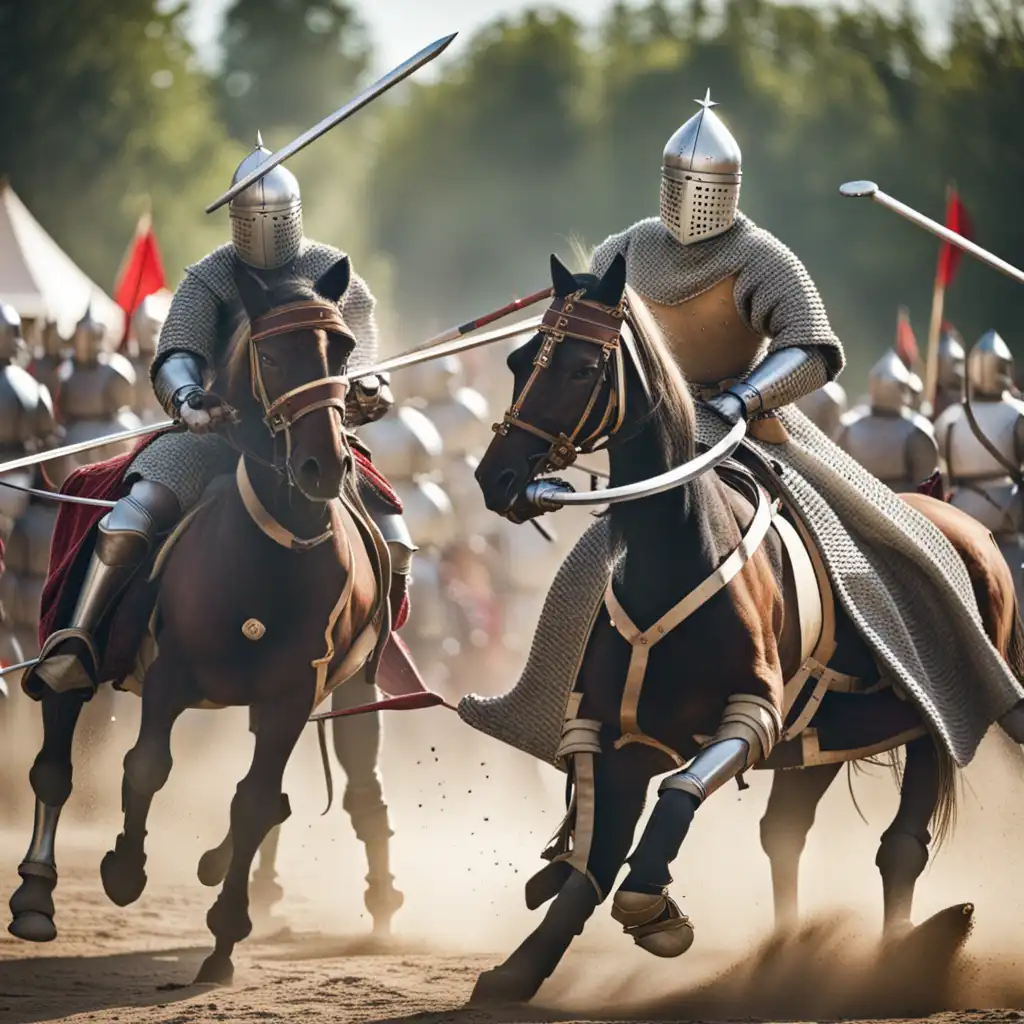
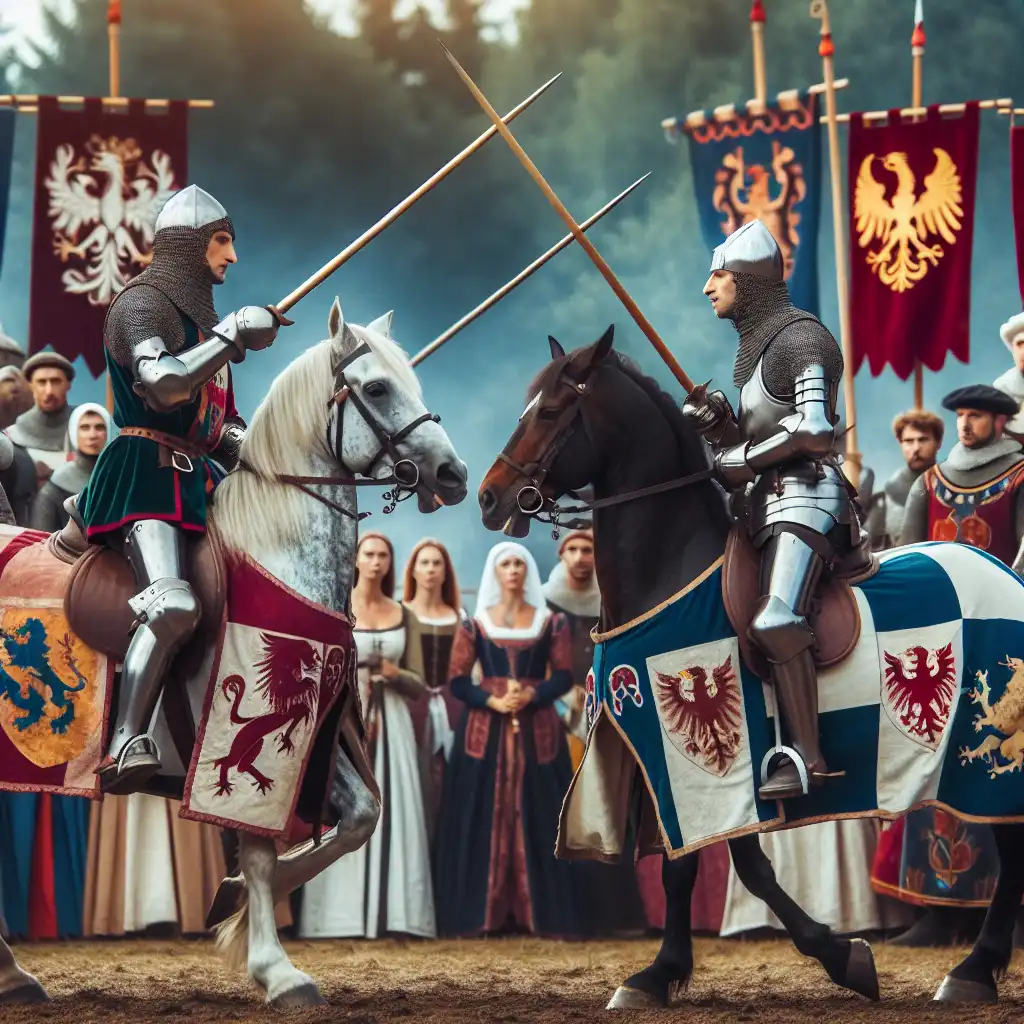
A fight that happened in history between two horsemen with lances.
In the medieval times, knights used to participate in jousts.
joust
dʒaʊst
불러오는 중…
dʒaʊst
A fight that happened in history between two horsemen with lances.
In the medieval times, knights used to participate in jousts.

dʒaʊst
To fight someone, in games or politics for example, especially by trying to be better than them.
The two candidates jousted fiercely in the presidential debate.
dʒaʊst
A friendly argument or competition.
They had a joust to see who could finish their tasks first.
오디오를 불러오지 못했어요. 잠시 후 다시 시도해 주세요.
The word 'joust' means to engage in a medieval competition between two horse riders with lances. Nowadays, 'jousting' is also used as a verb to describe any friendly or competitive conflict or competition between two parties. People may use it figuratively to describe a heated debate or contest. For example, one can say, "The two politicians josted over healthcare reform in a lively debate."
Battle typically refers to a violent conflict between two or more large groups or armies, often resulting in significant destruction and loss of life.
A battle usually involves weapons such as guns, swords, or bombs, and there are typically many people involved.
So, in short, a battle involves large groups of people engaged in a violent conflict, while a joust involves two knights competing in a ritualized competition.
단어 열기: Battle →Clash and joust are both words that refer to some kind of confrontation or competition, but they have different connotations and are used in different contexts.
Clash typically refers to a conflict or battle, often between two groups or individuals with opposing views or goals.
For example, two armies might clash on a battlefield, or two politicians might clash in a debate.
It can also be used more metaphorically to describe any sort of competitive exchange or clash of ideas, but it usually retains a sense of chivalry or honor.
Clash is generally used to describe a more aggressive or violent confrontation, while joust tends to be used in a more lighthearted or romanticized way to describe a type of competition.
단어 열기: Clash →Combat generally refers to a fight or battle between two or more opponents, with the intention of defeating or subduing the other.
Combat is a broader term that encompasses all kinds of fights, while a joust is a specific type of fight that involves knights charging at each other on horses.
단어 열기: Combat →Contest refers to a competition or a challenge where people compete to see who is the best at something. This can be anything from running a race to solving a puzzle.
So, while both words describe competitions, contest is a more general term that can refer to any type of competition, while joust specifically refers to a historical combat sport.
단어 열기: Contest →A duel refers to a fight between two individuals with weapons, usually as a result of a personal conflict or challenge.
Duels are not legal in most places anymore and are generally considered to be illegal and dangerous. Jousts are usually performed for entertainment and in medieval times, were a popular form of competition.
The main difference between duel and joust is that a duel involves fighting while a joust is a competition.
단어 열기: Duel →Encounter refers to a meeting or a chance meeting of two parties, which could be friendly or hostile.
Encounter is a more general term for any kind of meeting, while joust specifically implies a competitive or combat-based interaction.
단어 열기: Encounter →Skirmish, on the other hand, refers to a small or brief fight or battle, often involving small groups.
It can be used to refer to a minor conflict between opposing forces, such as a military skirmish, or a verbal disagreement between individuals.
Joust describes a more formal, organized, and competitive situation, while skirmish describes a more chaotic and perhaps less structured fight or conflict.
단어 열기: Skirmish →Tournament also involves competition, but it refers to a larger event with several participants competing in different types of contests or games.
A tournament could last several days and attract crowds from all over.
To summarize, jousting is a one-on-one competition between knights on horseback, while a tournament is a larger event with multiple participants playing different games or contests, including jousting.
단어 열기: Tournament →After centuries of war, the world’s kingdoms have come to an agreement. Every five years teams representing the elves goblins and treefolk will compete in a grand tournament of dragon jousting.
YouTube에서 보기 ↗I love the urgency of what we do. I like the battles that take place, the jousting.
a little girl break it again you broke it at the handle let's put on the big latch with big shields give me the short one that makes it fair and powdery guys a chance light-armored it was the first kind of jousting to
YouTube에서 보기 ↗Marriage is a blood sport. Marriage is jousting. It's disembowelment. It's just terrible, terrible visceral injuries. It's not for everybody.
So the Hindenburg wasn't you know it was inevitable it was going to go. This is auto-gyro jousting in Malibu in the 30s. The auto-gyro couldn't wait for the invention of the helicopter, but it should have -- it wasn't a big success.
YouTube에서 보기 ↗The Courtroom is a battlefield, and oral argument requires a fair amount of verbal jousting and sparring with the Justices.
I organise my work in the form of a daily diary. Each chapter is strictly chronological but is also monothematic - say, a war, a set of peace negotiations, a joust.
When I first started doing these roasts in the mid '90s, they were a lost art, like jousting or calligraphy. But I feel like roasts help tame the room and let off steam... It's like it's all being handled by professionals.
In place of presidential addresses, stump speeches, or town halls, we have Trump's demagogic mass rallies. In place of the usual jousting between the administration and the press, we have a president who fantasizes on Twitter about physically assaulting CNN.
To be sure, India has achieved enviable success in business services, like the glistening call centers in Bangalore and elsewhere. But in the global jousting for manufacturing jobs, India does not get its share.
Every woman who has left and gone into private practice has done fabulously. So the question is why aren't more women drawn to this field? It's helpful to enjoy the art of advocacy - verbal combat or verbal jousting. I find it telling that so many woman might be horrified, and you know, wouldn't want to do it.