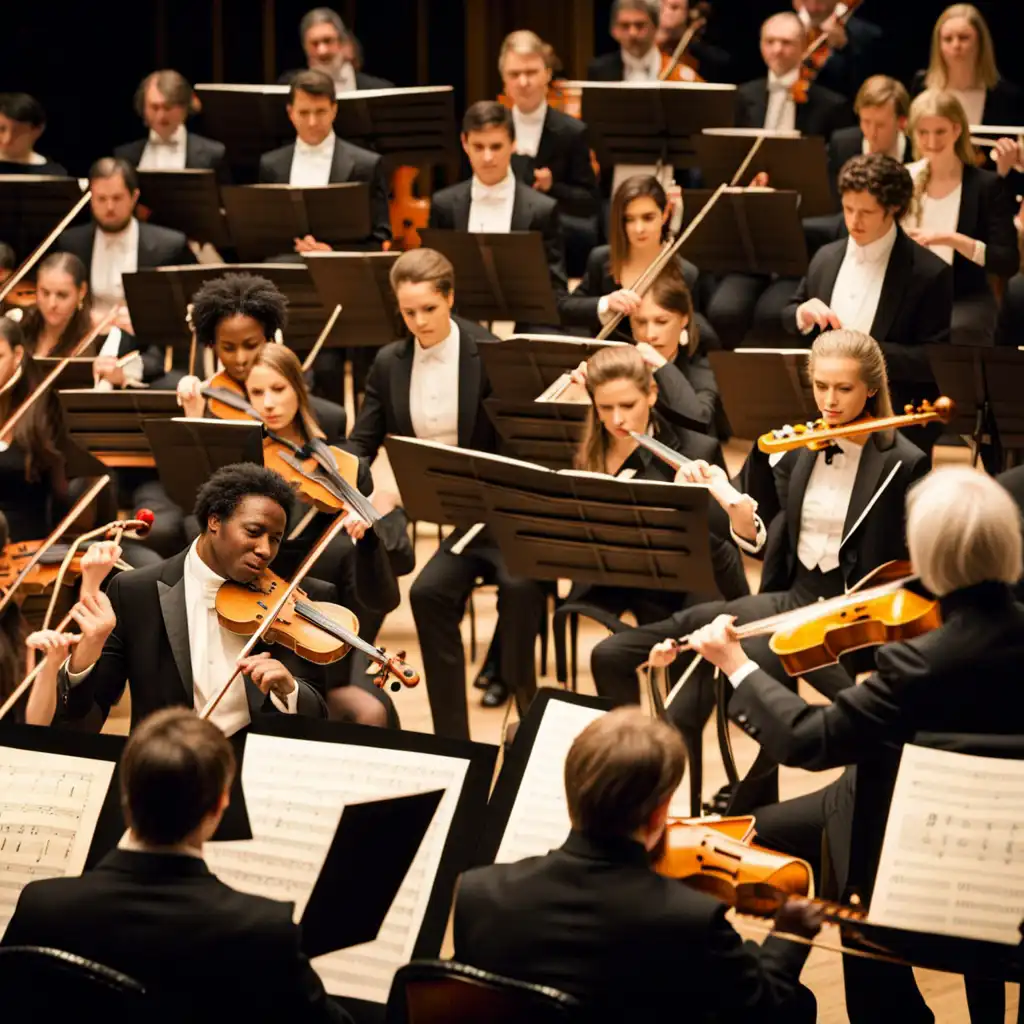
orchestral
adjective orchestral
ɔːrˈkestrəl
related to an orchestra or the kind of music it plays
Beethoven's 5th Symphony is an important piece of orchestral music.
orchestral
ɔːrˈkestrəl
Loading…
ɔːrˈkestrəl
related to an orchestra or the kind of music it plays
Beethoven's 5th Symphony is an important piece of orchestral music.
Audio could not be loaded. Please try again later.
The word 'orchestral' is used to describe something related to an orchestra. An orchestra is a group of musicians who play instruments like violins, cellos, trumpets, and drums together. When we say something is 'orchestral', it means it has the qualities or characteristics of an orchestra. For example, a piece of music could be described as 'orchestral' if it has many different instruments playing together in a harmonious way. Or, a film score could be called 'orchestral' if it uses a large group of musicians playing instruments to create a grand, sweeping sound. So, the word 'orchestral' is used to describe things that are reminiscent of or similar to the way music is played in an orchestra.
Ensemble refers to a group of people playing instruments or singing together, regardless of the type or number of instruments involved.
In simpler terms, ensemble can refer to any group of musicians playing together, while orchestral specifically refers to a larger group playing classical music.
Open word: Ensemble →Harmonic describes musical sounds that are produced simultaneously and sound pleasant together, like when multiple notes are played at once or when a musician plays a chord on a guitar.
Harmonic is about the combination of sounds, while orchestral is about the type of music being played by a group of musicians.
Open word: Harmonic →Instrumental refers to a piece of music that is performed only by instruments, without any vocals or singing. For example, a piano sonata or a guitar duet.
In other words, instrumental music could be played by one or a few musicians, while orchestral music requires a full orchestra.
Open word: Instrumental →Melodic is an adjective used to describe music that has a pleasing, memorable tune or melody. It is applicable when describing a song or a piece of music that has a strong melody.
For example, a catchy pop song with a memorable tune is considered melodic.
Melodic refers to the quality of the tune or melody while orchestral refers to music composed for a large group of musicians playing different instruments.
Open word: Melodic →Musical refers to anything related to music in general while orchestral specifically refers to music played by an orchestra, a large ensemble of musicians who play together.
So, anything related to music can be called musical but only music played by an orchestra can be called 'orchestral.' For example, a pop song can be called musical, but it is not orchestral because it is not played by an orchestra.
A symphony performed by an orchestra is both musical and orchestral.
Open word: Musical →Polyphonic music refers to music that has multiple melodies sounding simultaneously, creating a complex and layered sound.
The main difference between the two is that orchestral refers to music played by a large group of instruments, while polyphonic refers to music with multiple melodies being performed at the same time.
Both words can be applied in different contexts depending on the type of music being played, but orchestral is commonly used in classical music, and polyphonic is often used in genres such as baroque music and choral music.
Open word: Polyphonic →The words orchestral and symphonic are both related to music played by a large group of musicians, usually including strings, woodwinds, brass, and percussion instruments.
Symphonic refers more generally to any type of music that is performed by a large ensemble.
In practical terms, orchestral music is typically more classical and formal, while symphonic music can span different genres and styles, from classical to pop, rock, and film scores.
For example, the music performed by a symphony orchestra could be orchestral or symphonic, or both.
Open word: Symphonic →Tuneful refers to music that has a pleasant melody and is easy on the ear. This can include any genre of music, from pop to classical to country.
Both words describe different aspects of music, with orchestral referring to the performance and instrumentation, and tuneful referring to the quality of the melody.
Orchestral is often used to describe more complex and formal music, while tuneful tends to describe music that is catchy or easy to sing along to.
Open word: Tuneful →but I'm a little less convinced that you share the central passion of my life, a passion for the live professional performing arts, performing arts that represent the orchestral repertoire yes, but jazz as well modern dance opera, theater and more and more and more.
Watch on YouTube ↗I began as a violinist, not a composer. Thus my contact with orchestral musicians, with the source of music, is very important.
you fight anybody who attempted to take her away from us but I'm a little less convinced that you share the central passion of my life a passion for the live professional performing arts performing arts that represent the orchestral repertoire yes but jazz as well modern dance opera theatre and more
Watch on YouTube ↗You need a platform upon which to release an orchestral record, otherwise it's just going to be an obscurity.
tuition scholarship I was able to play the staples of the orchestral and chamber music repertoire with world-renowned conductors and musicians just about every week I even had the opportunity to travel the world and play in the best concert halls throughout to
Watch on YouTube ↗Usually when I am approached to do a score for a horror movie, it's to attempt a repeat performance of what I did way back on 'Hellraiser' or 'Jennifer 8' - one of those really orchestral scores.
but while orchestral is unlikely to
Watch on YouTube ↗Purple - I mean, the music and the influence and the subliminal touches range from orchestral conversation to jazz to blues and soul and God knows what. It's a vast range of expressions.
I'm pleased to say the prince did take the tip from the orchestral performance, and the musicians were reunited with their families. But I think it sums up my talk rather well this, that where there is trust, there is music -- by extension life. Where there is no trust,
Watch on YouTube ↗I feel at home in an orchestral score.
please let's say the Prince did take the tip from the orchestral performance the musicians were reunited with their families but I think it sums up my talk rather well this that where there is trust there is music by extension life where there is no trust the music quite simply withers away
Watch on YouTube ↗The orchestral or symphonic music never interested me.
but while the orchestral is unlikely to
Watch on YouTube ↗I love huge dramatic songs with ridiculously big orchestral parts.
The motif’s inventive repetition is a large part of what makes this piece so memorable, but it’s not the only innovation on display. This was the first major orchestral composition to use trombones,
Watch on YouTube ↗What I love about film music is the variety. On one movie, you might be asked to do a completely electronic score, and then another might ask you to do orchestral only.
the sort of quadruple album and each arm is like a different universe like a different musical space I suppose and that the two songs are just playable from Jesse vol 2 which is quite cosy an acoustic feeling Jesse vol 1 it's like an orchestral record it's really broadened and sort of
Watch on YouTube ↗The baritone can serve functions that the alto and tenor cannot, in orchestral voicing.
while the dancers twitch to the music. These frightening figures enact the ballet’s brutal premise, which set audiences on edge and shattered the conventions of classical music. In these ways and many more, "The Rite of Spring" challenged the orchestral traditions of the 19th century.
Watch on YouTube ↗There's been a tendency to think that TV music has to be cheap and fast and for films it has to be nothing but orchestral music, but it's not right.