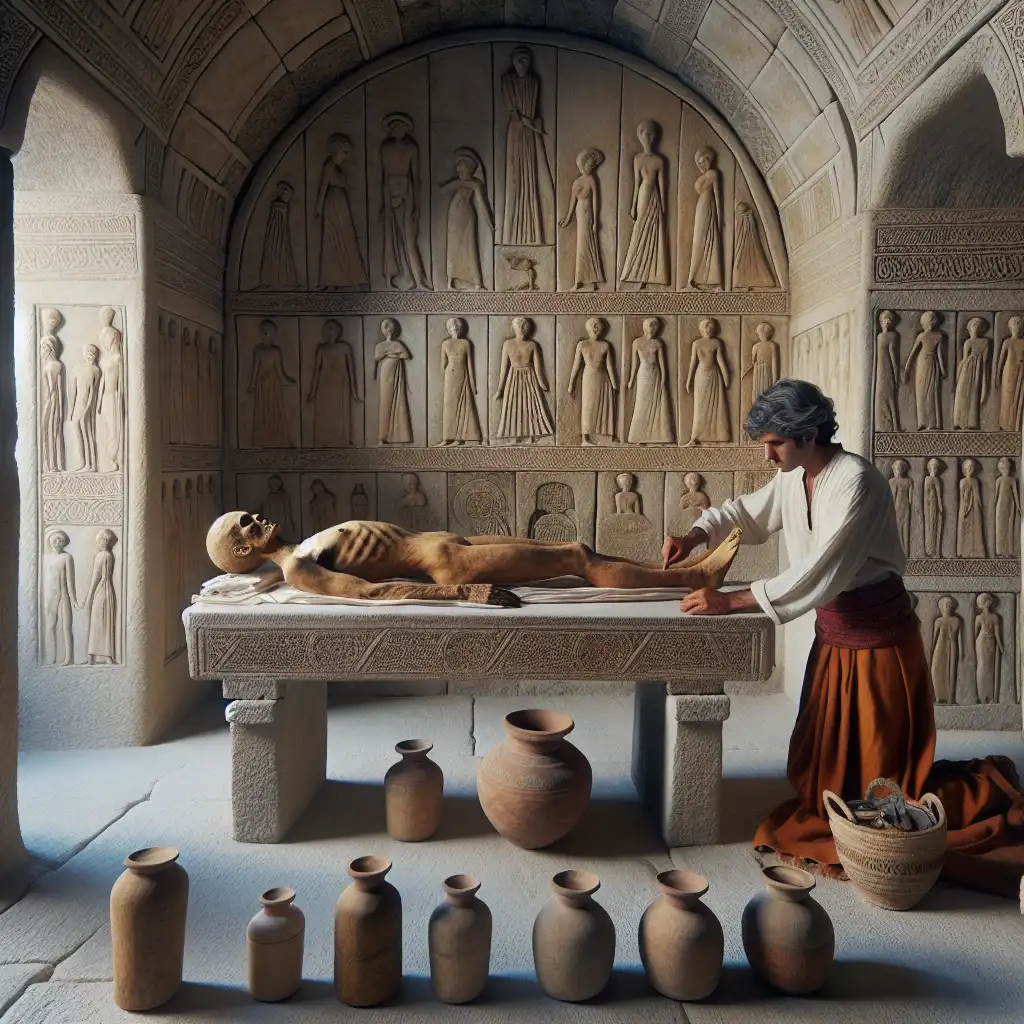
mummify
verb mummify
ˈmʌmɪfaɪ
To preserve a body by treating it with substances that slow decay.
The ancient Egyptians would mummify their dead pharaohs.
mummify
ˈmʌmɪfaɪ
加载中…
ˈmʌmɪfaɪ
To preserve a body by treating it with substances that slow decay.
The ancient Egyptians would mummify their dead pharaohs.

ˈmʌmɪfaɪ
To become very dry and shriveled, like a mummy.
The apple was left so long in the sun that it started to mummify.
音频无法加载,请稍后再试。
Mummify means to preserve a dead body by treating it with chemicals and wrapping it in cloth or bandages. This was done by ancient Egyptians to preserve the bodies of their pharaohs and other important people. Nowadays, mummification is still used in some cultures as part of their burial rituals. The word 'mummify' can also be used to describe something that has been preserved or kept in a similar way for a long period of time.
Conserving refers to preserving something in its original state without altering or changing it. For example, conserving a historical building or conserving endangered animal species means keeping them alive and intact in their natural habitat.
So, conserving is applicable to preserving things that are still alive or in good condition, while mummification is applicable to preserving dead bodies or objects for religious or cultural reasons.
打开单词: Conserve →Dry out often refers to the process where moisture is removed from an object, causing it to become dry. This can be applied to things such as clothes or wet surfaces.
Mummify usually refers to the preservation of a dead body (often in ancient Egypt) by removing its internal organs and then drying it out with salt or other materials.
Dry out describes the removal of moisture from objects, while mummify specifically refers to the process of preserving a dead body.
打开单词: Dry out →Embalm and mummify are both methods of preserving a dead human body, but they are used in different cultures and have different meanings.
Embalm refers to a process in which a chemical solution is used to preserve a body, often for the purpose of preparing it for a funeral or burial.
In summary, embalming is a modern Western process for preserving bodies for funeral purposes, while mummification was a specific practice used by ancient Egyptians for spiritual reasons.
打开单词: Embalm →Enshroud means to cover or wrap something completely, usually referring to a person or object with a cloth or veil. It is applicable in situations such as covering a dead body with a shroud or wrapping a statue with a cloth for protection.
打开单词: Enshroud →Fossilize refers to the process of preservation and hardening of the remains of living organisms. This occurs when the organic material of the organism is slowly replaced by minerals over a long period of time.
打开单词: Fossilize →Hydrate means to add water or moisture to something to keep it fresh or prevent it from drying out. It is applicable when talking about plants, animals, and humans, as all of them need water to stay alive and healthy.
Hydrate means adding moisture to keep something fresh, while mummify means removing all moisture to preserve something forever.
打开单词: Hydrate →Petrify refers to a process of turning something into stone or causing rock to form around or within it, such as fossils.
Mummify is applicable to deceased bodies, while petrify is applicable to both living and non-living things turning into stone.
打开单词: Petrify →Mummify means to preserve a human or animal body using special chemicals and processes. This was a common practice in ancient Egypt, where they believed that preserving the body after death was necessary for the journey to the afterlife.
Preserve means to maintain or keep something in its original state or condition. This can apply to a wide range of things, such as food, artwork, historical documents, or even natural resources like forests or wildlife habitats.
Mummify specifically refers to preserving human or animal bodies using specialized methods, while preserve can refer to the general act of keeping something in its original state or condition.
打开单词: Preserve →The Mummy's Curse %\PIPE% Lost...
在 YouTube 上观看 ↗