causal
adjective causal
ˈkɔːzl
Relating to or showing the cause of something.
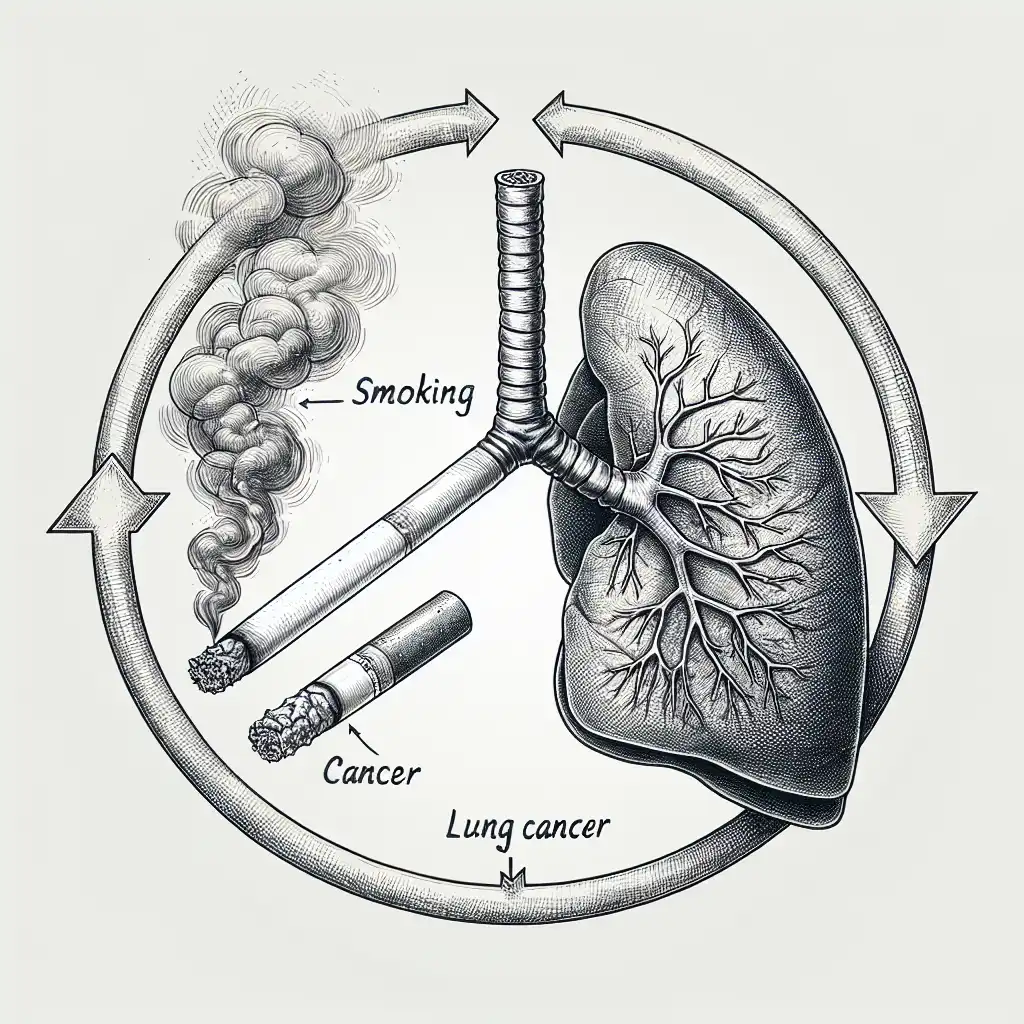
There's a causal link between smoking and lung cancer.
causal
ˈkɔːzl
लोड हो रहा है…
ˈkɔːzl
Relating to or showing the cause of something.
There's a causal link between smoking and lung cancer.

ˈkɔːzl
Being the real reason something happened.
In this philosophical argument, we need to understand the causal agent to understand the end effect.
ऑडियो लोड नहीं हो सका। कृपया बाद में फिर कोशिश करें।
The word 'causal' is used to describe the connection between two things or events - where one thing is the cause of the other thing happening. For example, if you eat too much junk food, the causal effect could be that you become unhealthy. It is useful to use 'causal' when you want to explain why something happened or why someone did something. However, you should be careful when using this word as it is a little more technical and should be used in appropriate situations - not all situations require the use of 'causal'.
Causative means something that is making something else happen. For example, the virus is causative in the development of the flu.
Causal refers to the cause of something, while causative refers to something that produces an effect or outcome.
शब्द खोलें: Causative →Contributory refers to something that helps to bring about a result but may not be the direct cause of that result.
For example, secondhand smoke may be a contributory factor to lung cancer, because it can increase the risk of developing the disease, but it is not the direct cause.
Causal factors have a direct cause-effect relationship, while contributory factors contribute to a result but may not be the direct cause.
शब्द खोलें: Contributory →Instigate means to start or initiate something, often by encouraging others to take action.
It can have a negative connotation, implying that someone is trying to cause trouble or provoke conflict. For example, a bully may instigate a fight by taunting others.
Causal describes a cause-and-effect relationship, while instigate means to start or initiate something, often with negative connotations.
शब्द खोलें: Instigate →Originate means something starts or begins in a particular place or time. It tells us where or when something started. For example, the coronavirus outbreak originated in Wuhan, China in late 2019, meaning that's where it first started.
Causal explains why something happens, while originate explains where or when something starts.
शब्द खोलें: Originate →Precipitate describes something that triggers or hastens the occurrence of an event or action. For example, financial instability can precipitate a recession.
In simpler terms, causal is about cause and effect, whereas precipitate is about making something happen sooner or faster.
शब्द खोलें: Precipitate →Causal refers to the root cause or underlying reason for an event or phenomenon, whereas proximate refers to the immediate and direct cause.
For example, the causal factor for a car accident might be the driver being under the influence of alcohol, while the proximate cause might be the driver’s failure to obey a traffic signal.
Causal factors tend to be more overarching and can involve multiple layers or contributing factors, while proximate causes tend to be more specific and immediate.
शब्द खोलें: Proximate →Responsible refers to being accountable or answerable for something. For example, if a vase breaks, the person who caused it to break is responsible for the damage.
Causal refers to the cause or reason, while responsible refers to being held accountable.
शब्द खोलें: Responsible →Trigger means something that sets off a chain reaction or event. For example, a loud noise may trigger a person's startle reflex.
In simpler terms, causal is the direct cause while trigger is the thing that sets something off. Causal is applicable when discussing the root cause of something, while trigger is applicable when discussing the events that follow a certain action or occurrence.
शब्द खोलें: Trigger →Feedback loops: How...
YouTube पर देखें ↗From this time on, the universe is built up into an aggregate of permanent objects connected by causal relations that are independent of the subject and are placed in objective space and time.
Do we see reality as it...
YouTube पर देखें ↗Hardships of early human life favored the evolution of certain cognitive tools, among them the ability to infer the presence of organisms that might do harm, to come up with causal narratives for natural events and to recognize that other people have minds of their own with their own beliefs, desires and intentions.
SC Finalist %\PIPE% National...
YouTube पर देखें ↗Judea Pearl is one of the most important scholars in the field of causal reasoning. His book 'Causality' is the leading textbook in the field.
The new era of positive...
YouTube पर देखें ↗Much of what I do in my job is think about whether relationships we see in data are causal, as opposed to just reflecting correlations. It's exactly these issues which come up in evaluating studies in public health.
How economic inequality...
YouTube पर देखें ↗Both of these branches of evolutionary science, are, in my opinion, in the closest causal connection; this arises from the reciprocal action of the laws of heredity and adaptation.
John Searle: Our shared...
YouTube पर देखें ↗For a scientific theory of him to be possible, man, including his habits of valuation, has to be taken as determined by causal laws, as an instance and part of nature.
Susan Savage-Rumbaugh:...
YouTube पर देखें ↗When your mind is fully withdrawn in superconsciousness, it becomes centered in the bliss of the spine. You are then in your ideational, or causal, body. That is the level of the soul.
Diagnosing a zombie:...
YouTube पर देखें ↗The relationship between carbon consumption and human well-being is causal, not coincidental.
Laura Schulz: The...
YouTube पर देखें ↗Causal analysis provides absolutely no value judgment, and a value judgment is absolutely not a causal explanation.
David Deutsch: Chemical...
YouTube पर देखें ↗We should be exploring consciousness at the neural level and higher, where the arrow of causal analysis points up toward such principles as emergence and self-organization.