electrostatic
adjective electrostatic
ɪˌlektrəʊˈstætɪk
Related to or produced by electric charges that are not moving
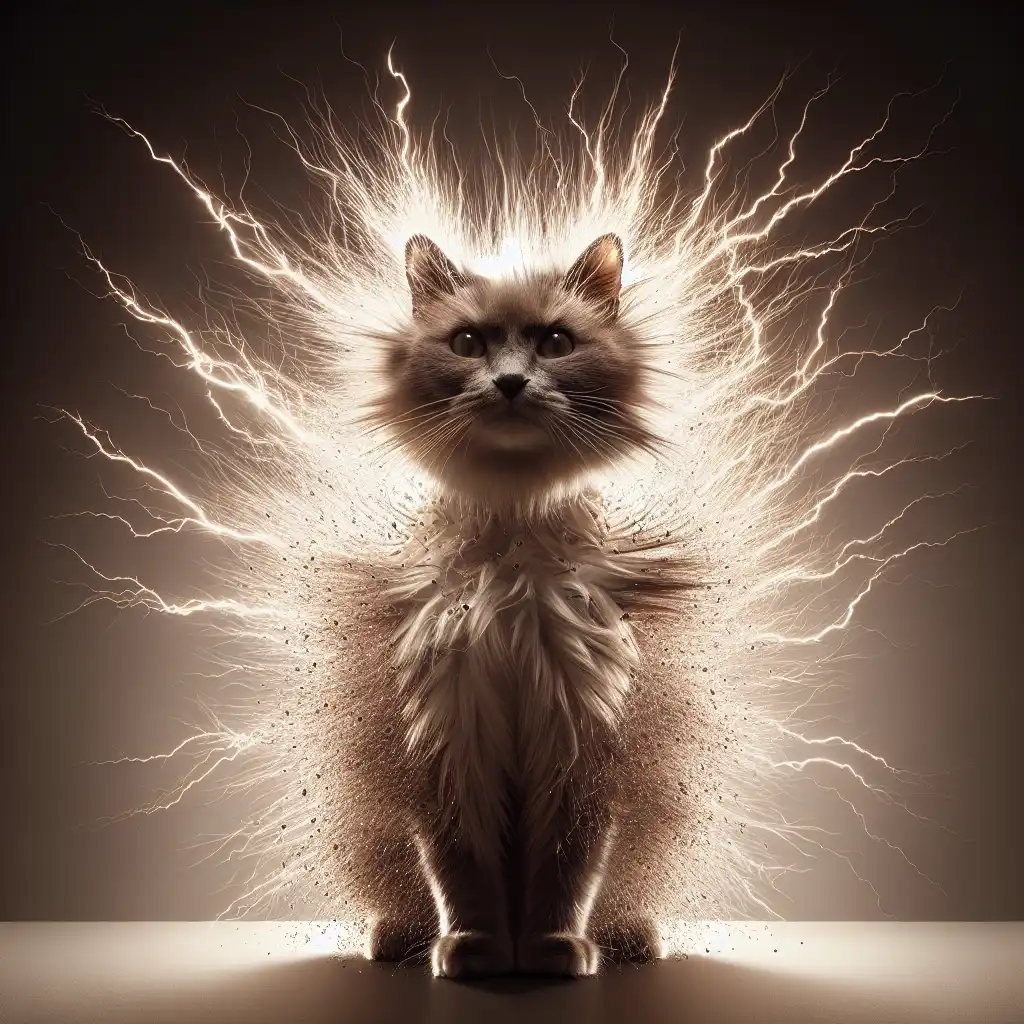
The electrostatic force can cause the hairs of the cat to stand on end.
electrostatic
ɪˌlektrəʊˈstætɪk
Loading…
ɪˌlektrəʊˈstætɪk
Related to or produced by electric charges that are not moving
The electrostatic force can cause the hairs of the cat to stand on end.
Audio could not be loaded. Please try again later.
The word 'electrostatic' refers to the interaction between electrically charged objects that are not moving. It is used to describe situations where objects have a build-up of static electricity due to friction or a difference in charge. For example, when you rub a balloon against your hair, it becomes electrostatically charged and can stick to surfaces. This term is commonly used in science and engineering fields to describe the behavior of electricity in non-moving objects.
Charge refers to a property of matter that results in attractive or repulsive forces between objects.
Electrostatic refers to the study of stationary electric charges and the forces between them. It encompasses the behavior and interactions of charges at rest, as opposed to charges in motion (which would fall under the study of electromagnetism).
Both terms are applicable in the fields of physics and engineering, with charge being used more broadly and electrostatic being more specific to stationary electric charges.
Open word: Charge →Conductive and electrostatic both relate to the movement of electricity, but in different ways.
Conductive refers to the ability of a material to transmit electricity. Materials that are conductive allow electricity to pass through them easily, like copper wires or aluminum foil.
Conductive materials allow electricity to flow through them, while electrostatic relates to the build-up of electrical charge on a surface.
Open word: Conductive →Electric refers to the flow of electric current through a conductor or device. While, electrostatic refers to the static charges that are formed when two objects are rubbed together or when there is a build-up of charge on an object.
Electricity is applicable when we are talking about electrical circuits and devices, such as batteries, wires, and motors.
Electrostatic is applicable when we are talking about charged objects or materials, such as static electricity or the attraction between a balloon and a wall.
In simpler terms, electric is about the flow of electricity through electrical devices like the wires and appliances at home, while electrostatic is about the forces that exist between electrically charged particles or objects, like the static shocks you may get from touching a metal door handle after walking on a carpet.
Open word: Electric →Energetic refers to the amount of energy something possesses. This can include potential energy (stored energy that can be released later) and kinetic energy (energy of motion).
Energetic can also refer to how much power or force something has, such as an energetic person who is full of enthusiasm and vigor.
Electrostatic refers to electric charges at rest and their interactions, while energetic refers to the amount of energy or force something possesses.
Open word: Energetic →Ionic refers to a type of chemical bond formed between two atoms when one atom gives up electrons and the other accepts them.
This results in positively and negatively charged ions that attract each other and form a stable molecule. Ionic bonds are common in compounds like table salt or magnesium oxide.
Electrostatic refers to electric charge on objects, while ionic refers to the chemical bond between atoms. Electrostatic forces are applicable in industrial processes like cleaning and painting, while ionic bonds are found in many different types of compounds in nature and everyday life.
Open word: Ionic →Electrostatic and magnetic are both related to the behavior of particles, but they are different in the following ways:
- Magnetic refers to the behavior of moving charges or magnetic dipoles, such as when a compass needle points north. It deals with the attraction or repulsion of magnetic fields that are generated by moving charges.
Magnetic fields are often produced by electric currents or magnets and are important in many everyday technologies such as electrical motors, speakers, and MRI machines.
The main difference between electrostatic and magnetic is that the former deals with stationary charges while the latter deals with moving charges or magnetic fields.
Open word: Magnetic →Potential refers to the energy that is stored within a system, which can be released to perform work.
Potential is applicable in situations where energy is stored within a system, such as in a battery or in an electric circuit.
In simpler terms, electrostatic refers to the force between charged particles while potential refers to the stored energy within a system.
Open word: Potential →Electrostatic and static both refer to the buildup of electricity on a surface, but there's a difference in how the electricity is generated.
Static electricity results from the transfer of electrons between two surfaces, while electrostatic electricity is generated by the separation of positive and negative charges.
For example, rubbing a balloon on your hair creates static electricity, as the electrons are transferred between the balloon and your hair.
However, a Van de Graaff generator creates electrostatic electricity by using a belt to build up positive and negative charges on two metal spheres.
Both static and electrostatic electricity can cause similar effects, such as shocks or attraction/repulsion of objects, but electrostatic effects can be much stronger and more reliable.
As a result, electrostatic effects are often used in scientific experiments or industrial applications, while static electricity is more commonly encountered in everyday situations.
Open word: Static →New bionics let us run,...
Watch on YouTube ↗The dust bunnies that...
Watch on YouTube ↗