impeach
verb impeach
ɪmˈpiːtʃ
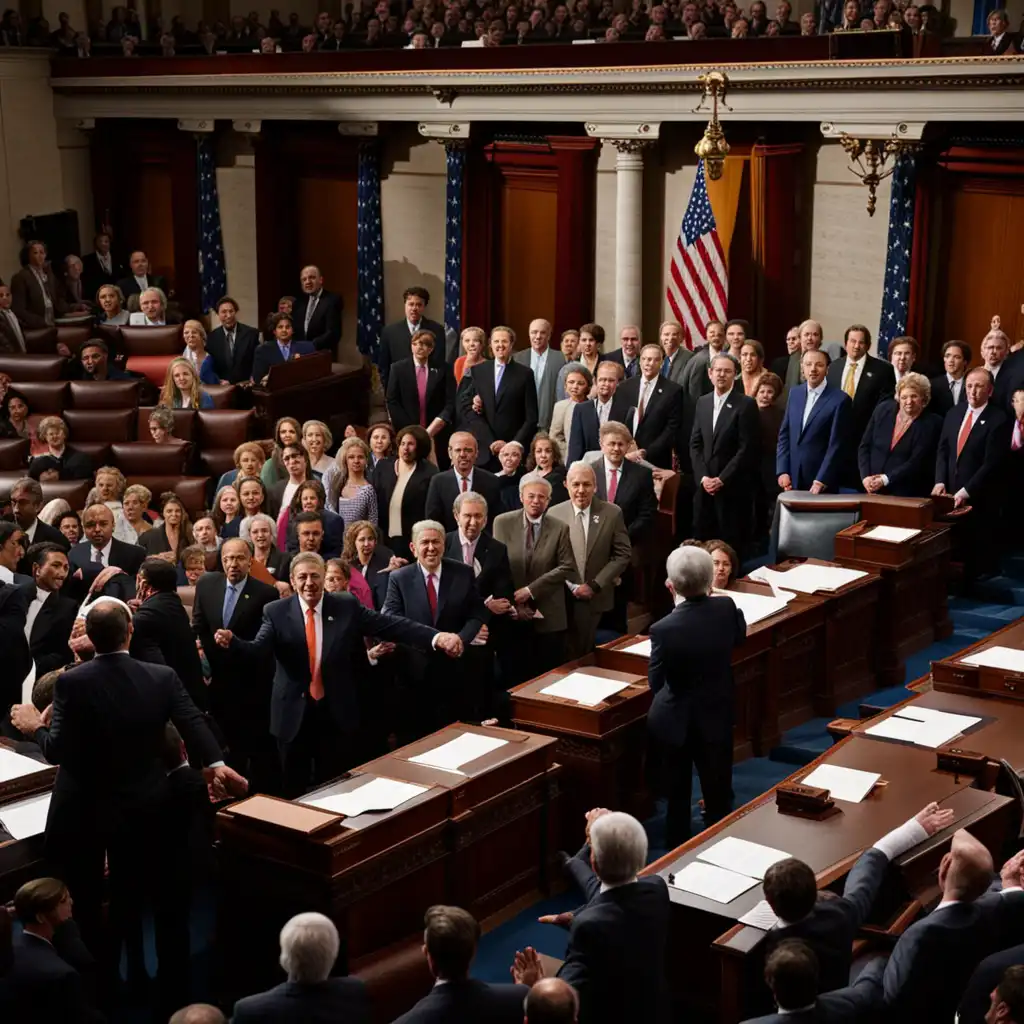
To officially charge a public official with misconduct in office
The Congress decided to impeach the president for his actions.
impeach
ɪmˈpiːtʃ
読み込み中…
ɪmˈpiːtʃ
To officially charge a public official with misconduct in office
The Congress decided to impeach the president for his actions.

ɪmˈpiːtʃ
To challenge the honesty or credibility of
The defense lawyer tried to impeach the witness's testimony.
音声を読み込めませんでした。しばらくしてからもう一度お試しください。
Impeach is a word used to describe the process of bringing charges against a government official for wrongdoing, such as a president or governor. It is usually done by a legislative body, such as the House of Representatives in the United States, and can result in the official being removed from their position. It is not a word that is typically used in everyday conversation and is reserved for formal discussions about government and politics.
To accuse someone is to state that they have done something wrong, without necessarily having any evidence to support the claim.
Unlike an accusation, it involves a formal process, legal evidence, and often results in the removal of the accused from office.
Accuse is a more general term used in everyday life to make allegations about someone, while impeach refers to a specific legal process used to remove a government official from their position.
単語を開く: Accuse →Blame usually means you are holding someone responsible for something bad that has happened. For example, if you break a vase and your mom blames you for it, she is saying that it's your fault that the vase is broken.
Blame is used in everyday situations to hold someone accountable for something bad, while impeach is a term used in politics to hold government officials accountable for serious misconduct or crimes.
単語を開く: Blame →Censure is an official reprimand or condemnation of someone's actions, behavior, or words. It is a formal statement of disapproval by a group or organization, usually a government body.
Censure is applicable when someone is found to have done something wrong, but not necessarily something that rises to the level of an impeachable offense.
単語を開く: Censure →To charge someone means to formally accuse them of a criminal offense or wrongdoing. This term is mostly used in criminal law, where a person can be charged with a crime, such as theft, assault or murder.
To sum it up, charge is applicable in the context of criminal law, while impeach is applicable in the context of politics and public officials.
単語を開く: Charge →Condemn means to express strong disapproval of something, often because it is seen as immoral or unethical.
You might say that condemn is about expressing disapproval of someone's behavior or choices while impeach is about removing someone from a position of power because they have done something wrong or broken the law.
単語を開く: Condemn →Criticize means to express disapproval or give an opinion about something in a negative way. It is applicable in situations when someone wants to point out the flaws or weaknesses in something or someone, but does not have the power to take any official action.
In a nutshell, criticize is used to express disapproval or give negative feedback, while impeach is a formal process for removing someone from office for serious misconduct.
単語を開く: Criticize →Denounce means to publicly condemn or criticize someone or something. It is mostly used when someone wants to speak out against something they think is wrong, like a law or policy.
So, while denounce is used to express disapproval, impeach is used to take legal action against someone who is suspected of doing something wrong while holding a public office.
単語を開く: Denounce →The term indict refers to the process of bringing criminal charges against someone. This is done by a grand jury, which is a group of citizens who determine whether or not there is enough evidence to bring someone to trial.
Impeach is a political process used to remove government officials from office, while indict is a legal process used to bring criminal charges against someone.
単語を開く: Indict →How does impeachment...
YouTube で見る ↗In our brief national history we have shot four of our presidents, worried five of them to death, impeached one and hounded another out of office. And when all else fails, we hold an election and assassinate their character.
Enrique Peñalosa: Why...
YouTube で見る ↗Trump's war on the nation's news media, his war on truth, his war on reality ultimately caused him to become the first U.S. president to be impeached two times.
How do US Supreme Court...
YouTube で見る ↗I brought myself down. I impeached myself by resigning.
Majora Carter: Greening...
YouTube で見る ↗I think Bush's immigration proposal is treason and he should be impeached.
Greening the ghetto -...
YouTube で見る ↗To be clear, impeachment is above all else a political act.
History vs. Richard...
YouTube で見る ↗Maybe Trump himself will be voted out through impeachment, right?
What happened to trial...
YouTube で見る ↗Impeachment is allowed under Brazil's Constitution.
This country isn't just...
YouTube で見る ↗Impeachment must not be a raw exercise of political power in which the House impeaches whoever it wishes for any reason it deems sufficient. Indeed, it is the solemn duty of all of the members of the House in any impeachment case to exercise their judgment faithfully within the confines established by our Constitution.
Fred Swaniker: The...
YouTube で見る ↗We often get impeachment inquiries or moves for impeachment inquiries on one president or another, and it doesn't go anywhere.
Ngozi Okonjo-Iweala: How...
YouTube で見る ↗I fear no motion of no confidence or impeachment, for they are the lawful mechanisms for the people of this beautiful country to remove their president.