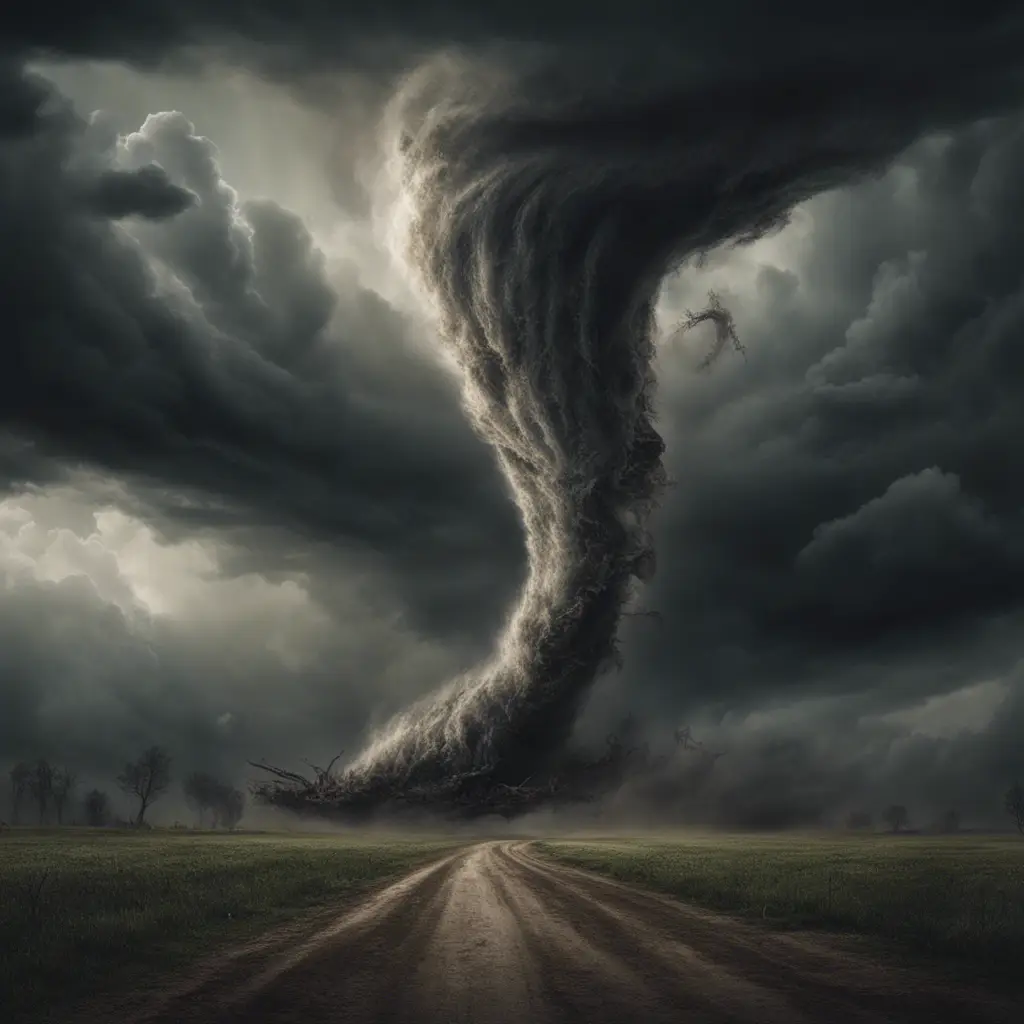
twister
noun twister
ˈtwɪstər
A tornado or a cyclone.
The twister caused a lot of damage to the city.
twister
ˈtwɪstər
불러오는 중…
ˈtwɪstər
A tornado or a cyclone.
The twister caused a lot of damage to the city.

ˈtwɪstər
A difficult situation or problem.
The math problem was a real twister.

ˈtwɪstər
A game played on a large plastic mat, where people use their bodies to reach different colored spots.
At the party, we played a fun game of Twister.

ˈtwɪstər
A tool used to twist things like wires or papers together.
Using a twister, he securely bound the wires together.

ˈtwɪstər
A person who intentionally confuses or deceives people by twisting truth.
Don't trust him, he is a twister.
오디오를 불러오지 못했어요. 잠시 후 다시 시도해 주세요.
The word 'twister' can refer to a few different things. It can refer to a type of tornado, which is a powerful and dangerous wind storm that can often be seen in certain parts of the world, particularly in the United States. It can also refer to a game called "Twister," which is often played at parties. In this game, players have to place their hands and feet on different colored circles on a mat, and then twist and contort their bodies in various ways in order to avoid falling or losing the game. Additionally, 'twister' can also refer to something that is twisted or curled up, such as a pretzel or a piece of curly hair.In language, 'twister' can also refer to a sentence or phrase that is difficult to understand or parse, often because it is written in a complex or convoluted way. So, depending on the context, 'twister' can refer to a weather phenomenon, a party game, a type of food, a physical object, or even a type of sentence structure.
Both cyclone and twister refers to a weather phenomenon that involves strong winds rotating around a center.
A cyclone is a large-scale, low-pressure system that occurs over water and is also known as a hurricane or typhoon depending on the region.
Cyclones can cause significant damage to coastlines and offshore structures. A twister is a smaller-scale, more localized weather event that occurs over land and is also commonly known as a tornado.
While cyclones are generally more powerful than twisters, both can be very dangerous and can cause significant damage.
단어 열기: Cyclone →Hurricane and twister are both natural disasters caused by extreme weather conditions, but they are different in a few key ways.
A hurricane is a large storm that forms over the ocean and moves towards land. It is characterized by strong winds (usually at least 74 mph), heavy rain, and storm surges (high waves that can cause flooding).
Hurricanes are typically seen in the Atlantic and Pacific oceans and can affect an entire region, like a state or a country.
Twisters are usually much smaller than hurricanes and can affect a small, localized area, like a neighborhood or a street.
To summarize: hurricanes are large, ocean-based storms that can affect entire regions, while twisters are smaller, land-based storms that affect smaller areas.
단어 열기: Hurricane →A squall is a sudden, violent gust of wind often accompanied by rain, hail or snow.
It is more specific in nature than a squall and is most commonly associated with severe weather conditions like thunderstorms.
A squall is a sudden and strong gust of wind, while a twister is a rotating column of air that can cause a lot of damage.
Squalls can happen during any weather condition, while twisters are most commonly associated with severe weather.
단어 열기: Squall →Storm is a general term used to describe any disturbance in the atmosphere, which may include strong winds, heavy rain, thunder, lightning, and even snow or hail.
The word twister specifically refers to a type of storm known as a tornado. Tornadoes are powerful rotating columns of air that are usually accompanied by high winds, large hailstones, and intense thunderstorms.
Storm is a general term that can refer to many different kinds of disturbances in the atmosphere, while twister is a specific term that refers only to tornadoes.
단어 열기: Storm →Tempest usually refers to a violent storm with strong winds, thunder, and lightning.
So, basically, tempest is a more general term for any kind of severe storm, while twister specifically refers to a type of storm that involves a rotating column of air.
단어 열기: Tempest →The words tornado and twister generally refer to the same thing: a violently rotating column of air that extends from a thunderstorm to the ground.
However, tornado is the more formal term and is typically used by meteorologists and other weather experts. Twister is a more colloquial term that is often used by the general public, especially in regions of the US where tornadoes are common (such as the Midwest).
Both terms can be used interchangeably in most situations, but tornado is the more technically accurate term.
단어 열기: Tornado →A vortex is a spiral or circular motion of fluid or air.
Vortexes can have different shapes and sizes, and they can exist for different lengths of time.
A twister or tornado is a specific type of vortex, which is a more general term for any swirling motion of fluid or air.
A twister is applicable when talking about a specific type of swirling motion that occurs during thunderstorms, whereas vortex can refer to any swirling motion across different environments.
단어 열기: Vortex →A whirlwind is a small-scale rotating column of air that is often visible as a funnel-shaped cloud, but it typically does not touch the ground.
Whirlwinds are often caused by the heating of the ground and the interaction of different air currents.
A twister is a specific type of storm, i.e., a tornado, while a whirlwind is a smaller, less intense rotating column of air that is typically not associated with severe weather.
단어 열기: Whirlwind →"So long lives this and this gives life to thee." In fact this type of specific consonance, which occurs at the beginning of words may be familiar to you already. It's called alliteration or front rhyme. Great examples include tongue twisters.
YouTube에서 보기 ↗I work with my acting coach to help me get into character and do pronunciation drills and tongue twisters to help me deliver lines.
than anyone realized helping explain how tornadoes maintain their strength the probe recorded images from the edge of a twister but none from inside the tornado
YouTube에서 보기 ↗Hermione uses all these big long tongue twister words. I don't know what she's going on about half the time!
really timeless simple technology my twisters really really tight there's basically more friction understanding friction and gravity and letting those work together with you it was going to be technology is really important I
YouTube에서 보기 ↗Unlike the twisters he famously chased in the movies, Bill Paxton was the kind of force of nature you ran toward and never away from.
has built a fairly harrowing life's work for himself he predicts when a tornado will hit he gets himself there before it actually arrives to put down a recording probe that he's actually designed into the twisters path and then he gets out
YouTube에서 보기 ↗My son likes Doctor Seuss books, but they're right tongue twisters. You get to certain bits and you stumble your words and it makes you feel like an idiot.
than break it up as usual to answer this scientists first need to understand more about how tornadoes form but twisters don't give up their secrets easily observers who get too close can pay with
YouTube에서 보기 ↗take it didn't I but playing chicken with a twister is a dangerous game
YouTube에서 보기 ↗call them twisters or tornadoes nature's most violent storms with swirling winds
YouTube에서 보기 ↗that's knock knock joke for more hilarious jokes tongue twisters and riddles check out National Geographic kids just joking available wherever books are sold
YouTube에서 보기 ↗tornadoes maintain their strength the probe recorded images from the edge of a twister but none from inside the tornado that the closer I come to that type of
YouTube에서 보기 ↗miles across that's wider across the Manhattan research has allowed us to identify the essential ingredients needed for twisters to form in the u.s. warm moist air typically from the Gulf
YouTube에서 보기 ↗