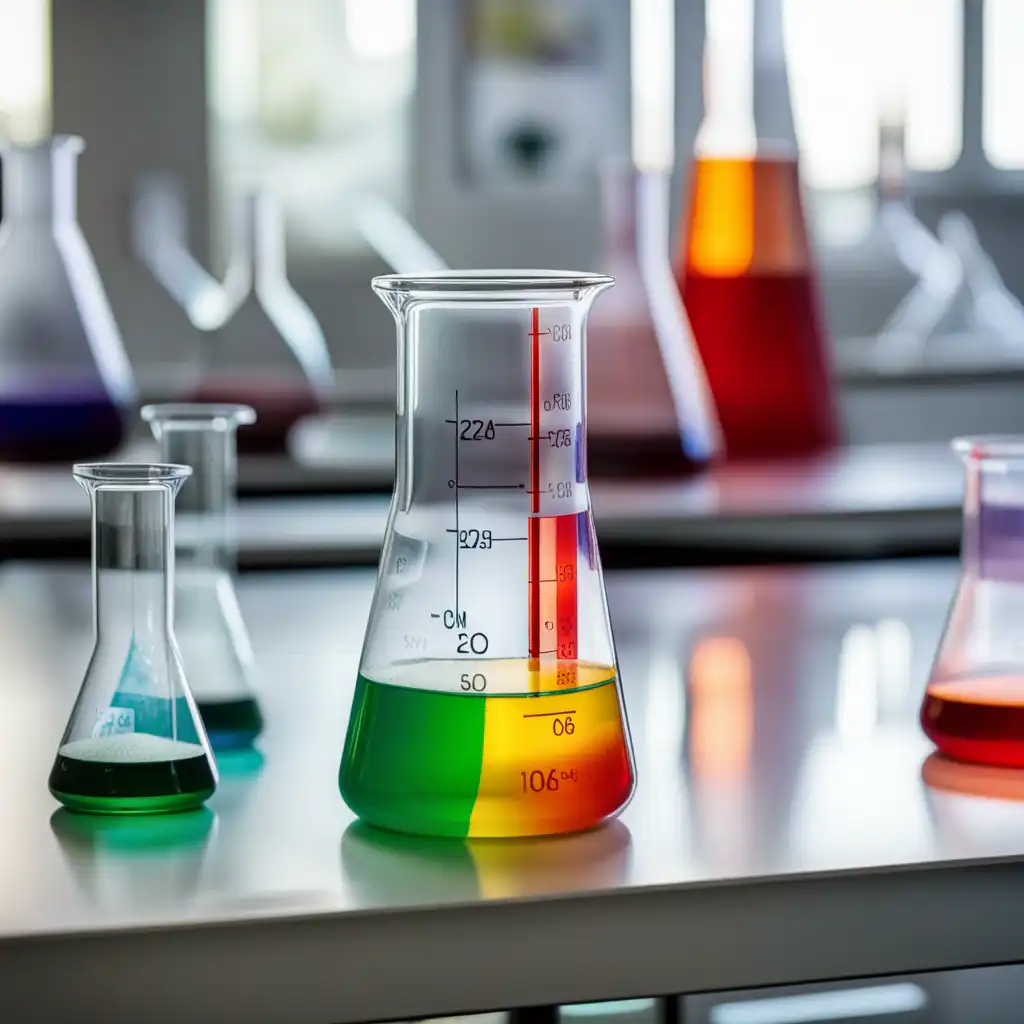
beaker
noun beaker
ˈbiːkər
A cup or glass with a flat bottom and no handle, often used in scientific experiments.
The scientist mixed the chemicals in a beaker.
beaker
ˈbiːkər
Chargement…
ˈbiːkər
A cup or glass with a flat bottom and no handle, often used in scientific experiments.
The scientist mixed the chemicals in a beaker.

ˈbiːkər
A large cup or glass that is used for drinking, especially beer.
He took a large swig from his beaker of beer.
Impossible de charger l’audio. Réessayez plus tard.
A beaker is a cylindrical, glass container that is used in laboratories to hold and measure liquids, such as chemicals or solutions. It is often marked with measurements, such as milliliters or ounces, to help scientists accurately measure and mix substances. Beakers come in different sizes and can be used for different purposes, such as heating or mixing, depending on their design.
A burette is a long, thin graduated glass tube with a stopcock at one end.
It is used to measure the volume of a liquid with high precision, particularly for titration experiments. Burettes are designed to deliver specific volumes of liquids with exact concentrations.
A beaker is a general-purpose container for mixing and holding liquids, while a burette is a specialized tool for precise liquid measurements.
Ouvrir le mot: Burette →A beaker and a flask are both containers used in science labs, but they have different shapes and purposes.
A flask is a container with a narrow neck and a wider body. It usually has a round or pear-shaped body with a flat bottom, and it does not have a pouring lip.
Flasks are used for more precise measurements of liquids, especially in experiments where you need to measure the volume of a liquid very precisely.
A beaker is used for general mixing and holding of liquids, while a flask is used for precise measurements of liquids.
Ouvrir le mot: Flask →A pipette is a small laboratory tool used for dispensing precise volumes of liquid in small amounts. It is thin and long with a narrow tip and can be made of glass or plastic.
The key difference between beakers and pipettes is that beakers are used for holding and mixing larger volumes of liquid, while pipettes are used for accurately transferring small volumes of liquid.
In a laboratory, beakers are commonly used for general-purpose measuring, stirring or heating of liquids, while pipettes are used for analytical work such as titration, measurement of small amounts of liquid, or preparation of solutions with precise concentrations.
Ouvrir le mot: Pipette →Vampires: Is It Real? %\PIPE%...
Voir sur YouTube ↗When the honour is given to that scientist personally the happiness is sweet indeed. Science is, on the whole, an informal activity, a life of shirt sleeves and coffee served in beakers.
How we can use light to...
Voir sur YouTube ↗Quickly, bring me a beaker of wine, so that I may wet my mind and say something clever.
The Power of a Waterfall...
Voir sur YouTube ↗The emergence of "4D...
Voir sur YouTube ↗Prohibition criminalizes...
Voir sur YouTube ↗Utopian Underwater...
Voir sur YouTube ↗Portraits of Women...
Voir sur YouTube ↗The emergence of "4D...
Voir sur YouTube ↗3 rules to spark...
Voir sur YouTube ↗Accidental Pirate %\PIPE%...
Voir sur YouTube ↗