absolutism
noun absolutism
ˈæbsəluːtɪzəm
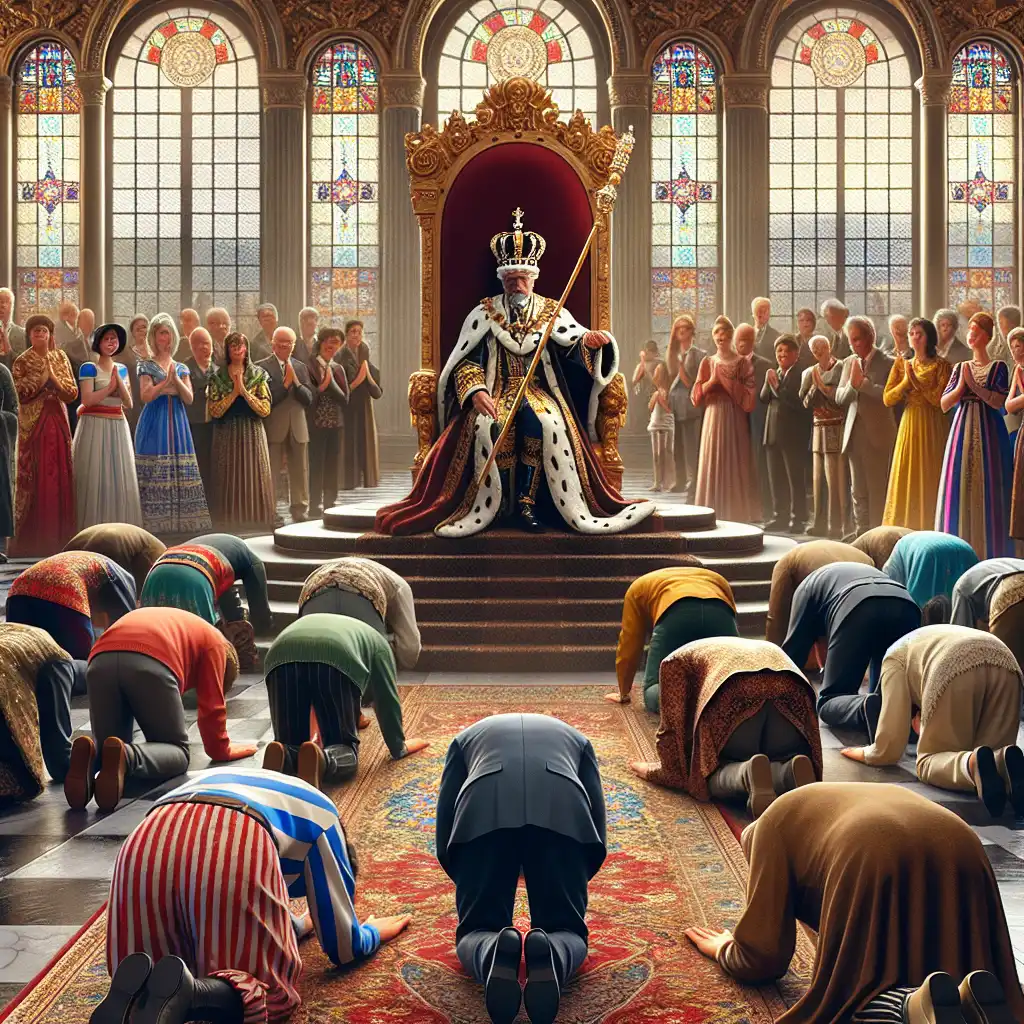
A political system in which a ruler has total power
Many nations today still practice absolutism, with the power of the state held by one person or family.
absolutism
ˈæbsəluːtɪzəm
불러오는 중…
ˈæbsəluːtɪzəm
A political system in which a ruler has total power
Many nations today still practice absolutism, with the power of the state held by one person or family.

ˈæbsəluːtɪzəm
The principle or the exercise of complete and unrestricted power in government
He accused the president of pursuing a policy of bureaucratic absolutism.
ˈæbsəluːtɪzəm
In philosophy, the belief that truth is not relative but universal and not dependent on individual perspectives
In moral absolutism, certain actions are viewed as inherently right or wrong, regardless of the circumstances.
오디오를 불러오지 못했어요. 잠시 후 다시 시도해 주세요.
Absolutism is a word that refers to a type of government where one person has complete power over everything. This person is the absolute ruler and has the final say on everything that happens in the country. It's important to know this word if you're studying history, politics, or government systems. You may also come across it in current events discussions about countries that have or had absolute rulers.
Authoritarianism is a type of government where a small group or one person has all the power, and rules in a way that does not involve the people.
Absolutism is a type of government where one person has complete control without opposition, while authoritarianism is a government where a small or one person has all the power and nobody can resist them.
Absolutism was more common in Europe in the past, while authoritarianism exists in different parts of the world today.
단어 열기: Authoritarian →Autocracy refers to a system of government where the ruler has complete control over the government, but may delegate some power to other officials or institutions.
Absolutism is when one person has total control over everything, while autocracy is when one person has total control over the government, but may share some power.
Both concepts can apply to different types of governments, but absolutism is more commonly associated with monarchies, and autocracy can exist in various forms of government, including monarchies, dictatorships, and oligarchies.
단어 열기: Autocracy →Despotism refers to a form of government where the ruler has unlimited power and abuses it for personal gain. It is a more extreme form of absolutism where the ruler rules with an iron fist and is willing to use violent or oppressive means to maintain their power.
Despotism is often associated with oppressive regimes and dictators.
Absolutism can be a form of government that is stable and effective when the ruler is just and competent. Despotism, however, can lead to abuse of power and oppression, and is generally frowned upon in modern times.
단어 열기: Despotism →Monarchy is a form of government where the monarch (usually a king or queen) is the head of state. The power of the monarch is often limited by a constitution or other laws and regulations, and there is usually a system of checks and balances in place to ensure that the monarch does not abuse their power.
Absolutism is a type of government where the ruler has complete control and unlimited power, while monarchy is a form of government where the monarch has power, but it is often limited by laws and regulations.
Absolutism is applicable in some historical or fictional contexts where rulers had almost absolute power, while monarchy is still prevalent in some countries with constitutional monarchies.
단어 열기: Monarchy →Tyranny refers to a form of government where the ruler abuses their power to oppress and harm citizens.
The main difference between absolutism and tyranny is how the ruler exercises their power. While absolutism is the exercise of unlimited power without necessarily harming people, tyranny is the exercise of unlimited power through the oppression and harm of citizens.
단어 열기: Tyranny →Ethical dilemma: Would...
YouTube에서 보기 ↗The principle of evil in Europe is the enervating spirit of Russian absolutism.
Dear Facebook this is...
YouTube에서 보기 ↗All parties without exception, when they seek for power, are varieties of absolutism.
Relativity must replace absolutism in the realm of morals as well as in the spheres of physics and biology.
Philosophically, I believe that libertarianism - and the wider creed of sound individualism of which libertarianism is a part - must rest on absolutism and deny relativism.
I want to gesture toward a poetry of ourselves and others under the conditions of twenty-first-century absolutism, making us dimensional in a time when the human concrete is continually erased by state and religious violence and by disingenuous jargon serving state power.
For years, Republicans have effectively outsourced their thought leadership to the loudmouths at the end of the bar. But perhaps the most extreme example of that trend has been the issue of guns, where the party has ceded control to a gun lobby that has built its brand on absolutism.
Unlike Washington, the California legislature has proved that cooperation is both possible and essential to successful policymaking, while stubborn absolutism will have you trailing head lice in popularity polls.
If I hear someone say something, and they're 100 per cent about it, then it's almost inevitable that I'll take the opposite view. I guess I feel at odds with things like society. Absolutism is always a trigger for me.
George Bush made a mistake when he referred to the Saddam Hussein regime as 'evil.' Every liberal and leftist knows how to titter at such black-and-white moral absolutism.