
helium
noun helium
ˈhiːliəm
Helium is a type of gas that is lighter than air and does not have color or smell. It's used to fill balloons and airships.
When you fill a balloon with helium, it floats in the air.
helium
ˈhiːliəm
Loading…
ˈhiːliəm
Helium is a type of gas that is lighter than air and does not have color or smell. It's used to fill balloons and airships.
When you fill a balloon with helium, it floats in the air.
ˈhiːliəm
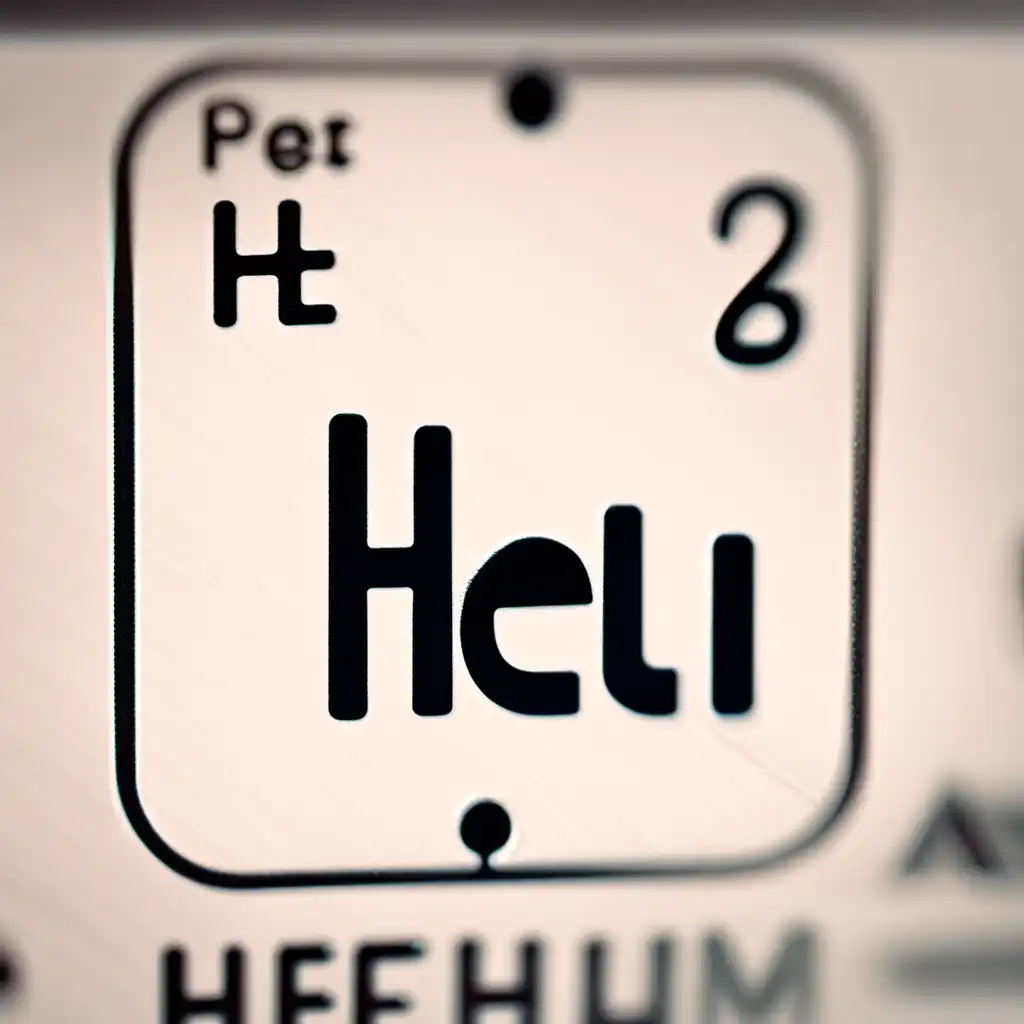
In scientific terms, helium is a type of chemical element. Its symbol is 'He' and atomic number is 2.
Helium is the second element on the periodic table, after hydrogen.
Audio could not be loaded. Please try again later.
Helium is a gas that is lighter than air. It is often used to fill balloons, so they float in the air instead of falling to the ground. Helium is also used in things like airships and medical equipment. When talking about balloons or things that float, you might hear people mention helium.
He is a pronoun that is used to refer to a male person or an object that is masculine.
Helium is a chemical element that is found in the periodic table. It is a gas that is colorless and odorless, and it is used in balloons, diving equipment, and other applications.
He is a word used to refer to people, while helium is a gas used for practical purposes.
Open word: He →in the three minutes that followed the birth of our universe. Eventually clusters of atoms accumulated and formed stars. Within these stars nuclear reactions fused light elements, such as hydrogen and helium, to form heavier elements such as carbon and oxygen.
Watch on YouTube ↗I start my day with a hot water and lemon routine. I meditate. And I take my problems lightly, like my mother always said: treat them like helium balloons and let them go. I devour a lot of books to feed my mind.
and the pattern of the ripples was imprinted into our universe as regions of slightly different density in the hydrogen and helium gas that formed shortly after the big bang
Watch on YouTube ↗I have this one little saying, when things get too heavy just call me helium, the lightest known gas to man.
- Most people know helium as the lighter than air gas that fills our party balloons. But more importantly it's an irreplaceable element for science and industry.
Watch on YouTube ↗Earlier generations of stars in the galaxy could well have had planets. But really, there was only hydrogen and helium to work with, so they'd all be gas giants and not small, rocky planets.
because we actually know quite a lot about the universe at this stage. We know above all that it was extremely simple. It consisted of huge clouds of hydrogen and helium atoms, and they have no structure. They're really a sort of cosmic mush. But that's not completely true.
Watch on YouTube ↗The sun derives its energy from fusion reactions in which hydrogen is transformed into helium.
Along with the idea that the visible universe has been constantly expanding from a densely packed single point, one of this theory's most important predictions is that the early universe consisted of just two hydrogen and helium, in a ratio of three to one. And this prediction can also be tested with light.
Watch on YouTube ↗Most stars just fuse hydrogen into helium, but larger stars can fuse helium into other elements. Still larger stars, in turn, fuse those elements into slightly bigger ones, and so on.
scientists are able to determine the relative abundance of elements, such as hydrogen and helium within the universe. But cosmic rays may provide even more fascinating information about the fabric of the universe itself.
Watch on YouTube ↗The federal helium program sells vast amounts of the gas to U.S. companies that use it in everything from party balloons to MRI machines. If the government stops, no one else is ready.
Rather this giant planet may have a dense liquid center surround by a worldwide ocean of hydrogen and helium gases. Jupiter's gassiest composition can be observed in its atmosphere. About 44 miles thick,
Watch on YouTube ↗Liquid helium belongs to a class of fluids known as quantum fluids, as distinct from classical fluids.
the radiation era's last two stages, the protons and neutrons underwent a significant change. They fused and created nuclei. And in doing so they created the first chemical element in the universe helium.
Watch on YouTube ↗Tired of burning fossil fuel and polluting the planet? The moon is covered with helium 3, an isotope from the sun that is the perfect fuel for clean fusion reactors.
and that hydrogen that helium then began to cook into the heavier elements. So the elements of life -- carbon and oxygen and iron, all the elements that we need to make us up -- were cooked in those first generations of stars, which then ran out of fuel exploded,
Watch on YouTube ↗Big Bang gave us hydrogen and helium. We couldn't make people out of hydrogen and helium. So we're made out of exploding stars.
surrounded by a layer of clouds. These clouds predominantly made of hydrogen and helium, include traces of methane, which give this ocean world its rich blue color.
Watch on YouTube ↗I've read short stories that are as dense as a 19th century novel and novels that really are short stories filled with a lot of helium.