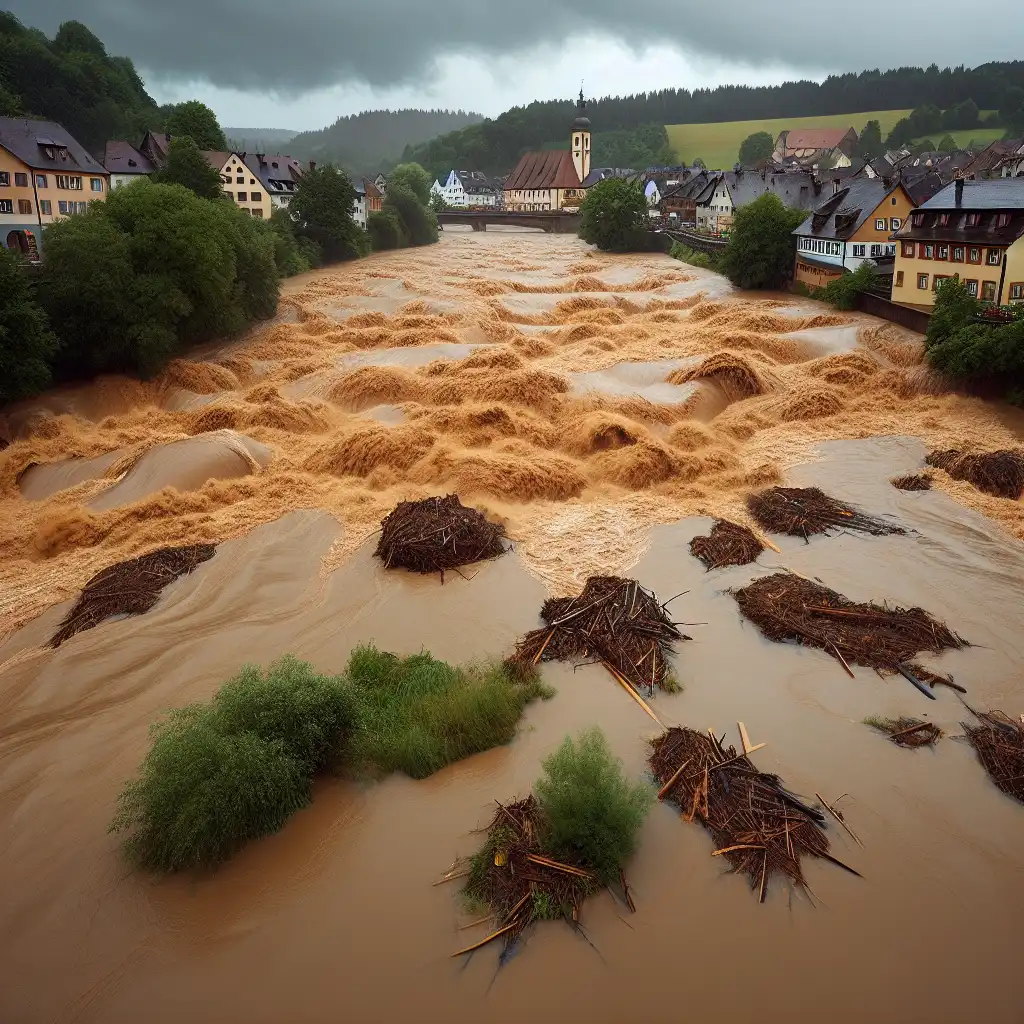
turbid
adjective turbid
ˈtɜːrbɪd
Not clear, muddy or containing a lot of things that do not belong, particularly in a liquid
The floodwaters became turbid after the heavy rains.
turbid
ˈtɜːrbɪd
Loading…
ˈtɜːrbɪd
Not clear, muddy or containing a lot of things that do not belong, particularly in a liquid
The floodwaters became turbid after the heavy rains.

ˈtɜːrbɪd
Confused or unclear in the mind or thoughts
His turbid thoughts made it difficult for him to articulate his feelings.
Audio could not be loaded. Please try again later.
The word 'turbid' is used to describe something that's not clear or cloudy. You can use it to describe water that has dirt or sediment in it, or to describe a situation that is confusing or unclear. For example, you might say "The river was turbid after the heavy rains" or "The politics in our country are turbid and hard to understand."
Cloudy means that a liquid or a gas has tiny particles suspended in it, making it hazy or obscure. It is appropriate to use when talking about weather conditions, such as a cloudy day, a cloudy sky.
It can also describe liquids, such as cloudy water or cloudy urine.
Turbid refers to a liquid that is not only cloudy but has particles that make it difficult to see through.
Cloudy has a hazy or obscured appearance, while turbid has an opaque or milky appearance because of suspended particles.
Open word: Cloudy →Dingy refers to something that is dirty, dark and unclean.
It is often used to describe a place or object that is shabby or grimy. For example, a dingy room may have peeling wallpaper or a dirty floor.
Dingy describes something that is dirty or shabby, while turbid describes a liquid that is cloudy or unclear due to suspended particles.
Open word: Dingy →Dirty refers to something that is covered or stained with dirt, impurities or other unwanted substances.
Dirty refers to something that is unclean, while turbid refers to something that is clouded or murky. Dirty is generally used to describe surfaces or objects that are visibly covered in dirt, while turbid describes liquids or gases that are not clear or transparent.
Open word: Dirty →Hazy refers to a situation where there is a lack of clarity or sharpness in vision, either due to dim light or something being obscured by a mist, fog or haze.
For example, you might describe the view from your window as hazy because there is a thick fog in the air.
Hazy describes something that is difficult to see due to a hazy or foggy condition, whereas turbid describes something that is cloudy or murky due to particles or sediment in a liquid.
Open word: Hazy →Muddy water has sediment or dirt particles suspended in it, which makes it opaque and opaque. It often happens after heavy rain or in areas with a lot of soil erosion.
Muddy water has visible dirt or sediment particles, while turbid water has many tiny particles that make it cloudy.
Open word: Muddy →The words murky and turbid both describe something that is not clear, but there is a slight difference in their meaning.
Murky describes something that is dark and unclear, as if there is something hiding in it or obscuring it. For example, a pond might be described as murky because it is dark and we can't see clearly to the bottom.
Murky describes something that is dark and unclear, while turbid describes something that is muddy or cloudy due to particles or substances.
Open word: Murky →Obscure means something that is difficult to understand or unclear.
So, while both words describe something that is unclear or difficult to see through, obscure is used more for ideas or thoughts, and turbid is used more for physical substances.
Open word: Obscure →Opaque refers to something that is completely impenetrable to light or any other form of radiation. It means that you cannot see through it at all.
Opaque means completely opaque, while turbid refers to something that is somewhat cloudy.
Open word: Opaque →Aquatic Animals Take To...
Watch on YouTube ↗The wine of youth does not always clear with advancing years; sometimes it grows turbid.
What Could Trigger a...
Watch on YouTube ↗Mediaeval mythology, rich and gorgeous, is a compound like Corinthian brass, into which many pure ores have been fused, or it is a full turbid river drawn from numerous feeders, which had their sources in remote climes.