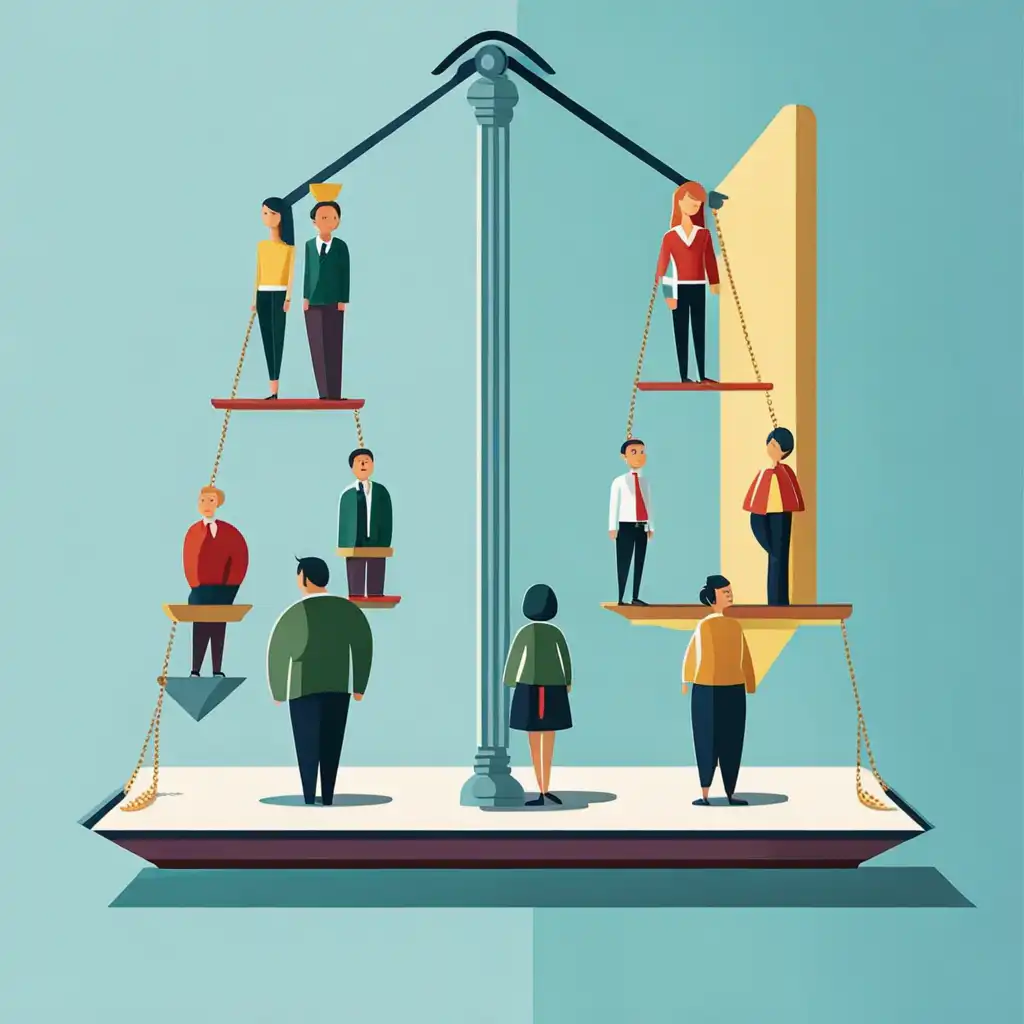
inequity
noun inequity
ɪnˈekwəti
A situation that is unfair because some people have more rights or better opportunities than others
He spoke passionately about the inequities of the social system in our country.
inequity
ɪnˈekwəti
불러오는 중…
ɪnˈekwəti
A situation that is unfair because some people have more rights or better opportunities than others
He spoke passionately about the inequities of the social system in our country.
오디오를 불러오지 못했어요. 잠시 후 다시 시도해 주세요.
Inequity is a word that describes a situation where something is not fair or equal. For example, if one group of people has more opportunities, resources or privileges than another group, that would be an inequity. It is often used in discussions about social justice, equal rights and fairness. You can use this word to talk about situations where you or someone else is being treated unfairly.
Bias is a tendency to favor one thing over another, without considering the objective facts.
It can be positive, negative or neutral, and can be conscious or unconscious, intentional or unintentional. Bias refers to a preference or inclination towards a particular idea or thing, which may affect our actions or views.
For example, if a teacher always gives high grades to their favorite students, that teacher is said to be biased.
Inequity is a result of a bias that puts one group in a privileged position over others. For example, if girls are not allowed to attend school, then we can say that there is an inequity between boys and girls.
To summarize, bias is a personal inclination towards something, while inequity is a situation where there is an unfair or unequal distribution of resources, opportunities or privileges.
Bias can lead to inequity, and it is important to recognize and address both in order to create a fair and just society.
단어 열기: Bias →Discriminate means to treat someone or something unfairly based on their specific characteristics, such as their race, gender, or religion.
Discrimination can result in inequity, but not all instances of inequity necessarily involve discrimination. Discrimination is applicable when discussing instances when individuals or groups are being unjustly treated based on their differences.
단어 열기: Discriminate →Disparity refers to a difference, gap, or inequality between two or more things. This can be in terms of income, education, opportunities, or any other aspect.
Disparity refers to a difference, while inequity refers to an unfair difference. Disparity is applicable when describing a difference or gap between things, while inequity is applicable when describing an unfair or unjust difference.
단어 열기: Disparity →Favouritism refers to the act of showing preferential treatment to someone based on personal bias or affection, without considering whether or not it is fair.
Favouritism can be seen in situations where a boss might give someone special benefits, promotions or privileges that others do not receive, simply because they like them better.
Favouritism is a personal form of bias while inequity is more related to systemic biases.
단어 열기: Favouritism →Imbalance refers to a lack of balance or proportion in something. For example, an imbalance in diet means not having enough of certain nutrients.
Imbalance is related to the quantity or quality of something, whereas inequity is more related to fairness and justice in society.
단어 열기: Imbalance →Injustice refers to a situation where someone has been treated unfairly and deprived of their rights or freedoms.
Injustice can be applied to situations where someone is discriminated against, oppressed or denied their basic rights due to their race, gender or social status.
Inequity refers to unequal treatment or opportunities, while injustice refers to unfair treatment or deprivation of rights.
단어 열기: Injustice →Partiality refers to a situation where someone is biased towards something or someone. For example, if a judge has a personal connection to one of the people involved in a trial and shows favoritism towards them, it is partiality.
Partiality can be applied to any situation where someone shows bias or favoritism.
Inequity refers to a lack of fairness or equality, while partiality refers to bias or favoritism. Both words can be applied to a variety of situations where there is a problem with fairness or impartiality.
단어 열기: Partiality →Prejudice refers to preconceived opinions or attitudes held about individuals or groups, often based on stereotypes rather than facts.
For example, if someone refuses to hire a person of a certain race because of their prejudices, that would be an example of prejudice.
Both of these concepts are related to the idea of unfairness, but they refer to slightly different aspects of it. Inequity is about unequal treatment, while prejudice is about biased attitudes and beliefs.
단어 열기: Prejudice →Why giving away our...
YouTube에서 보기 ↗I've been very lucky, and therefore I owe it to try and reduce the inequity in the world. And that's kind of a religious belief. I mean, it's at least a moral belief.
Greening of Pittsburgh %\PIPE%...
YouTube에서 보기 ↗I didn't wake up and decide to become an activist. But you couldn't help notice the inequities, the injustices. It was all around you.
A brief history of...
YouTube에서 보기 ↗If you're a white candidate, it is twice as important for you to be talking about racial inequity and not just describing the problem - which is fashionable in politics - but actually talking about what we're going to do about it and describing the outcomes we're trying to solve for.
The Khan Academy %\PIPE%...
YouTube에서 보기 ↗I find the world with its inequities and injustices to be messy, unfair, and complicated. The cosmos, on the other hand, is orderly and beautiful - this I find terribly alluring and captivating.
How to build your...
YouTube에서 보기 ↗We whites who position ourselves as liberal often opt to protect what we perceive as our moral reputationsrather than recognize or change our participation in systems of inequity and domination.
The lie that invented...
YouTube에서 보기 ↗I don't think we should stop emphasizing race because I think, you know, race is still very, very important, and we have to recognize that and continue to introduce programs to address racial inequities. But we have to widen our vision and also address the growing problems of economic class.
The difference between...
YouTube에서 보기 ↗Most people who are selling their mineral rights, this is a once-in-a-lifetime transaction. The people who are buying, the landmen who are coming in, do it every day. So there's a little inequity there about knowledge.
How American and Chinese...
YouTube에서 보기 ↗I have a lot of interests in global issues, as you know, humanity, inequity, arms control, and I continue to be active on all these issues.
The problem with...
YouTube에서 보기 ↗In order to succeed, people need a sense of self-efficacy, to struggle together with resilience to meet the inevitable obstacles and inequities of life.
Ilissa Ocko: The fastest...
YouTube에서 보기 ↗From the time I was a little girl, I'd just always been naturally curious. And I was raised in a family that... would just get really worked up about inequities and unfairness.