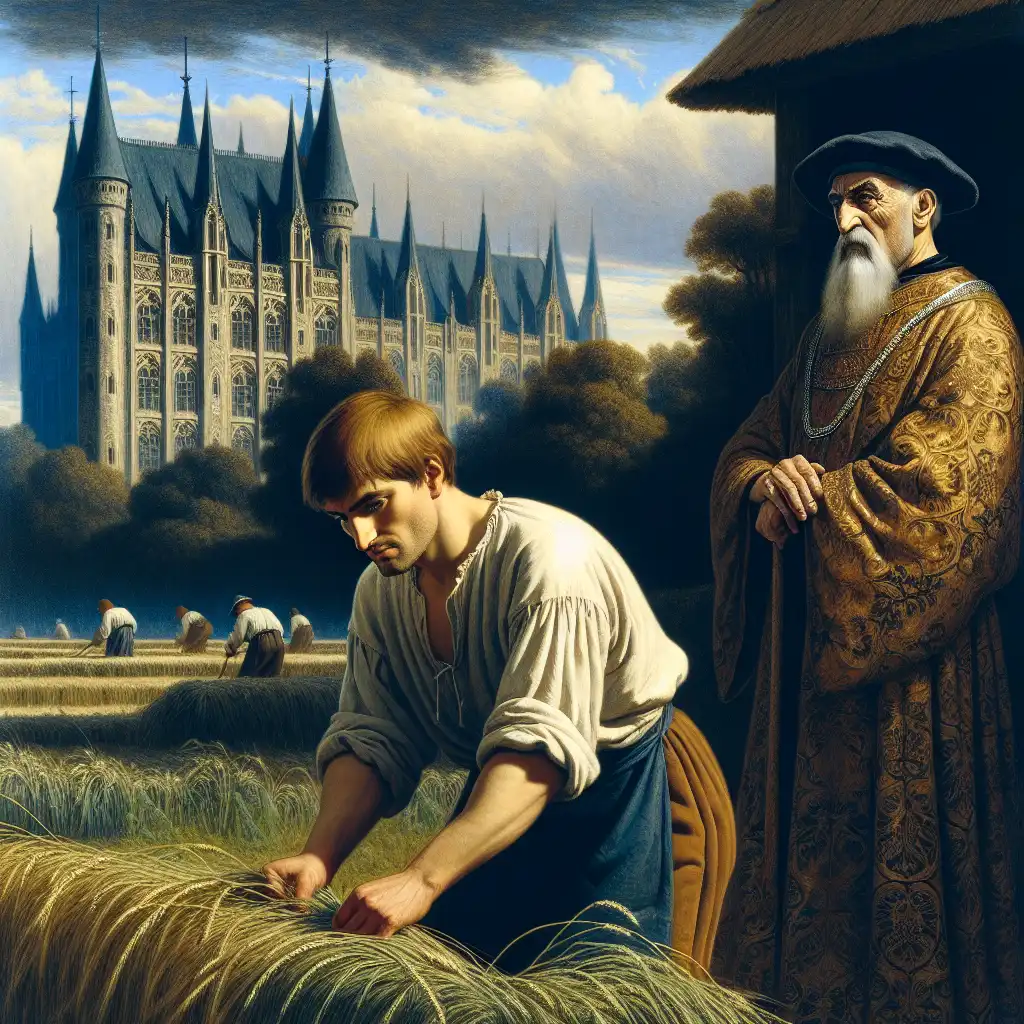
'Villein' is an old English word used to describe a type of peasant who was bound to a lord's estate during the Middle Ages. This meant that they had to work the land and pay certain taxes to the lord in exchange for protection and a place to live. It is not commonly used in modern English, but may appear in historical or literary contexts.
Both peasant and villein refer to agricultural laborers in medieval Europe.
However, peasant is a more general term and can refer to any rural laborer whereas villein specifically refers to a type of serf who was tied to the land and subject to the control of a noble lord.
Essentially, a villein was a type of peasant who had even fewer rights and freedoms than other peasants. Peasant is applicable in any situation where someone is a rural agricultural worker, whereas villein specifically refers to a feudal system where someone is tied to the land and controlled by a lord.
A serf was a person who, during the Middle Ages, was bound to work on land owned by a lord or noble. They were not allowed to leave the land without permission and were often given protection in exchange for labor.
The term serf was more commonly used in Eastern Europe.
A villein was similar to a serf but was more commonly used in Western Europe, particularly in England. They were made to serve as agricultural laborers, but unlike serfs, they were given some degree of freedom and could own their own property.
In summary, both serfs and villeins were peasants who had to work for nobles, but serfs had less freedom and were more common in Eastern Europe, while villeins had more autonomy and were mainly found in Western Europe.
Slave refers to a person who is owned by someone else and is forced to work without pay or freedom. The term is commonly used in reference to people who were captured or purchased and forced to work by their masters.
Villein refers to a person who is not a slave but is still bound to work for a lord or master. They were not owned as property, but they were required to work on a specific piece of land and were not free to leave without permission.
A slave is someone who is owned and forced to work without pay or freedom, whereas a villein is someone who is bound to work for a lord but has some freedom and is not owned as property.
Both words refer to a type of unfree person in medieval times, but thrall comes from Norse and refers specifically to a slave or captive, while villein comes from French and refers to a person in a feudal system who is bound to the land and required to perform labor for a lord in exchange for protection.
A thrall is a slave and villein is a semi-free laborer.