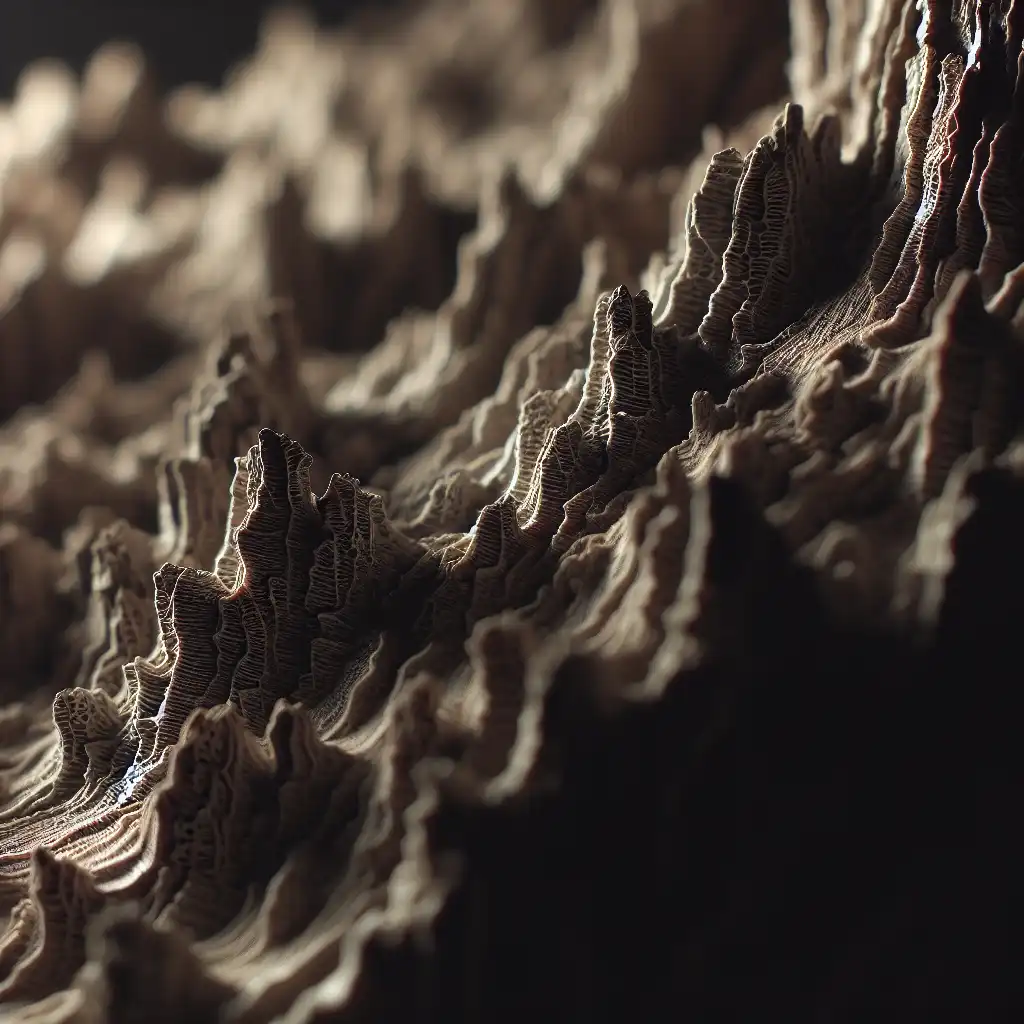
scabrous
adjective scabrous
ˈskæbrəs
Rough and covered with, or resembling, scabs
The tree bark was so scabrous that it was abrasive to touch.
scabrous
ˈskæbrəs
Đang tải…
ˈskæbrəs
Rough and covered with, or resembling, scabs
The tree bark was so scabrous that it was abrasive to touch.

ˈskæbrəs
Difficult and presenting problems
He found himself in a scabrous situation, one that was hard to navigate.

ˈskæbrəs
Indecent, having obscene or vulgar elements
His scabrous joke was deemed inappropriate during the formal dinner.
Không tải được âm thanh. Vui lòng thử lại sau.
The word 'scabrous' is used to describe something that is rough, uneven, and unpleasant to touch or look at. It can be used to refer to the surface of a rock, a tree bark, or a person's skin that has been injured and developed a scab. However, it is a slightly formal word and is not commonly used in everyday conversation. It is more commonly found in written texts such as novels or academic papers.
Bumpy generally refers to a surface that has small, uneven or rough areas.
Bumpy and scabrous refer to different degrees of roughness or unevenness of a surface, with bumpy being more general and scabrous being more specific.
Mở từ: Bumpy →Both words refer to something rough or uneven, but coarse generally implies a rough texture, while scabrous implies roughness due to small, hard bumps.
For example, a rough sandpaper can be described as coarse, while the surface of a coral reef can be described as scabrous.
Coarse is applicable to describe texture, while scabrous is more applicable to describe a particular type of roughness.
Mở từ: Coarse →Harsh means something that is rough or unpleasant, either in terms of taste, sound, or behavior. It is applicable when describing something that is difficult to tolerate or deal with, like harsh criticism or harsh climate.
In summary, while both words refer to something rough, harsh usually refers to something unpleasant or difficult, while scabrous refers to something that is rugged or uneven.
Mở từ: Harsh →Prick is often used to refer to a sharp pain or defamatory remark, while scabrous describes something that is rough or covered in scabs.
For example, if someone were to use a sharp tone of voice or insult another person, you might describe it as a 'prick.' If you were talking about a rough surface or material, you might call it 'scabrous.' Prick has a negative connotation, while scabrous is more neutral.
Mở từ: Prick →However, rough is a more common everyday term that can apply to a variety of textures, while scabrous is a more technical term that applies specifically to surfaces that are rough and covered in small bumps or projections.
For example, a piece of sandpaper would be considered rough, but the skin of a shark would be considered scabrous.
Mở từ: Rough →Scaly refers to something that has a rough, flaky texture, like the skin of a reptile or fish.
Scabrous describes something rough and bumpy that is difficult to deal with, while scaly describes something rough and flaky that has a texture like scales.
Mở từ: Scaly →Scabrous means rough or uneven, whereas the word scratchy means causing an itching or irritating sensation.
Scratchy is applicable when describing a sensation that causes irritation or discomfort, such as the feeling of a scratchy sweater or an itchy insect bite.
Scabrous describes a physical characteristic, while scratchy describes a feeling or sensation.
Mở từ: Scratchy →Uneven refers to something that is not level or flat, with differences in height or surface. An uneven surface may be bumpy, warped or slanted.
Scabrous would more often be used to describe a texture or feeling, while uneven would be used to describe shape or form.
Generally, scabrous implies an unpleasant texture or feeling, while uneven may be neutral or simply descriptive. For example, you might describe a rock as uneven, but only describe a surface as scabrous if it was rough in a way that was uncomfortable or unpleasant to touch.
Mở từ: Uneven →He did not know what love was. And he did not know what good it was. But he knew he carried it around with him, a scabrous spot of rot, of contagion, for which there was no cure.