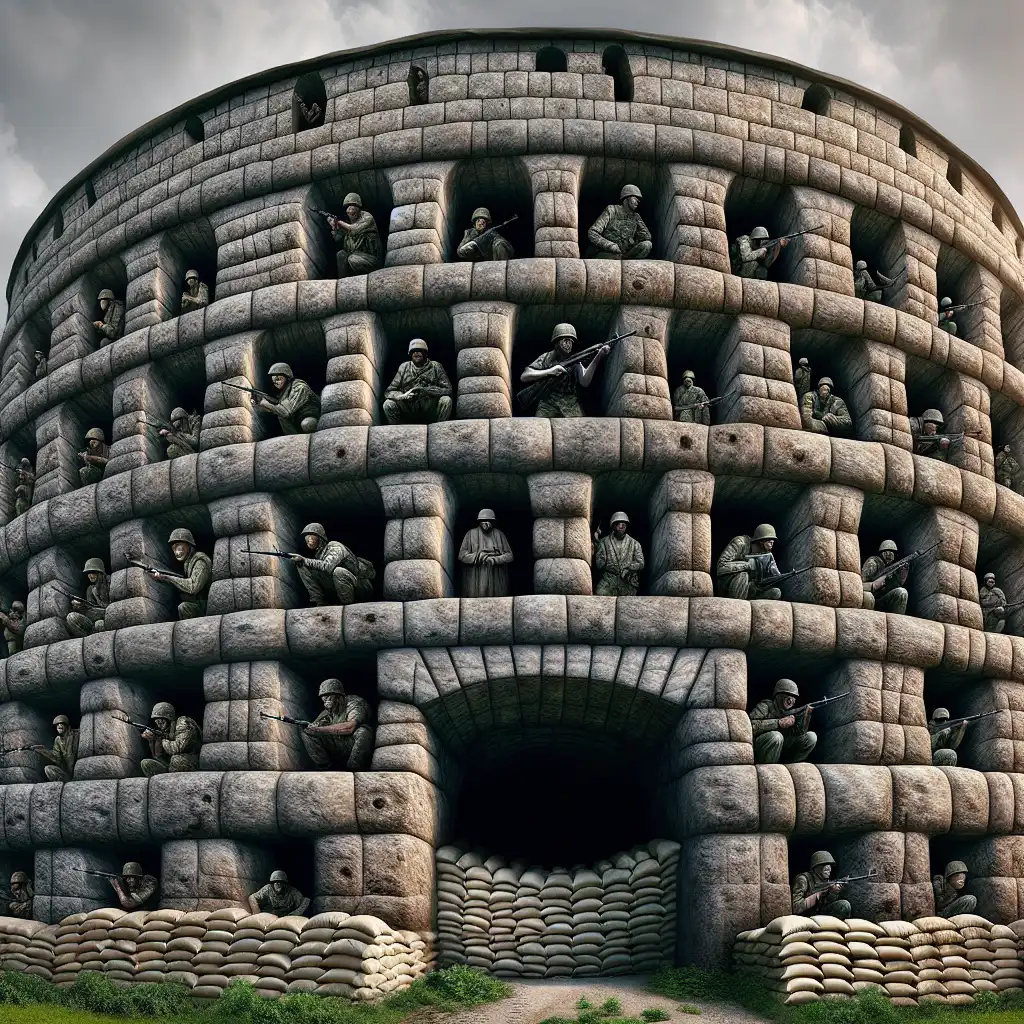
A blockhouse is a small building made of heavy materials like wood or stone. It was often used in the past as a fortification or a defensive structure during wars. Nowadays, it may be used for storage or shelter in remote areas. You may also hear it used in the context of outdoor recreational activities, such as a blockhouse on a hiking trail or a hunting area.
A bastion is a massive, projecting part of a fortification, typically pentagonal or semi-circular in shape, that is designed to provide defensive positions for soldiers to fire upon the enemy.
It's often located at the corner of a fortification and is usually made of stone or brick. Bastions were popular in Medieval Europe.
A bastion is a large, permanent fortification designed for long-term use, while a blockhouse is a small, makeshift structure used for short-term defense.
A bulwark is a defensive wall or structure that is built to protect against a larger threat, such as a storm or a naval attack.
In summary, blockhouses are small fortifications used for defense against human enemies, while bulwarks are larger defensive structures used to protect against natural disasters or military attacks.
A citadel is a stronghold or fortress, typically made of stone or brick, and usually located in a strategic location, such as the top of a hill or in the center of a city.
A blockhouse is a smaller defensive structure made of wood, while a citadel is a larger, more substantial fortress made of stone or brick.
Blockhouses were typically used in colonial America and in military posts, while citadels were more typically found in ancient cities, medieval towns, and military strongholds.
It is usually made of wood and has thick walls to protect the people inside from enemy attacks. Blockhouses are usually built in strategic locations, like at the corners of a fort or along important transportation routes, to help defend against invaders.
A fort is a larger and more complex military structure that is designed to protect a wider area.
It can be made of various materials, including stone, brick, and wood. Forts typically have walls, bastions, and/or trenches for defense, and they may be surrounded by a moat or other obstacle.
Forts were used throughout history to defend cities, borders, and important military installations.
The main difference between a blockhouse and a fort is that a blockhouse is smaller and more focused on protecting a specific area or point, while a fort is larger and designed to protect a larger area.
Blockhouses are often part of a larger fortification system, but they can also be standalone structures.
A garrison is a group of soldiers who are stationed at or near a military base or town. The purpose of a garrison is to maintain security and control over a particular area or region.
Garrisons can be found all around the world, in both peacetime and in times of conflict.
A blockhouse is a fortification structure, whereas a garrison refers to a group of soldiers.
Blockhouses can be found in more historical and specific contexts, while garrisons are more common and widespread.
A redoubt is a small fortification or defensive structure that is designed to be easily defended.
It is typically circular and has a high earthen wall with a ditch in front of it. The purpose of a redoubt is to protect soldiers from enemy fire and to provide a secure location from which they can launch attacks on the enemy.
A blockhouse is used to protect people or equipment while a redoubt is used to protect soldiers in battle. Blockhouses were often used in frontier regions to protect settlers from attacks by Native Americans, while redoubts were commonly used in military campaigns to secure strategic locations.
A stockade refers to a barrier or enclosure made of vertical wooden stakes or logs set in the ground. It was used to protect settlements or military camps from intruders and attack.
At times, a stockade could have a gate or an entrance to allow people to enter and exit the protected area.
A blockhouse is a fortified structure, while a stockade is a barrier or enclosure.
A blockhouse would be used as a form of defense during a battle, while a stockade is used to protect a specific area.
A stronghold is a much larger and more complex fortified structure that is designed to protect a large area or serve as a strategic military base.
A blockhouse is used in more localized situations to protect a specific group of people or location, while a stronghold is used to secure larger areas and serve as a base for military operations.