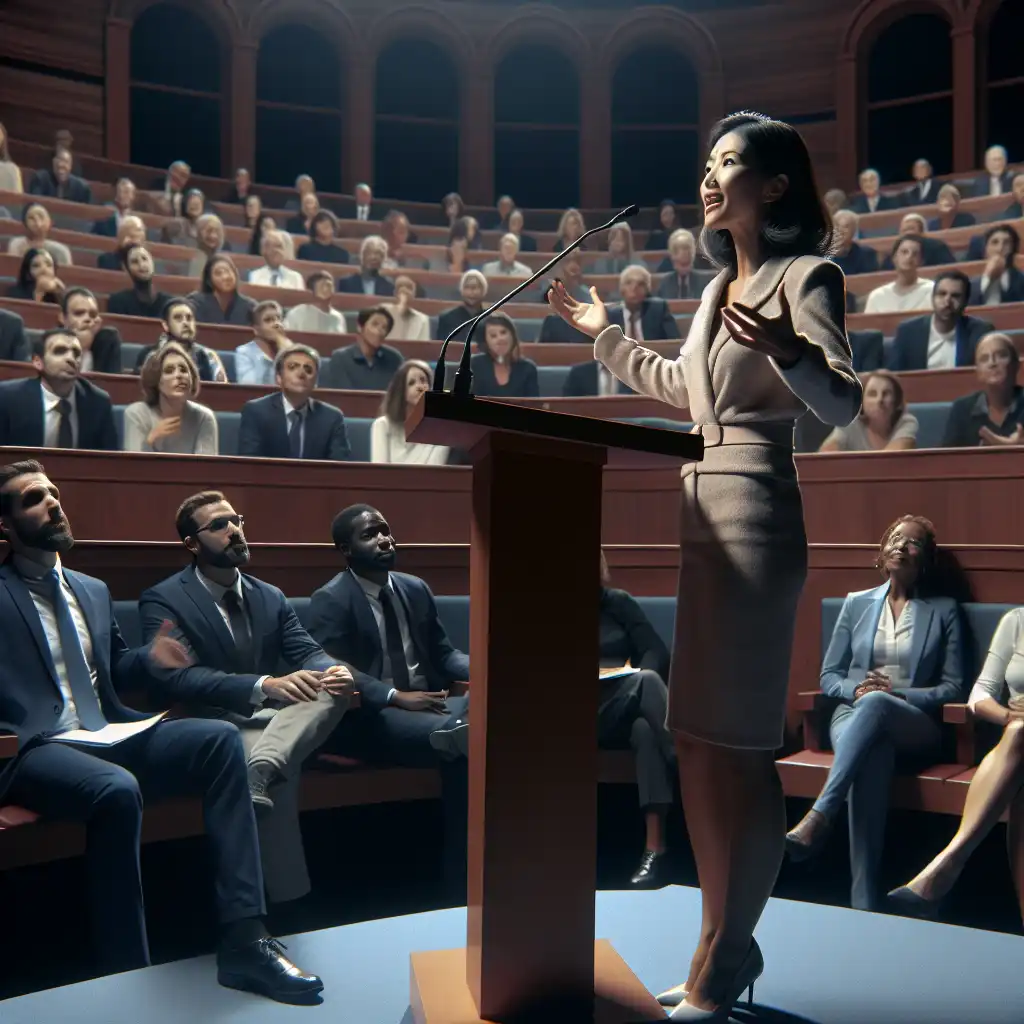
debater
noun debater
dɪˈbeɪtər
A person who takes part in formal discussions or arguments
She is a skilled debater who always knows her facts.
debater
dɪˈbeɪtər
読み込み中…
dɪˈbeɪtər
A person who takes part in formal discussions or arguments
She is a skilled debater who always knows her facts.
音声を読み込めませんでした。しばらくしてからもう一度お試しください。
A debater is a person who engages in a discussion or argument on a particular topic or issue. They present their ideas and opinions in a structured way and try to convince others of their viewpoint. Debaters can be found in various settings, such as in school debates, political campaigns, or even in casual conversations among friends. If you want to express that someone is good at arguing or persuading others, you can use the word 'debater' to describe them.
Adversary refers to someone who is an opponent or enemy, someone who is against you.
It is often used to describe someone in a conflict or competition. For example, in a sports game, the opposing team would be considered the adversary.
So, while an adversary is someone who is against you, a debater is someone who is engaging in a discussion to present their views and persuade others.
Adversary is applicable in situations of conflict or competition, while a debater is applicable in situations where the goal is to persuade through logical and reasoned argumentation.
単語を開く: Adversary →An advocate is someone who supports or recommends a particular cause, idea, or policy. They speak in support of their position, and try to persuade others to agree with their viewpoint.
An advocate is usually more interested in promoting their own ideas than in hearing or considering alternative perspectives.
So, both advocate and debater can argue about a particular subject, but the focus of the advocate is more on persuasion, while a debater is more focused on presenting compelling arguments based on evidence and logic.
単語を開く: Advocate →An interlocutor is someone who participates in a conversation or dialogue with another person, often seeking to understand and learn from the other person's perspective.
Interlocutors listen actively, ask questions, and seek clarity.
Interlocutors are applicable in informal conversations or interviews, where the goal is to gain insight and understanding into a topic or another person's perspective.
単語を開く: Interlocutor →An opponent is a person who disagrees with someone else's point of view and seeks to defeat or undermine it. They may use emotional arguments, personal attacks or other tactics to persuade their audience.
Opponents often see the other side as an enemy to be defeated rather than a potential discussion partner.
A debater is someone who engages in respectful discussion and seeks to persuade through logic and evidence, while an opponent seeks to undermine the other side and win at all costs.
単語を開く: Opponent →An orator is a skilled public speaker. They deliver persuasive speeches to influence or move their audience emotionally.
Orators can be found in different contexts, including political campaigns, religious organizations, advocacy groups, or in any situation where public speaking is required.
The main difference between a debater and an orator is that a debater seeks to convince an opponent in a formal discussion, while an orator aims to persuade a broader audience through eloquent public speaking.
単語を開く: Orator →A rhetorician is someone who is skilled in the art of persuasive speaking and writing. They focus on using language in a persuasive and effective way to appeal to the emotions, values, and beliefs of their audience.
While both debaters and rhetoricians are concerned with persuasion, a debater is more focused on presenting a logical argument while a rhetorician is more focused on using language and style to persuade.
Debaters are often seen in formal debate competitions and political arenas, while rhetoricians are commonly found in fields like advertising, public speaking, and literature.
単語を開く: Rhetorician →How to disagree...
YouTube で見る ↗Vidal was a novelist, an essayist, a playwright, a screenwriter, and many other things. Buckley started a magazine, hosted a TV show, lead a political movement, and was a master debater. They were multihyphenates in a way that you rarely see anymore.
Governor Romney is a good debater.
Donald Trump is the best debater on the debate stage.
I wasn't a great debater.
The power of real debate is in the language and intellectual honesty of the debaters, alongside the engagement of spectators.
Some writers are so enthralled by ideas (one thinks of Doris Lessing) that their characters become debaters, and their fables approach allegory.
Anything can go wrong in a debate, and Obama is not a perfect debater.
Christopher Hitchens, the late essayist and sot, was a man who purposefully cultivated a lot of friends of a certain type - rich, self-important, generally dim-witted and hence easy for a well-spoken Oxbridge debater to impress - and he electrified Washington D.C. society mainly by not being a completely charmless bore.
The case could be made that Rick Perry is the worst debater to ever run for president.
On the road to the GOP nomination, Trump earned the reputation as a good debater by slandering and bullying his opponents, knocking them out with cheap shots and lies. On a crowded stage, Trump got away with these deplorable tactics.