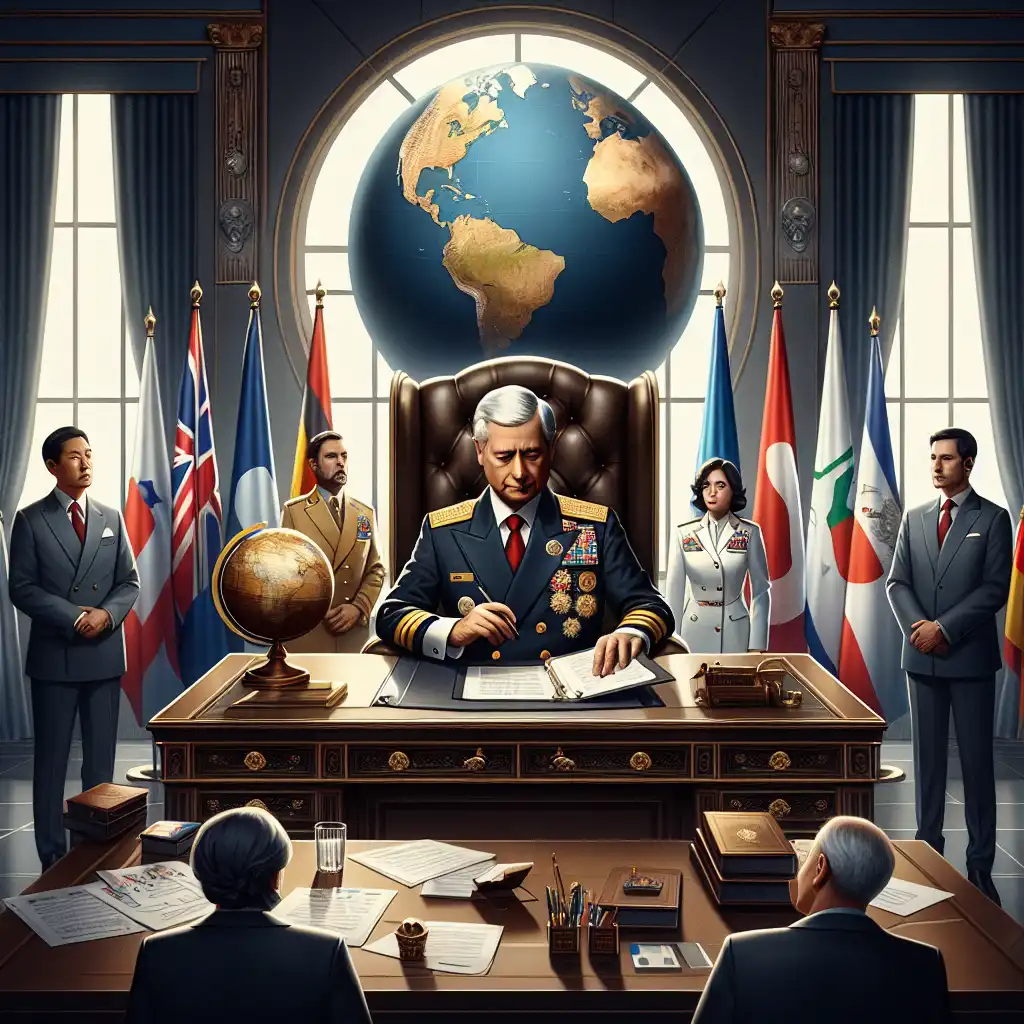
statecraft
noun statecraft
ˈsteɪtkræft
The art of managing a nation's affairs or governing a country.
The president displayed exceptional statecraft during his time in office.
statecraft
ˈsteɪtkræft
Chargement…
ˈsteɪtkræft
The art of managing a nation's affairs or governing a country.
The president displayed exceptional statecraft during his time in office.
Impossible de charger l’audio. Réessayez plus tard.
Statecraft refers to the skills and strategies used by a government or leader to manage and govern a country. It involves making important decisions and taking actions that affect the welfare and stability of the nation. Statecraft can be used in various contexts such as diplomacy, military, economics, and politics. For example, a skilled politician might use statecraft to negotiate a treaty with another country, while a military leader might use statecraft to plan and execute a successful battle. The word statecraft is often used in discussions about the effectiveness and success of a government or leader, and is an important concept for anyone interested in politics or international relations.
Administration refers to the day-to-day tasks involved in running a government, such as managing budgets, bureaucratic procedures, and public services.
Administration focuses on managing the inner workings of government while statecraft involves the strategic thinking and decision-making that shapes a country's relations with other nations.
Ouvrir le mot: Administration →Diplomacy is the act of managing relationships between countries through peaceful negotiations and agreements. It focuses on communication, compromise, and finding common ground.
Diplomacy is used when dealing with international relations, such as resolving conflicts or negotiating trade deals.
Diplomacy is focused on managing relationships between countries, while statecraft focuses on the management of a country's affairs.
Ouvrir le mot: Diplomacy →Governance and statecraft are related but not exactly the same.
Governance refers to the way a country or organization is managed and led. It includes the processes and structures that enable decision-making and the implementation of policies.
Examples of governance include government systems, corporate management, and community leadership.
Statecraft is a specific type of governance that is concerned with diplomacy and international relations. It is the art of conducting negotiations and managing relationships between states or other organizations.
Governance is a broader term that refers to the overall management and leadership of an organization, while statecraft specifically deals with diplomacy and international relations.
Governance applies to both public and private sectors, while statecraft is primarily applicable in the context of national and international politics.
Ouvrir le mot: Governance →Leadership refers to the ability to guide and motivate a group or organization towards achieving a goal or vision. It encompasses the ability to inspire and influence others, make decisions, and take responsibility for the outcomes.
While leadership can apply to a wide range of situations, including business, education, and community organizations, statecraft specifically relates to the management of a country's affairs.
Ouvrir le mot: Leadership →Statecraft and statesmanship both refer to the art of leading a country or government, but they have slightly different connotations.
Statesmanship encompasses a broader set of qualities and values, such as integrity, wisdom, and empathy. It involves using one's leadership position to serve the greater good and uphold ethical principles, even if it means making difficult or unpopular decisions.
Both statecraft and statesmanship are important in leadership, but they may be more applicable in different contexts. For example, a successful diplomat or military strategist may be praised for their statecraft, while a leader who inspires trust and solves conflicts through compromise may be considered a statesman.
Ultimately, the most respected leaders are often those who demonstrate both a mastery of statecraft and a commitment to statesmanship.
Ouvrir le mot: Statesmanship →Is war between China and...
Voir sur YouTube ↗Study history, study history. In history lies all the secrets of statecraft.
He who is firmly seated in authority soon learns to think security, and not progress, the highest lesson in statecraft.
In government, our chief executives have been lawyers. The great majority of our cabinets and congresses are and have been men trained in the law. They have provided the leadership and the statecraft and the store of strength when it was needed.
If men understood domestic economy half as well as women do, then their political economy and their entire consequent statecraft would not be the futil muddle which it is.
Though the general principles of statecraft have survived the rise and fall of empires, every increase in knowledge has brought about changes in the political, economic, and social structure.
When learning was monopolized by the monks in the Middle Ages, people specialized only in warfare and statecraft. And even these were not altogether free from the scholastic influence.
A western audience might not appreciate 'Chanakya's Chant' because of its dependence on history and ancient statecraft. My book is a modern-day thriller that draws on a bedrock of history. My primary object is to entertain, not educate.
The designs of the paper euros, introduced in 2002, proclaim a utopian aspiration. Gone are the colorful bills of particular nations, featuring pictures of national heroes of statecraft, culture and the arts, pictures celebrating unique national narratives. With the euro, 16 nations have said goodbye to all that.