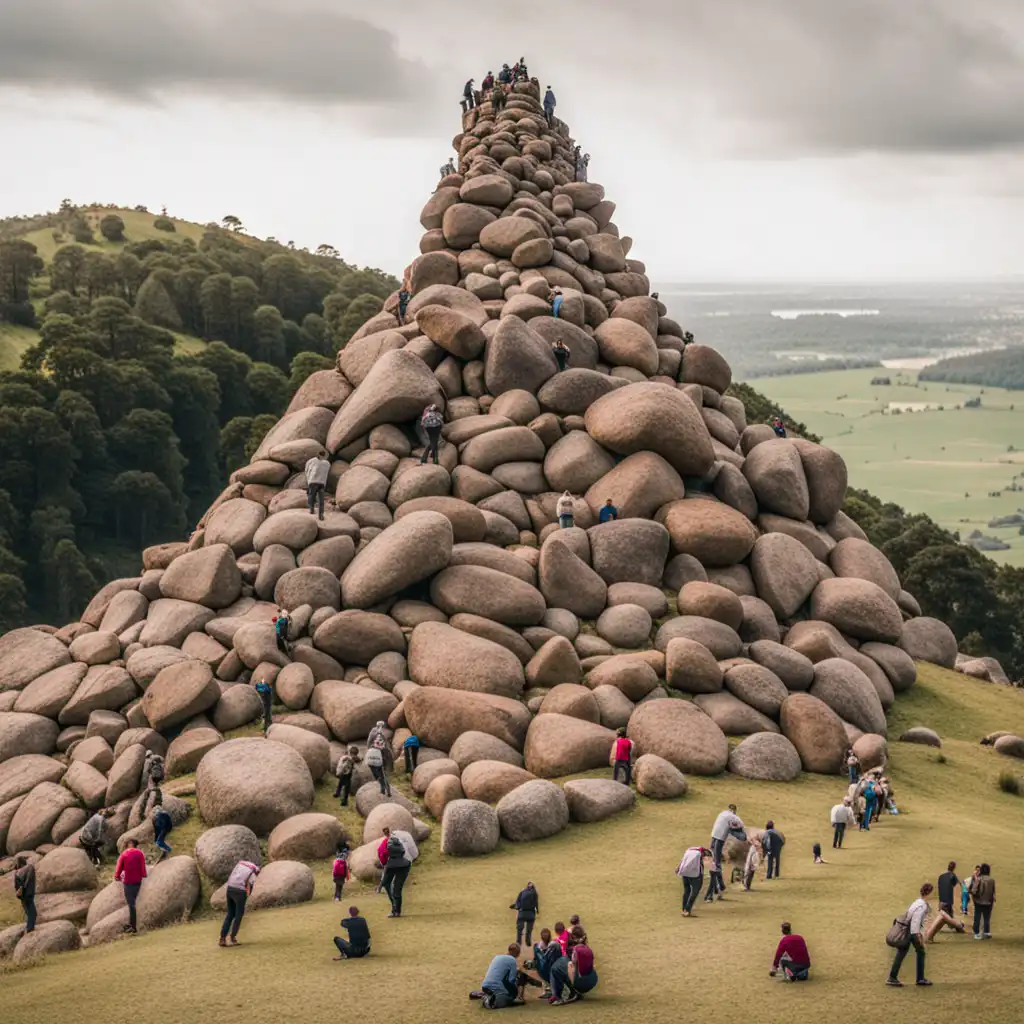
mound
noun mound
maʊnd
A small, usually natural hill or pile of earth or stones.
We climbed to the top of the mound for a better view.
mound
maʊnd
Cargando…
maʊnd
A small, usually natural hill or pile of earth or stones.
We climbed to the top of the mound for a better view.

maʊnd
A structure for a pitcher in baseball from where they throw the ball.
The pitcher gets ready to deliver the ball from the mound.

maʊnd
To make a pile or heap of something.
He mounded the dirt into a pile in the corner of the yard.
No se pudo cargar el audio. Inténtalo de nuevo más tarde.
A mound is a small hill or raised area of land. It can be found in a park, on a farm or in a garden. It can also refer to a large pile of dirt or earth, such as a burial mound or a construction site. In sports, a mound usually refers to the raised area of soil on a baseball field where the pitcher stands during the game.
Bank refers to a raised area of land or slope that is often man-made and used for support or protection.
Bank is more commonly used in the context of finance or construction, while mound describes natural land formations or archaeological sites.
For example, a river bank is a sloping area of land along the edge of a river, while an ant mound is a raised area of dirt created by ants.
Abrir palabra: Bank →Bump refers to a small raised area on a surface, usually caused by a collision or impact.
A bump can be found on various surfaces such as skin, roads, and objects.
For example, a bump on the road can be caused by an uneven surface, while a bump on the skin can be caused by an insect bite.
A mound refers to a larger raised area of ground such as a hill or a pile of earth, stones or debris. It is a more significant and permanent structure than a bump.
A bump is a small raised area caused by collision, while a mound is a larger area of raised ground. The context determines which one to use, and you use them appropriately.
Abrir palabra: Bump →An embankment is a man-made structure, often made of soil or rocks, that is created to prevent flooding or to support transportation infrastructure like railroads or highways.
In short, embankments are typically built for practical purposes and are specifically designed to prevent flooding or support infrastructure, while mounds can be both natural or man-made and are often created for either functional or aesthetic reasons.
Abrir palabra: Embankment →Both heap and mound refer to a collection of objects or substances that are piled up.
A heap is usually an untidy or disorderly pile of objects, like a heap of laundry or a heap of trash.
So, while both words refer to a collection of objects piled up, heap is usually used for untidy or disorganized piles, while mound is used for more intentional and structured piles.
Abrir palabra: Heap →The main difference between the words hill and mound is their size and formation.
A hill is a natural elevation in the landscape that rises higher than the surrounding area, and is usually formed by the movement of the Earth's tectonic plates or eroded over time by wind and water.
Hills are often larger and steeper than mounds and can be found in mountainous regions, grasslands, or even in urban landscapes.
A mound is a small hill that is artificially created by humans, usually for a purpose such as burial, fortification or as a marker.
In summary, hills are natural elevations while mounds are human-made structures. Hills are generally larger and steeper than mounds and can be found in various natural environments, whereas mounds are typically smaller and usually found in man-made environments.
Abrir palabra: Hill →Hump generally refers to a raised part of a surface that is uneven and asymmetrical. In simpler terms, it can mean a bump or a protuberance.
Hump is often used to describe the shape of an animal's back or the curve of a hill.
Hump typically refers to an uneven, asymmetrical raised surface, while mound usually describes a symmetrical and rounded raised area on the ground.
Abrir palabra: Hump →A knoll is a small hill or a mound of earth that is often located in a grassy area.
A knoll can be naturally occurring or man-made, and it is often used as a landmark or a place to sit and enjoy the view.
It can be used for various purposes like burial or building structures, and it is usually much larger than a knoll. Mounds are often found in archaeological sites, sports fields or in landfills.
A knoll is a small and gentle hill while a mound is a larger pile of earth or stones often created by human activity.
Abrir palabra: Knoll →A mound is generally a raised or elevated part of the ground that is larger in size and more defined than a pile. It could be a hill or an artificial structure like a burial mound.
A pile is a heap of objects or substance that appears unordered and is typically created through accumulation.
A pile could be made of dirt, clothes, books, or any other things that can be stacked up.
Usually, piles are formed when things are placed in a disorganized way and they remain in that position.
A mound is a specific type of raised or elevated landform, while a pile describes a disordered heap of objects or substances.
Abrir palabra: Pile →A rise is a natural elevation or upward slope in the earth's surface.
Rises can also refer to hills or small mountains.
In short, mounds are man-made or natural piles of earth, while rises are naturally occurring elevations in the earth's surface.
The terms can be used interchangeably in some contexts, but generally, mounds imply a deliberate human action, while rises refer to natural formations.
Abrir palabra: Rise →The baboon just went off a few hundred metres and sat behind the nearest termite mound. It's pretty grim not the sort of thing you can show on any screen. The baboon slowly ate the baby alive as it bleated for its mother and that's the image and memory I have. In the space of maybe 5 minutes I witness the full gruesome circle of life.
Ver en YouTube ↗As soon as I got out there I felt a strange relationship with the pitcher's mound. It was as if I'd been born out there. Pitching just felt like the most natural thing in the world. Striking out batters was easy.
Andvari often took the form of a fish and one day, he dove deeper than ever before— so deep he reached the land of the water nymphs, who guarded mounds of gold. At first Andvari merely wanted to see their treasures for himself.
Ver en YouTube ↗I don't ever remember seeing a base runner who was all the way to third base run back across the mound. It was kind of a respectful thing.
Any money that the family gives to the cemetery would go back into protecting and managing the land. There are no headstones and no graves in the typical sense. The graves are scattered about the property under elegant mounds,
Ver en YouTube ↗I don't believe for one second that the eye surgery has helped me on the mound.
solitary splendor but most are built with hundreds sometimes thousands of individual animals linked together to form a single coral mound plate or cluster of branches some are like little trees and shrubs they provide food and shelter for thousands of other forms of life
Ver en YouTube ↗The two biggest things that translate from the pitching mound to hunting and fishing are patience and perseverance. When you're on the mound, you have to take the game one pitch at a time, regardless of the score, and that approach helps when I'm in the woods or on the water as well.
the infrared scopes could see through stone there were mounds of silver in the
Ver en YouTube ↗I repeat my delivery consistently. My balance is much improved. And the mental and physical toughness Pilates requires to complete movements the correct way have directly helped me on the mound.
termites are social insects working together to form a characteristic sight seeing all over the bush that's a termite mound actually it's a tip of the
Ver en YouTube ↗You've gotta feel at home when you're on the mound.
an open-air parliament centered on a mound, where assemblies ruled on matters of justice and other issues. Such sites were commonly used in the Viking world for resolving anything from local disputes to matters involving kings.
Ver en YouTube ↗I'm pretty much the one that goes to the mound.
People used them to propel great fluffy mounds of shaving cream. And to protect your hair from wind and rain. It was also the propellant that made fire extinguishers and spray paint cans so much fun.
Ver en YouTube ↗The Orioles' Dick Hall comes off the mound like a drunk kangaroo on roller skates.
due to logistical and funding challenges but you can still make them out underneath mounds of dirt and trees these extra layers actually help preserve the ruins by protecting them from the elements some pieces of history that are easy to see are carvings that are all over the site the hieroglyphs
Ver en YouTube ↗It's just Lord be with me... Winning and losing isn't the most important thing. He's not worried about the outcome of the game. He's worried about how I reflect Him and how I'm pitching... I think every time you pitch and every time you go on the mound you have to understand that it's for Him.
builders possessed only rudimentary technologies is particularly important because it's been proven without doubt that it was very deliberately aligned to sunrise at the winter solstice its facade is a white quartz restored by archaeologists who believe the mound was originally covered in a smooth stone
Ver en YouTube ↗He who thinks he is raising a mound may only in reality be digging a pit.