
cavernous
adjective cavernous
ˈkævərnəs
Very big and spacious, often in an impressive or intimidating manner.
He looked around his uncle's cavernous mansion, feeling completely dwarfed by the grandeur.
cavernous
ˈkævərnəs
Cargando…
ˈkævərnəs
Very big and spacious, often in an impressive or intimidating manner.
He looked around his uncle's cavernous mansion, feeling completely dwarfed by the grandeur.
ˈkævərnəs
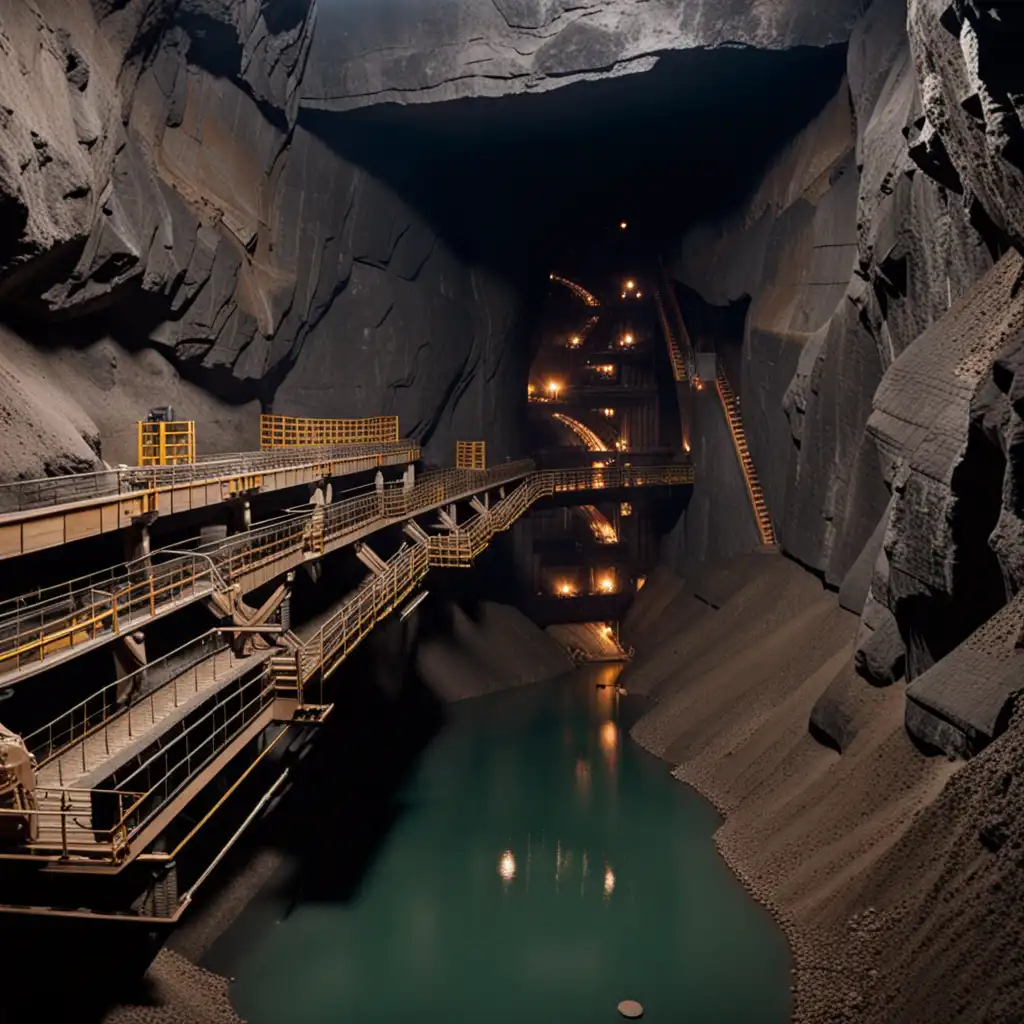
Resembling a large underground chamber or cave.
The cavernous coal mines stretched for miles under the mountain.

ˈkævərnəs
Having deep-set or cavernous physical features.
His cavernous eyes conveyed a depth of experience and wisdom.
No se pudo cargar el audio. Inténtalo de nuevo más tarde.
The word cavernous is used to describe a space or room that is very large, like a cave. It is often used to express the feeling of emptiness or vastness. For example, a cavernous hall is a very big room that might feel empty or echoey. It is also used to describe a person's voice that is deep and has a lot of resonance. In short, we use the word cavernous when we want to give the impression of a big, hollow and echoing space or object.
Broad means having a large width or distance across something, whereas the word cavernous means having a large, deep space or hole within something, like a cave.
For example, a river may be broad because it stretches across a wide area, while a cave may be described as cavernous because it has vast underground chambers.
Essentially, broad applies to things that are wide while cavernous applies to things that are deep or have large spaces within them.
Abrir palabra: Broad →This word is often used to describe a place that feels like a cave, with lots of space and echoes. Deep refers to something that is far down or below the surface level.
This can relate to both physical depth, such as a deep pool, or metaphorical depth, such as a deep conversation.
Ultimately, both words relate to the idea of something being large or significant, but cavernous focuses more on physical space while deep relates more to distance or intensity.
Abrir palabra: Deep →Gape on the other hand, refers to opening the mouth wide, often out of surprise or astonishment.
Cavernous describes large and empty spaces, while gape describes the act of opening one's mouth wide.
Abrir palabra: Gape →Both cavernous and hollow refer to empty spaces, but the difference lies in the size and shape of the space.
Cavernous describes large and spacious empty areas, like a big cave or an auditorium. Hollow refers to smaller and more enclosed spaces, like an empty bottle or a tree trunk.
Cavernous is applicable when referring to large, open spaces, while hollow is used for smaller, enclosed spaces.
Abrir palabra: Hollow →Cavernous and spacious both refer to a large area, but there is a difference in their meanings.
Spacious means that something has plenty of room, but it doesn't necessarily have to be huge or empty. It usually suggests a place that is comfortable, with enough space for people to move around freely.
For example, "The living room was spacious, with plenty of room for everyone to relax on the couch."
However, if you want to describe a place that is simply big with plenty of room to move around, you might use the word spacious.
Abrir palabra: Spacious →Vast describes something that is just really, really big, like the ocean or a desert.
You would use vast to describe things like an endless plain, an enormous mountain range, or the universe itself.
Abrir palabra: Vast →Cavernous and wide are both adjectives used to describe the size or breadth of something.
Wide simply means that something has a lot of width or distance between two points.
It doesn't necessarily imply darkness or echoes like cavernous does. For example, a road or river could be described as wide.
Cavernous describes a space that is large, dark, and echoey, while wide is simply used to describe something with a lot of width or distance.
Abrir palabra: Wide →Yawn on the other hand refers to an action that takes place when someone opens their mouth wide and inhales deeply, often due to fatigue or boredom.
Cavernous describes things that are spacious or large while yawn describes a physical reaction or action of a person.
Abrir palabra: Yawn →The otherworldly...
Ver en YouTube ↗It's very homely, this castle. It doesn't have huge ballrooms. I didn't want a cold, cavernous place.
The most important thing...
Ver en YouTube ↗Laughter is binary: It either happens or it doesn't. As each joke arrives in the course of a film, the cavernous space of the theater is either filled with joy and laughter or with the quiet of cringing embarrassment. Every time you step to the plate to make a joke, you're going to experience one or the other.
Foraging Under the Ice %\PIPE%...
Ver en YouTube ↗I remember when I first walked into Mayer's cavernous office. You had to walk 50 yards to get to him, and in that time he could really study everything about you.
The sound of things not...
Ver en YouTube ↗Indolence, of course, is an absolutely crucial part of the creative process: you do not find poets sitting in rows in cavernous word factories, staring at screens. They are rather to be found lolling on the sofa or strolling through the groves, nursing their melancholic temperaments and losing themselves in extended reveries.
ONE HOUR Of Amazing...
Ver en YouTube ↗Could you survive the...
Ver en YouTube ↗What obligation do...
Ver en YouTube ↗The Factory %\PIPE% Think Like...
Ver en YouTube ↗Dive into an ocean...
Ver en YouTube ↗How to disagree...
Ver en YouTube ↗