injunction
noun injunction
ɪnˈdʒʌŋkʃn
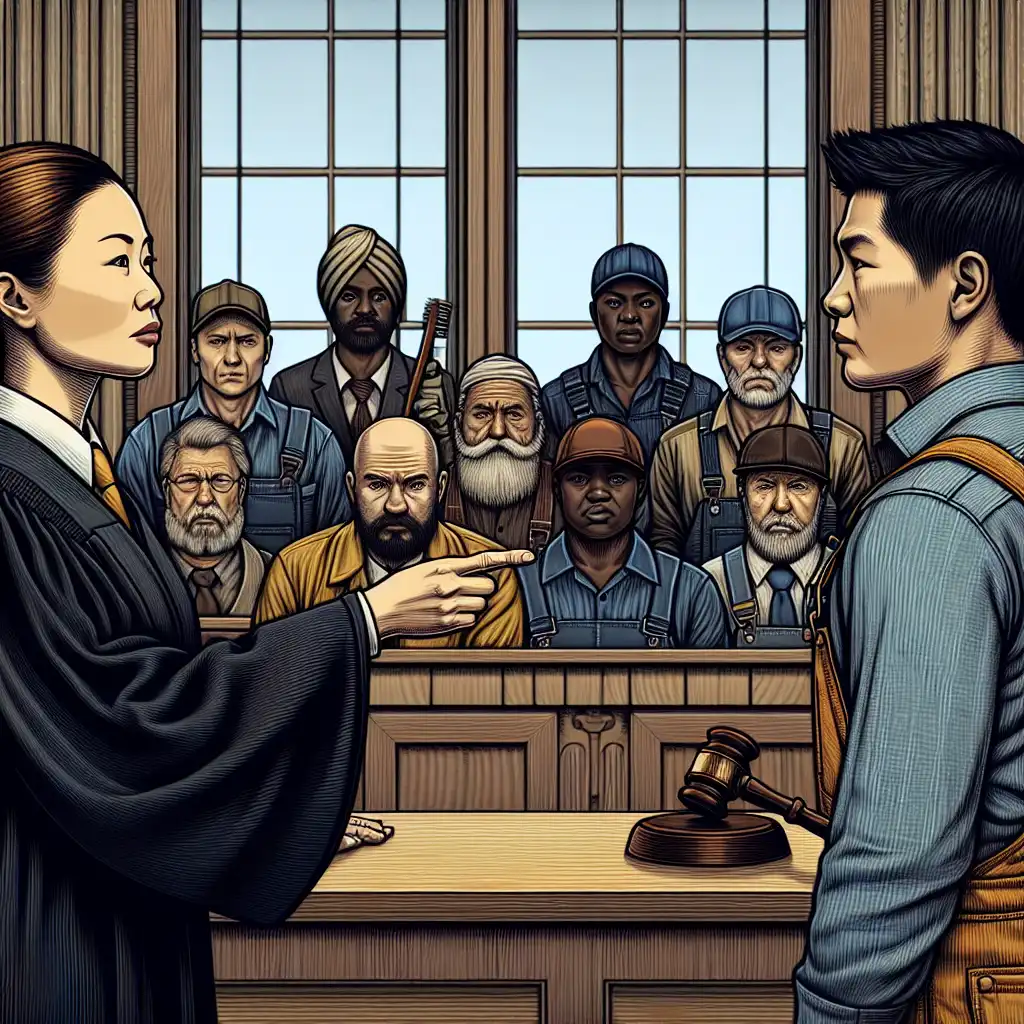
An official order from a court that demands something to be done or stopped
The company filed an injunction to stop the labour union's strike.
injunction
ɪnˈdʒʌŋkʃn
Loading…
ɪnˈdʒʌŋkʃn
An official order from a court that demands something to be done or stopped
The company filed an injunction to stop the labour union's strike.

ɪnˈdʒʌŋkʃn
A warning or order to do something
The head teacher gave an injunction to the students to keep the school clean.
Audio could not be loaded. Please try again later.
An injunction is a court order that tells someone to stop doing something. It is used when someone is doing something wrong or harmful that needs to be stopped. For example, if a company is polluting a river, the court may issue an injunction to make them stop polluting. Injunctions can also be used to require someone to do something, such as to turn over property or pay money owed. The word injunction is often used in legal and formal settings.
A ban is a prohibition or restriction on something. It means that something is not allowed or permitted, and it may be enforced by law.
For example, a ban on smoking in public places means that people are not allowed to smoke there.
The main difference between a ban and an injunction is that a ban is a general prohibition on something, while an injunction is a specific court order to stop doing something.
Bans are often implemented by lawmakers or governing bodies, while injunctions are typically issued by courts.
Open word: Ban →An edict is a formal public proclamation or order made by a person in authority.
It is typically used by a government or ruler to announce laws or regulations. For example, a king might issue an edict to declare war or establish a new tax law.
An edict is a formal order made by a person in authority, while an injunction is a legal order issued by a court.
Open word: Edict →Embargo refers to the restriction or prohibition that is imposed by a government or organization on certain goods or trade with a particular country or group.
An embargo is usually placed on countries that pose a threat to national security or for political reasons.
In essence, an embargo is a government or organizational tool that restricts trade or exchange of goods, while an injunction is a judicial order that prohibits a person or entity from taking a specific action.
Open word: Embargo →An injunction is a court order that requires someone to stop doing something, or to do something, while an interdiction is a prohibition or ban on something, often imposed by an authority.
Injunctions are typically used in legal cases where someone's rights have been violated, while interdictions are used by authorities to prohibit certain actions or behaviors that are deemed harmful or illegal.
For example, an injunction might be used to prevent a company from using a patented technology without permission, while an interdiction might be used to ban smoking in certain public places.
Overall, injunctions tend to be more specific and targeted, while interdictions tend to be broader and more general in scope.
Open word: Interdiction →An injunction is a court order that requires a person or entity to stop doing something or to refrain from doing something that could cause harm or damage to someone else.
An order is a court directive that requires a person or entity to do something specific. This could be something like paying damages or ordering someone to perform a specific action.
For example, if you were involved in a car accident and the other driver was found to be at fault, the court might issue an order requiring them to pay for your repairs.
An injunction is used to prevent harm while an order is used to enforce a particular action or payment.
Open word: Order →Prohibition is a law or rule that forbids people from doing something.
It is used to prevent harm or protect public safety. For example, there may be a prohibition on smoking in public places to protect people from secondhand smoke.
An injunction forces someone to do something or stop doing something, while a prohibition forbids people from doing something altogether.
Open word: Prohibition →A restraint is any action or measure taken to limit or control someone's behavior. This can be physical, such as restraining someone from moving or taking an object away from them, or it can be more abstract, like imposing rules or limitations on someone's actions.
An injunction is a specific legal order issued by a court, while restraint is a broader term that can refer to any measure taken to limit someone's behavior.
Open word: Restraint →Injunction and veto are two different legal terms. An injunction is a court order that prohibits or requires a particular action, while a veto is a power given to a person in authority to reject or veto an existing law or decision.
A veto is a mechanism used by those in authority to stop the implementation of a law or decision. The power of veto is typically held by chief executives of a country, such as US presidents or governors, and can be wielded to prevent legislation from becoming law, to prevent court nominees from being confirmed, or to stop the implementation of a government decision.
In summary, injunctions are used by courts to prevent harm or enforce legal rights, while vetoes are used by those in authority to stop laws or decisions they disagree with.
Open word: Veto →They are symbolically fed and cared for, and the family at this time will begin a number of ritual injunctions, which communicates to the wider community around them that one of their members is undergoing the transition from this life into the afterlife
Watch on YouTube ↗Part of the reason there's an injunction to the truth, for example, is that if you're in a circumstance of extreme uncertainty, your best weapon, let's say, or your best tool or your best defense is the truth, because it keeps things simpler.
A realistic view of humanity will stop the proliferation of impossible injunctions.
Every moral teacher or spiritual adviser gives injunctions about how to live wisely and well. But life is so complicated and full of uncertainty that rules seldom tell us quite what to do.
Desires collide; the wish to eat bumping up against the wish to be thin, the desire to indulge conflicting with the injunction to restrain. Small wonder food makes a woman nervous.
The character I've created, Christine, is mainly the first attempt for me to escape all the secret injunctions we have as girls all the time. Like, be pretty but be polite. Don't take too much space. All those things that didn't mean anything to me. I just decided to turn them around with my character.
I enjoy personal injury cases. I've tried quite a few of those. And, frankly, any kind of litigation that is trouble-shooting, whether it's equities, suits and injunctions, or whatever.
Empathy is born out of the old biblical injunction 'Love the neighbor as thyself.
At its best, an injunction creates a kind of vigilant heat that moves kids toward the light.
They may well say not only is this not true, but I will put in an injunction to prevent publication. No, stories don't go in unless I'm convinced by the people who write them that they're true. And if I'm wrong, then so be it.
You take out an injunction against somebody or some organisation and immediately news of that injunction and the people involved and the story behind the injunction is in a legal-free world on Twitter and the Internet. It's pointless.