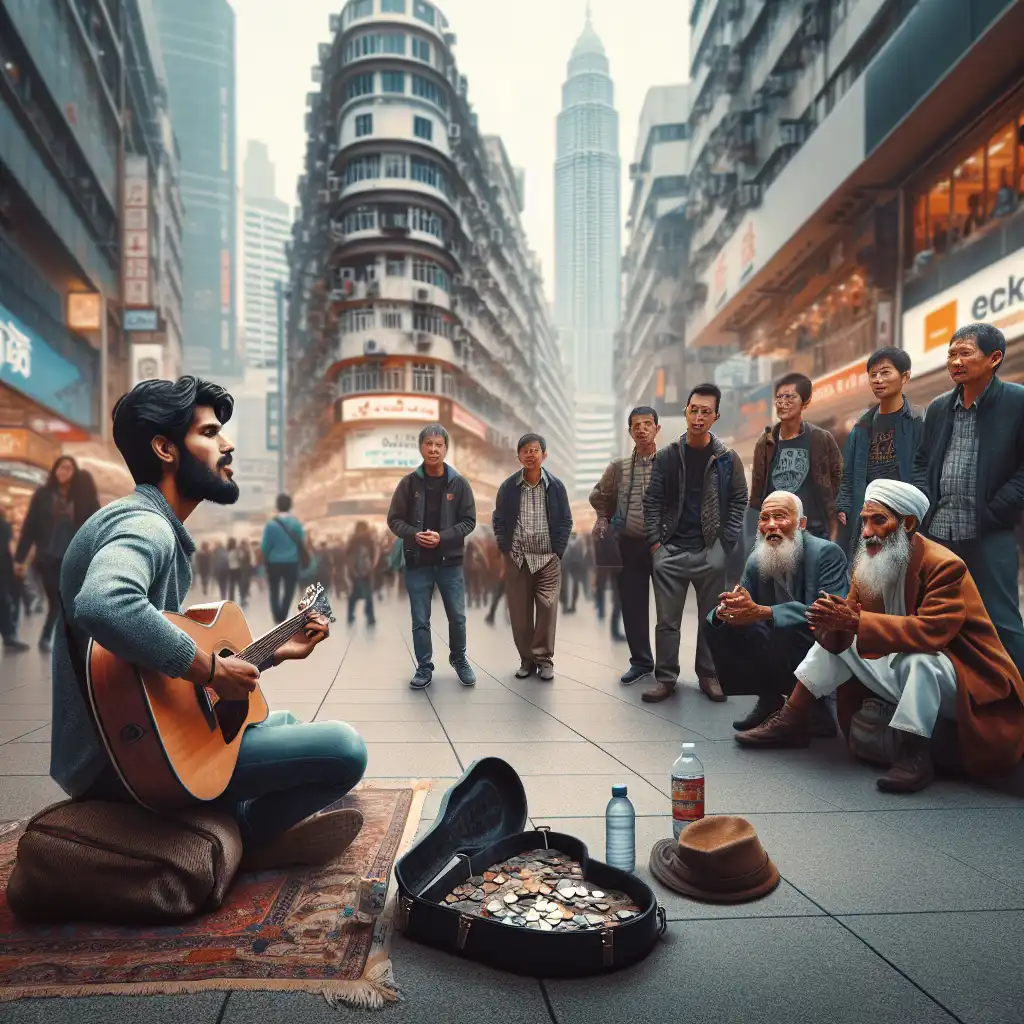
busk
verb busk
bʌsk
To perform music or other entertainment in the street or other public place for monetary donations.
She decided to busk in the city center to make some extra money.
busk
bʌsk
Chargement…
bʌsk
To perform music or other entertainment in the street or other public place for monetary donations.
She decided to busk in the city center to make some extra money.

bʌsk
To make preparation or be ready for something.
They busked for the arrival of the guests.
Impossible de charger l’audio. Réessayez plus tard.
The word 'busk' means to perform in public places, such as on street corners or in parks, for money or other donations. Busking can involve singing, playing an instrument, or performing tricks or comedy. It is often seen as a way for artists to gain exposure and make a living, and can be done legally with the proper permits in many cities around the world.
Croon refers to singing in a soft, gentle voice, often with a romantic or sentimental tone.
It is typically associated with the style of popular music from the early to mid-20th century, where male singers often crooned to love ballads.
So, busking is applicable when one wants to perform music or dance in a public place for money, while crooning is applicable when one wants to sing in a soft and gentle voice, typically for romantic or sentimental songs.
Ouvrir le mot: Croon →Busk means to perform on the street or in a public place for money, often through music or other entertaining activities.
Entertain means to provide enjoyment or amusement through a variety of activities, which may or may not involve a monetary exchange.
Entertaining can be done in various settings, such as parties, theaters, shows, or even on the street.
The main difference between these two words is that 'busking' usually involves performing in public for money, whereas 'entertaining' can be done in different contexts and does not necessarily have to involve a financial exchange.
Ouvrir le mot: Entertain →Perform usually means to entertain an audience through a planned and rehearsed act, such as singing, dancing, or acting on a stage or in front of a camera.
Performing requires preparation, planning, and skill, whereas busking relies on creativity, spontaneity, and the ability to engage with passersby in real time.
Therefore, performing is applicable in more formal settings, such as theaters or venues, while busking is more appropriate for informal outdoor settings.
Ouvrir le mot: Perform →Serenade refers to a musical performance in which someone sings or plays an instrument for someone else, usually as a romantic gesture.
A serenade is often performed at night under the window of the recipient of the gesture, and is accompanied by the player's heartfelt vocals or music.
So, in summary, busking is performing in public for money, while a serenade is a musical performance done to express romantic feelings.
Ouvrir le mot: Serenade →Busk means to perform music or other entertainment in a public place for donations or money. It typically involves playing an instrument or singing on the street, in a park, or anywhere else people can gather around to listen.
"Singing," on the other hand, simply means to use your voice to make musical sounds, whether alone or in a group, without necessarily expecting payment.
So, "busking" is a specific way of performing music for a living or extra income, while "singing" can be done for fun or in a more formal setting like a choir or concert.
Ouvrir le mot: Sing →Busk refers to playing music or performing on the street or in public places without being paid. Strum means to play a stringed instrument like a guitar or ukulele by moving the fingers across the strings (usually with a plectrum or pick) to create a rhythmic and melodic sound.
Busk refers to performing in public without payment, while strum refers to playing a stringed instrument like a guitar or ukulele.
Ouvrir le mot: Strum →A Traveling Circus and...
Voir sur YouTube ↗To be honest, busking was a massive part of becoming aware of homelessness. I used to run into a lot of 'Big Issue' sellers and a lot of people on the street. It really opened my eyes to the kind of life that they live and the options that are open for them - or not, actually.
I chose busking because I didn't want to be working for someone else. I wanted to work as I am. I feel like you ultimately do have a choice if you have your vision. So, I had a vision forever that I was going to play music. And there was no stopping that.
I thought the world of live performance and busking was where I was going to thrive. I had no idea that digital streaming platforms and radio and that world would be for me, you know?
I was very lucky. Things happened, both bad and good, but I never got into real, deep trouble. But it wore me down. By the time I was 18, I was done. I didn't want to live the life any more. I needed to develop past the point that busking takes you to.
Well, everything about singing, I learned from busking. Everything I learned about songwriting, I learned from busking.
I'm a complete and utter busker.
Without busking, there is no Fantastic Negrito.
I worked in a supermarket for a year; I worked in a finance department at a university, a pub, busking and singing. I tried to be a nanny for about three weeks.
It's cliche, but everybody says, 'We're all one song away,' and it's so true. The difference between me and the guy down the street busking with his guitar case open is just one song.
I've done my share of busking, and it's fun until it isn't. There are musicians in the subways that will make you cry, they're so good.