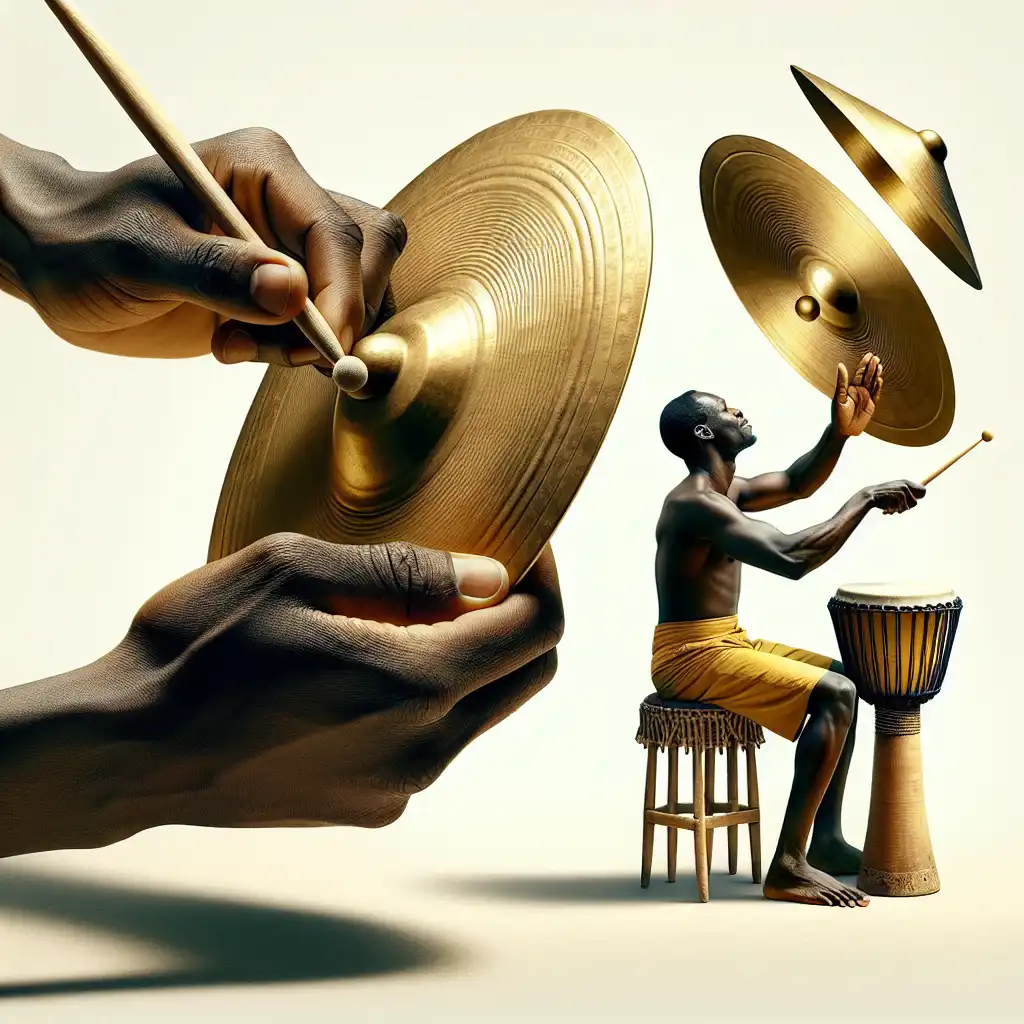
cymbal
noun cymbal
ˈsɪmbl
A musical instrument shaped like a dish, played by hitting it with a drum stick or clapping two cymbals together.
The drummer crashed the cymbals together at the end of the song.
cymbal
ˈsɪmbl
加载中…
ˈsɪmbl
A musical instrument shaped like a dish, played by hitting it with a drum stick or clapping two cymbals together.
The drummer crashed the cymbals together at the end of the song.
音频无法加载,请稍后再试。
A cymbal is a musical instrument that is made of metal and is often used in bands or orchestras. It is a flat, circular shape and makes a loud crashing sound when struck with a drumstick or other object. Cymbals are often used to add emphasis or drama to music, and they can be played in various ways to create different effects. You might see cymbals being used in a rock concert, a marching band, or a symphony orchestra.
A bell and a cymbal are both percussion instruments, but they have slightly different uses and sounds.
A bell is a hollow metal object that typically has a round shape with a tapered top; it can be struck with a mallet or rung by pulling a clapper inside it.
Bells are often used in orchestras, churches, and as signals in everyday life, such as doorbells or school bells.
A bell is a hollow, round metal object that is struck or rung, while a cymbal is a flat, round piece of metal that is usually struck with drumsticks and has a loud, crashing sound.
打开单词: Bell →Brass and cymbal are both musical instruments, but they are different from each other.
Brass refers to instruments made of brass metal, such as trumpets, trombones, and tubas. These instruments are played by blowing air through a mouthpiece to create sound.
Brass instruments are often used in orchestras and bands.
Cymbals are percussion instruments made of metal, usually brass or bronze. They consist of two circular plates that are struck together to make a loud, crashing sound.
Brass instruments are played by blowing and have a melodic function in music, while cymbals are struck together and have a rhythmic function in music.
打开单词: Brass →A drum is a percussion instrument that is typically played using sticks or hands. It is made up of a cylindrical or barrel-shaped body, which is covered with a stretched membrane or drumhead.
When the drum is struck, it produces a deep, resonant sound.
In terms of application, drums are typically used in bands and orchestras to provide rhythm and tempo. They are also commonly used in rock, pop, and jazz music.
打开单词: Drum →A gong is a larger, flat disc-shaped percussion instrument also made of metal. It produces a deep, resonant sound when struck with a mallet or drumstick.
Gongs are often used in orchestras, meditation and yoga practices, and for effect in sound recordings.
The main difference between cymbals and gongs is their size and the type of sound they produce. Cymbals are smaller and produce a sharp, high-pitched sound while gongs are larger and produce a deep, reverberating sound.
打开单词: Gong →A keyboard is a musical instrument that produces sound by pressing keys, which activate hammers that strike strings or fiddle with electronic mechanisms that create tones.
Keyboards can be used for a wide range of music genres, including classical, jazz, electronic, pop, and rock.
A cymbal is a metal percussion instrument used in drum sets, while a keyboard is an instrument that creates sound by pressing keys and can be used for a variety of music genres.
打开单词: Keyboard →Cymbals are a type of percussion instrument, but percussion includes a much wider range of instruments than just cymbals.
Percussion includes a range of instruments that produce sound by being struck, shaken or scraped, such as drums, maracas, tambourines, xylophones, and many more.
Percussion instruments can be used in a variety of musical genres, including classical, rock, jazz, and more.
打开单词: Percussion →A tambourine is a handheld percussion instrument that consists of a circular frame with small metal jingles around the edge.
The musician shakes or hits the tambourine to create a jingling sound. It is commonly used in folk or pop music to provide a rhythmic accompaniment.
A cymbal is a metal instrument that is hit together to create a crashing sound, while a tambourine is a circular handheld instrument with jingles that is shaken or hit to create a jingling sound.
打开单词: Tambourine →A cymbal and a triangle are both musical instruments, but they are different from each other.
A triangle is a percussion instrument that's made of a metal rod bent into the shape of a triangle, with one side left open.
In summary, cymbals are large metal plates that are hit together for a crashing sound, often used in rock and jazz. Triangles are a small metal rod shaped like a triangle that's hit with a beater for a ringing sound, often used in orchestral music.
打开单词: Triangle →Self-Possession %\PIPE%...
在 YouTube 上观看 ↗A lot of modern amps and preamps sound great when you're jamming by yourself, but don't hold up in a band situation. The sound isn't dense enough, and the lows and highs tend to get soaked up by the bass and cymbals.
There are parts on 'Wind's Poem' that are literal recordings of wind. I had this old sound effects record that I got some wind from and then I figured out that distorted cymbals sound just like wind so I used that a lot.
It's as if my left heel is my bass drum and my right heel is the floor tom-tom. I can get snare out of my right toe by not putting it down on the floor hard, and, if I want cymbals, I land flat on both feet, full strength on the floor.
I'm always getting injuries like bruised and bloody knuckles from catching a cymbal or the edge of a drum.
My idea is to play with the people who you know want to get it right. Then it's fun and easy to record, and you can get down to details, like taking out cymbals so the verse doesn't dwarf the chorus, something like that.
When you're going for a joke, you're stuck out there if it doesn't work. There's nowhere to go. You've done the drum role and the cymbal clash and you're out on the end of the plank.
I would break a lot of cymbals. You whack the cymbals hard enough, and they will crack in half. Drums are not actually as sturdy as they look. They're actually somewhat fragile instruments.
In my old age, I've learned that if I put the right cymbal crash in the very right spot, exactly, it can be as powerful as all my showoff drum rolls in my 20s.
If Bill jumps into something that relies on a lot of cymbals, I'll jump into something that relies on a lot of skin sounds; if he goes into metal tones, I'll go into wood, and so on. I basically play in his holes.
One that really caught me was Joe Morello. He was the first drummer I ever saw that could do a roll with one hand. He would turn his hand over and use his fingertips to get the stick bouncing. He could sit there with his right hand doing stuff on the cymbals and tom-toms while he was doing a roll with his left on the snare drum.