corpuscle
noun corpuscle
ˈkɔːrpʌsl
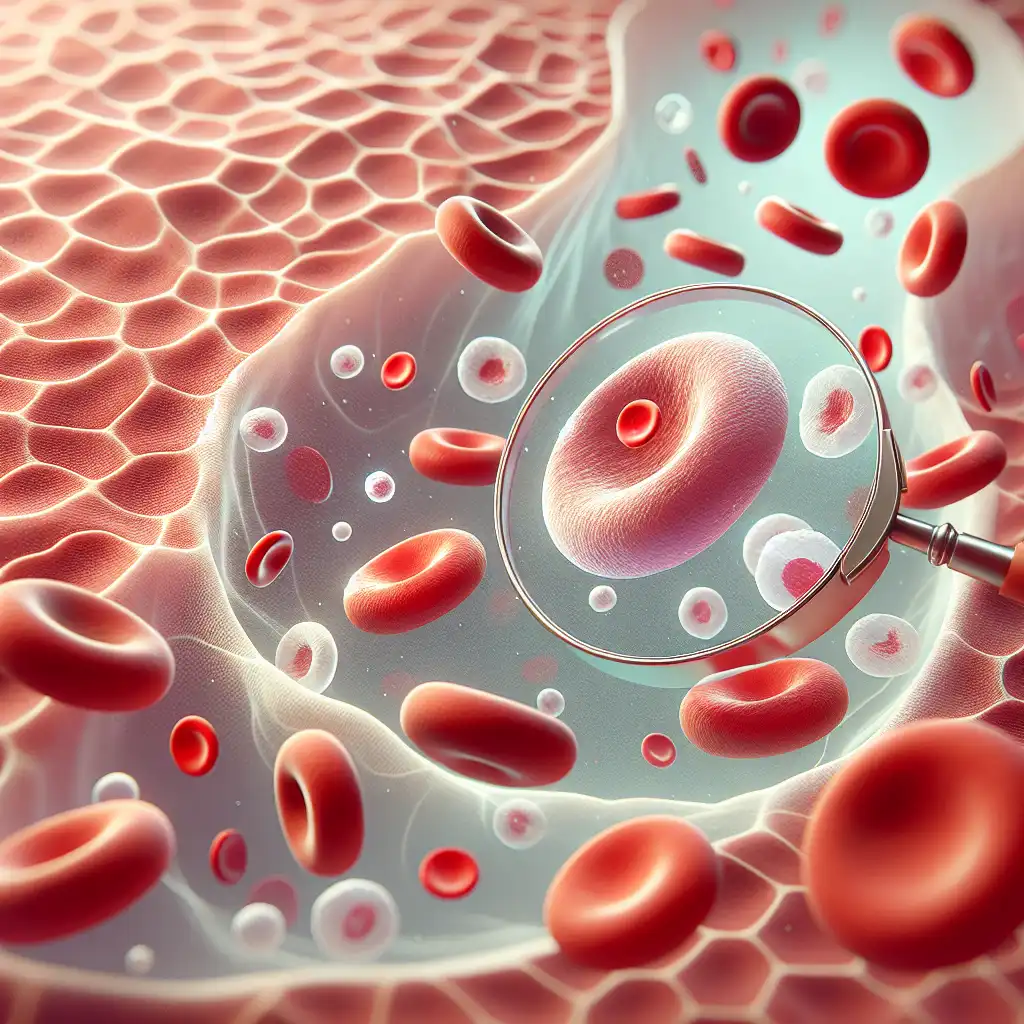
A tiny particle or cell in the body, like a blood or skin cell
Red and white blood corpuscles are carried in the blood stream.
corpuscle
ˈkɔːrpʌsl
Đang tải…
ˈkɔːrpʌsl
A tiny particle or cell in the body, like a blood or skin cell
Red and white blood corpuscles are carried in the blood stream.

ˈkɔːrpʌsl
A minute particle regarded as the basic constituent of matter or light
Light is composed of corpuscles.
Không tải được âm thanh. Vui lòng thử lại sau.
A corpuscle is a really tiny particle, like a blood cell. You might hear this word if you are learning about science, specifically the human body or biology. Scientists use it to describe different types of cells or particles that make up our bodies. It's not a word you would use in everyday conversation, but it's good to know if you are studying science.
Both words refer to tiny particles that make up matter, but atom specifically refers to the smallest unit of a chemical element that retains its properties, while corpuscle can refer to any small particle, including subatomic particles like electrons and protons.
In practice, atom is a more commonly used term in chemistry to refer to the building blocks of matter, while corpuscle may be used more often in physics, where particles that are smaller than atoms are studied.
For example, physicists might use the term "electron corpuscle" to refer to a particular type of subatomic particle.
Mở từ: Atom →Both the words cell and corpuscle refer to small units of matter in biology, but they are used differently.
A cell is the basic building block of all living organisms. It is a microscopic structure that can perform all the functions necessary for life, such as obtaining energy, reproducing, and responding to stimuli.
Cells are found in all living things, including plants, animals, and bacteria.
A corpuscle is a general term that refers to any small, rounded structure or particle. In biology, it is often used to refer to specific types of cells, such as blood cells or nerve cells, which are also known as corpuscular cells.
However, corpuscles can also refer to non-cellular particles found in the body, such as red blood cells, white blood cells, or platelets.
A cell is a specific type of corpuscle, and it refers to the basic unit of life, while corpuscle is a more general term used to describe small, rounded structures or particles in biology.
Mở từ: Cell →It is often used in biology to describe blood cells or other microscopic particles. Element refers to a basic building block of matter.
In simpler terms, a corpuscle is a small part of something else, such as a cell in the body, while an element is a fundamental substance that makes up everything around us.
Mở từ: Element →Germ usually refers to a microorganism that can cause disease, such as bacteria or viruses.
So, while corpuscle is a more general term for small particles or cells, germ is specifically used when referring to harmful microorganisms.
Mở từ: Germ →A microbe refers specifically to a microscopic organism, such as a bacteria, virus, fungi, or protozoa. Microbes are present in various environments, from soil to water to human bodies, and can cause diseases or be beneficial.
A corpuscle is a term used for any small structure, whereas a microbe specifically refers to a microscopic organism.
Mở từ: Microbe →A molecule is a group of two or more atoms held together by chemical bonds. It is applicable in the context of chemistry, where it refers to the smallest unit of a compound that retains the properties of the compound.
A corpuscle is a small particle of matter or a blood cell, while a molecule is a group of atoms held together by chemical bonds.
Corpuscles are applicable in biology and physics, while molecules are applicable in chemistry.
Mở từ: Molecule →Corpuscle and particle are both words used to describe small pieces or units of matter, but they are often used in different contexts.
A corpuscle typically refers to a small cell or particle within a living organism or tissue. For example, red blood cells are often referred to as corpuscles.
A particle is a more general term that refers to any small unit of matter, regardless of whether it is living or non-living.
Particles can be found in a wide range of disciplines, from physics and chemistry to environmental science and engineering.
So, while both words refer to small units of matter, corpuscle is typically used in the context of biology and medicine, while particle is a more general term that can be used across a range of scientific fields.
Mở từ: Particle →Corpuscle refers to a small, living cell in the body such as red or white blood cells, while unit refers to a single, separate entity that can be part of a larger group.
The term corpuscle is mostly used in biology, while unit is used in various fields such as mathematics, physics, and management.
For example, in math, a unit can refer to a standard quantity used to measure something, while in management, a unit can be a department or team within a company.
Mở từ: Unit →Is light a particle or a...
Xem trên YouTube ↗The most direct evidence of the wonderful plasticity and elasticity of red corpuscles is obtained when they are watched in a current, where they can be caught against a projecting edge and bent by the pressure of the current flowing past them.