lake
noun lake
leɪk
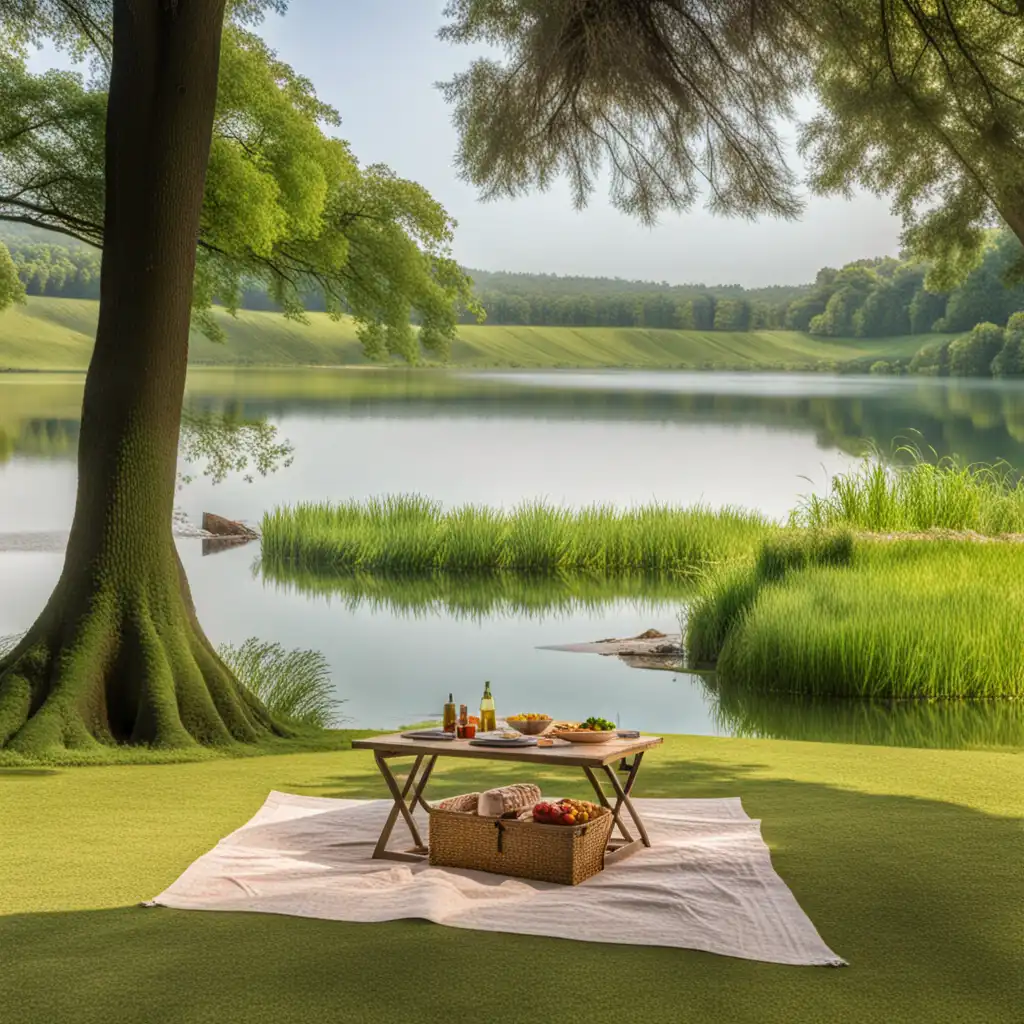
A body of freshwater surrounded by land
The picnic was held beside a beautiful lake.
lake
leɪk
लोड हो रहा है…
leɪk
A body of freshwater surrounded by land
The picnic was held beside a beautiful lake.
leɪk
A bright pigment used in painting and dyeing
Pure blue lake is used to create a calming effect in the painting.
ऑडियो लोड नहीं हो सका। कृपया बाद में फिर कोशिश करें।
A lake is a large body of water surrounded by land. It's different from a river or a stream because it doesn't move much or flow in any one direction. You might find lakes in parks, forests, and even cities. People enjoy visiting lakes to swim, fish, boat, or just relax and enjoy the beautiful view. The word "lake" can be used to describe a specific body of water or as a general term for any wide and deep body of water.
A lake is a large body of water that is surrounded by land, and often has its own name, while a bayou is a slow-moving, long and narrow body of water, usually a small stream or creek, that is often found in flat areas such as swamps, marshes or lowlands.
Bayous are more common in places like Louisiana and Florida, while lakes can be found all over the world.
Essentially, a bayou is a narrow waterway embedded in lowlands, whereas a lake is a larger body of water surrounded by land.
शब्द खोलें: Bayou →A fjord is a long, narrow inlet of the sea between steep cliffs or slopes, formed by glacial erosion. It is considered a type of coastal feature because it is connected to the sea.
For example, the famous Norwegian fjords are natural waterways that were formed by glaciers during the last Ice Age.
The main difference between fjords and lakes is that fjords are coastal features that are connected to the sea, whereas lakes are inland bodies of water that are not connected to the sea.
शब्द खोलें: Fjord →A lagoon is a body of shallow water that is separated from the ocean by sandbars, coral reefs, or other natural barriers.
A lagoon is a shallow body of water that is connected to the ocean, while a lake is a large body of freshwater that is not connected to the ocean.
The term lagoon is applicable when describing shallow water formations along the coastline, while the term lake is more appropriate when describing large freshwater bodies of water that are surrounded by land.
शब्द खोलें: Lagoon →A lake is generally larger and deeper than a pond. Lakes are often surrounded by land, and they usually have different levels of water that support different types of fish and plant life.
In contrast, ponds are smaller and shallower than lakes. They are usually less than 10 acres in size and are often surrounded by vegetation.
Ponds typically have a constant depth and support a smaller variety of plant and animal life than lakes.
Ponds can also be natural or man-made and are often used to support fish, wildlife, and agriculture.
The main difference between a lake and a pond is their size and depth. Lakes are larger and deeper, while ponds are smaller and shallower.
Additionally, lakes are used more for recreational activities, while ponds are often used to support fish and wildlife, as well as agricultural practices.
शब्द खोलें: Pond →A pool is a small body of water that is usually man-made, such as a swimming pool.
A lake is a natural body of water that is usually large and deep, while a pool is a smaller, man-made body of water that is shallow and used for recreational purposes.
शब्द खोलें: Pool →A reservoir is an artificial, human-made body of water.
It is usually created by blocking a river, stream or watercourse with a dam. Reservoirs are created to store water for different purposes, such as irrigation, hydroelectric power generation, and to provide drinking water to populated areas.
They are usually larger than lakes and can contain much more water. Reservoirs are usually devoid of natural vegetation and wildlife, though they can be stocked with fish for fishing.
In summary, lakes are natural bodies of water that exist in nature, whereas reservoirs are man-made and serve specific human needs.
शब्द खोलें: Reservoir →A tarn is a small mountain lake or pool. It is generally located in a high-altitude region, such as a mountain range, and is often formed by the melting of snow or ice.
In summary, lakes are large bodies of water found in a variety of different environments, whereas tarns are small mountain lakes or pools that are formed by melting snow or ice.
शब्द खोलें: Tarn →But first that spirit must pass through the duat or underworld. This is a realm of vast caverns, lakes of fire, and magical gates, all guarded by fearsome beasts - snakes crocodiles and half-human monstrosities
YouTube पर देखें ↗The lake and the mountains have become my landscape, my real world.
a lake of concentrated salt water 15 meters deep at the bottom of the sea
YouTube पर देखें ↗Perhaps the truth depends on a walk around the lake.
When you look how over this lake, and almost every winery has a beautiful outlook, I think that's what attracts people to come here. There's something unique happening here. We've met so many passionate wine makers. They've immersed us in the process. They've left us with this feeling
YouTube पर देखें ↗When I was 12 years old, I went to swim in a lake, and I almost died in that lake because the water was too deep - much deeper than I thought.
But at the time we enter that lake at the very moment we enter that lake, we are stepping back three and a half billion years in the past of another planet, and then we are going to get the answer came for. Life is everywhere absolutely everywhere.
YouTube पर देखें ↗I ran off stage at my first gig. Halfway through it, I forgot my lines and didn't know what to do, so I just ran out of the building down towards a lake. I was going to throw myself in, but the compere came out and said, 'No, it's going well, come back and finish the gig!
lush oasis in comparison to Mars and this is because we enjoy the luxury of life's most precious commodity water Mars did have water in its past billions of years ago it had rivers and lakes and may have looked a lot like the earth so the question is could there have been
YouTube पर देखें ↗The truth is, I can never die. For I will be in everything and see you in everything and watch over you. I am your reaction in the water of a mountain lake.
These immense ice sheets carved out a series of basins. Those basins filled with water as the ice began to melt, creating the world's largest area of freshwater lakes. Over time channels developed between these basins, and water began to flow in an ongoing exchange
YouTube पर देखें ↗When I write, I normally write anywhere that I can feel at peace, so if it's in my bedroom, if it's at the park, if it's by a lake somewhere, wherever I feel calm is where I like to write.
vision capability any night filming infrared all that stuff we'd been up for several hours mostly what we saw were various impala gazelle some elephant as well that had gathered around this salt lake all of a sudden it was heads up
YouTube पर देखें ↗I grew up in a family where everybody had a good time and we were at the lake every weekend and going to the beach and living a good life. It's been the way we always lived, and my wife's the same way - enjoy every day and have fun.
this importance of blue spaces so that's any environment that features water could be lakes rivers canals and of course the coast and what's really interesting is it looks like the margins might be most important where those two environments the green and the blue meet
YouTube पर देखें ↗My Mom said she learned how to swim when someone took her out in the lake and threw her off the boat. I said, 'Mom, they weren't trying to teach you how to swim.
They may be tiny look harmless and sound like a bunch of cartoon characters, but don't be fooled. These little guys are plotting ocean domination. Nurdles are some of the planet's most pervasive pollutants, found in lakes rivers and oceans across the globe.
YouTube पर देखें ↗I grew up with the smell of the lake and the feeling of the woods.
We've doubled the flows of nitrogen and phosphorus around the world simply by using fertilizers, causing huge problems of water quality from rivers, lakes and even oceans and it's also the single biggest driver of biodiversity loss. So without a doubt agriculture is
YouTube पर देखें ↗I grew up on a lake on the border of Washington and Idaho.