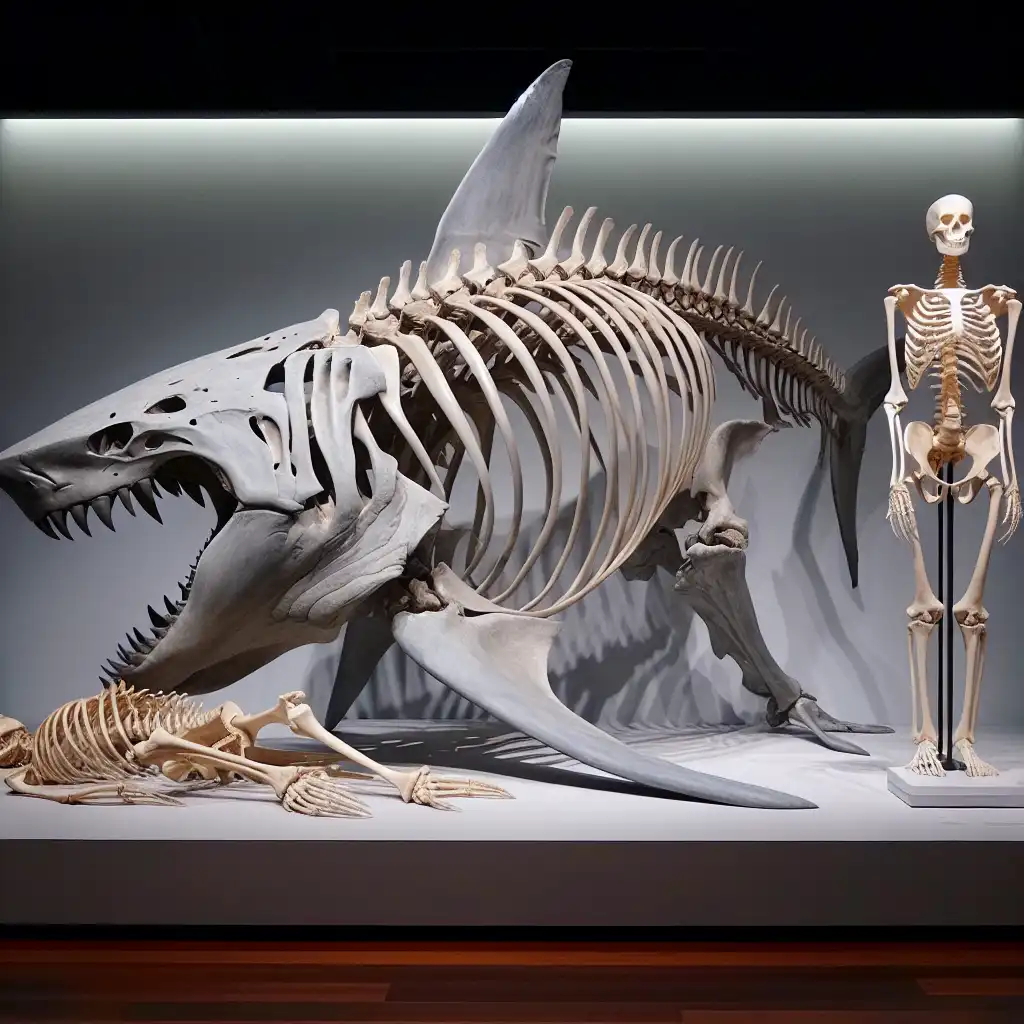
cartilaginous
adjective cartilaginous
ˌkɑːrtɪˈlædʒɪnəs
Related to or made of a firm, flexible tissue called cartilage.
The shark's skeleton is cartilaginous, not made out of bone like ours.
cartilaginous
ˌkɑːrtɪˈlædʒɪnəs
Cargando…
ˌkɑːrtɪˈlædʒɪnəs
Related to or made of a firm, flexible tissue called cartilage.
The shark's skeleton is cartilaginous, not made out of bone like ours.

ˌkɑːrtɪˈlædʒɪnəs
Relating to the part of the body where two bones meet, surrounded by cartilage.
The doctor said the cartilaginous joint between my knee bones was damaged.
No se pudo cargar el audio. Inténtalo de nuevo más tarde.
The word 'cartilaginous' is used to describe something that is made of cartilage, which is a firm but flexible type of tissue in the human body. This word is often used to refer to animals with a skeleton made primarily of cartilage, such as sharks or rays. So, if you are talking about a creature that has a skeletal structure made of cartilage, you can use the word 'cartilaginous' to describe it.
Connective tissue is a broader term that refers to any tissue that supports, binds, or connects other tissues or organs in the body.
This can include cartilage, as well as bone, blood vessels, and various types of fiber. Cartilaginous would be used to describe a specific type of tissue, whereas connective could be used to describe a variety of different tissues with different functions.
Abrir palabra: Connective →Dense refers to something that is tightly compacted or has a high concentration of material in a given area.
Dense is applicable in areas where strength and durability are important, such as the bones.
In simpler terms, cartilaginous refers to something that is bendy and shock-absorbing, while dense refers to something that is hard and tough.
Abrir palabra: Dense →Elastic describes something that can stretch and return to its original shape, like a rubber band. It is applicable when referring to materials that need to be flexible enough to accommodate movement, such as the elastic bands in clothing that allow them to stretch and fit comfortably.
Cartilaginous refers to something tough and flexible, while elastic refers to something that can stretch and return to its original shape.
Abrir palabra: Elastic →Fibrous refers to a type of tissue that is tough and made up of tough, fibrous protein fibers. This type of tissue can be found in places like tendons and ligaments, which connect muscles and bones in the body.
Cartilaginous tissues are softer and more flexible, while fibrous tissues are tougher and more rigid. Each type of tissue is used in different parts of the body to perform different functions.
Abrir palabra: Fibrous →Firm refers to something that is solid, sturdy, and not easily moved or changed. It is applicable in many contexts such as texture, physical strength, hardness, etc.
For example, a ripe banana can be considered firm, indicating it has not yet decayed to softness.
Abrir palabra: Firm →Resilient refers to something that is able to recover quickly from difficult situations, setbacks, or stress. It is applicable when describing the ability of a person or thing to bounce back from challenges or adversity.
Cartilaginous describes a physical attribute, whereas resilient describes a more abstract quality related to adaptability and toughness.
Abrir palabra: Resilient →Tough refers to something that is strong, sturdy, and durable.
Although there may be some overlap in certain contexts, in general, cartilaginous describes physical structures or tissues that have a certain level of flexibility or elasticity, while tough describes materials or objects that are resistant to damage or wear and tear.
A football helmet is tough, meaning it is made of strong, durable materials that can withstand impacts and protect the player's head.
Abrir palabra: Tough →Safari Live - Day 138 %\PIPE%...
Ver en YouTube ↗Why are sharks so...
Ver en YouTube ↗