
senescence
noun senescence
sɪˈnesns
The condition or process of becoming old.
The plant is at the stage of senescence, which is why it is showing signs of decay.
senescence
sɪˈnesns
불러오는 중…
sɪˈnesns
The condition or process of becoming old.
The plant is at the stage of senescence, which is why it is showing signs of decay.
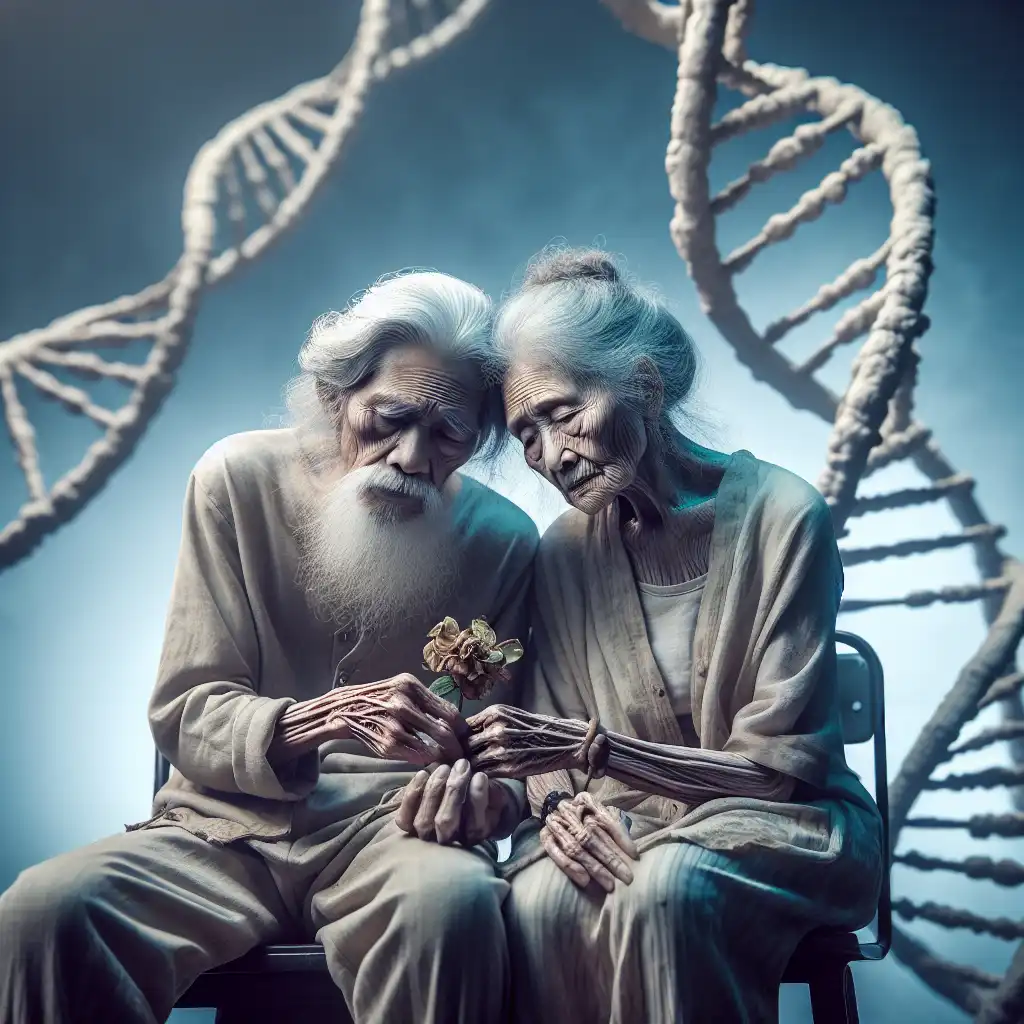
sɪˈnesns
The natural period in the life of an organism in which it ceases to be physically capable of reproduction and growth, eventually leading to decay and death.
The onset of senescence in varied organisms seems to be associated with specific genetic factors.
오디오를 불러오지 못했어요. 잠시 후 다시 시도해 주세요.
The word senescence refers to the process of aging, where the body and mind start to slow down and degenerate with time. This word is most commonly used in biological contexts, such as the aging of cells or the aging of organisms. It can also be used more figuratively to describe the decline or deterioration of something over time. For example, we might talk about the senescence of a culture or a language that is no longer as vibrant or widely used as it once was.
Age refers to the length of time a person has been alive, while senescence refers to the biological process of aging and deterioration that occurs in all living things over time.
Age is applicable in everyday conversations and discussions about birthdays and milestones, while senescence is used in scientific discussions about the biological mechanisms of aging.
In simpler terms, age is how long you've been alive, while senescence is the natural process that causes your body to change as you get older.
단어 열기: Age →Decay refers to the process of breaking down or decomposing organic materials over time.
Decay is applicable to non-living organic matter, while senescence is applicable to living organisms.
단어 열기: Decay →Decline refers to a gradual decrease in quality or strength over time, while senescence refers to the natural process of aging and eventual deterioration of living organisms.
Decline can be applied to various things such as the economy, health, or abilities of an individual. For example, the economy may experience a decline due to a decrease in consumer spending, a person's health may decline due to an illness or aging, and an athlete's physical abilities may decline as they age.
While decline can sometimes be prevented or revitalized, senescence is irreversible and occurs as a part of normal life.
단어 열기: Decline →Both decrepitude and senescence refer to the ageing process, but they are used in different contexts.
Decrepitude refers to the state of being extremely worn out or weakened due to old age or prolonged use. It describes something that is falling apart, breaking down, or failing due to age, such as an old building or an old car.
So, while decrepitude refers to physical deterioration due to age, senescence describes the natural ageing process of living organisms.
단어 열기: Decrepitude →Degenerate refers to the process of decline, deterioration, or corruption of something or someone.
It is typically used to describe circumstances where things are becoming worse or less valuable, such as a degenerate society or degenerate behavior.
Degenerate emphasizes decline, while senescence focuses on a natural process of deterioration that affects all living things over time.
단어 열기: Degenerate →Deteriorate means to gradually worsen or decay over time.
Deteriorate refers to a gradual decline or decomposition of something over time, while senescence refers to the natural aging process in living organisms.
단어 열기: Deteriorate →Wane refers to a gradual decrease or weakening of something over time. The term is usually applied to non-living things or concepts such as power, influence, or popularity.
For example, the popularity of a trend or a celebrity might wane over time.
Senescence describes the natural aging process of living organisms, while wane describes the gradual decrease or weakening of non-living things or concepts over time.
단어 열기: Wane →Senescence refers to the natural process of aging that occurs in living organisms. It involves changes in the body at the cellular and molecular level, including a decline in the functioning of various organ systems.
Senescence is a normal and inevitable process that occurs over time, and can be influenced by both genetic and environmental factors.
Wear and tear refers to physical damage or degradation that occurs over time as a result of use or exposure to external factors.
Unlike senescence, wear and tear is not an inevitable process, and can be mitigated by proper maintenance and care.
Senescence is the natural aging process that happens to living things, while wear and tear is the physical damage that occurs over time due to use or exposure to external factors.
Senescence is applicable to all living things, while wear and tear is primarily applicable to mechanical and biological systems.
단어 열기: Wear and tear →Cynthia Kenyon:...
YouTube에서 보기 ↗The general rule is that anything that is passed on in reproduction does not undergo senescence.
Experiments that hint of...
YouTube에서 보기 ↗The evolutionary theory of senescence can be stated as follows: while bodies are not designed to fail, neither are they designed for extended operation.
We've spent the last few millennia aware that senescence is horrible but knowing nevertheless that it's inevitable. We've had to find some mechanism to put it out of our minds so we can get on with our miserably short lives.
You can open up a centenarian's brain, and you'll see some areas that look like that of a 50-year-old or of a 110-year-old. You can have variation in the basic process of aging, called senescence, in different parts of the same body.